
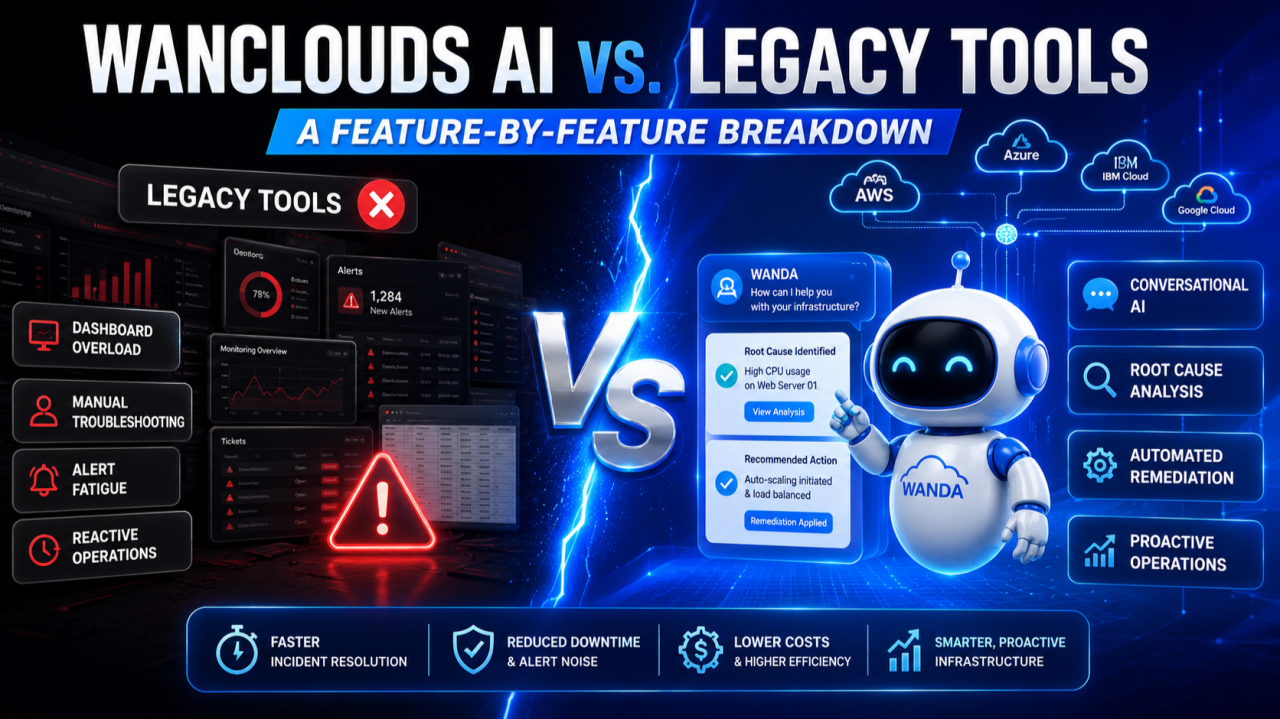
IT infrastructure operations is a $100 billion problem, and most of that spend goes toward dashboards, alert floods, and manual runbooks that still require a human to connect the dots. Wanclouds AI takes a different approach: an agentic AI platform (branded WANDA — Wanclouds Agentic AI) that operates, analyzes, and optimizes multi-vendor, hybrid, and distributed IT and cloud infrastructure through natural-language interaction. Here's how it compares to the legacy monitoring, ITSM, and point-solution tools most enterprises are running today.
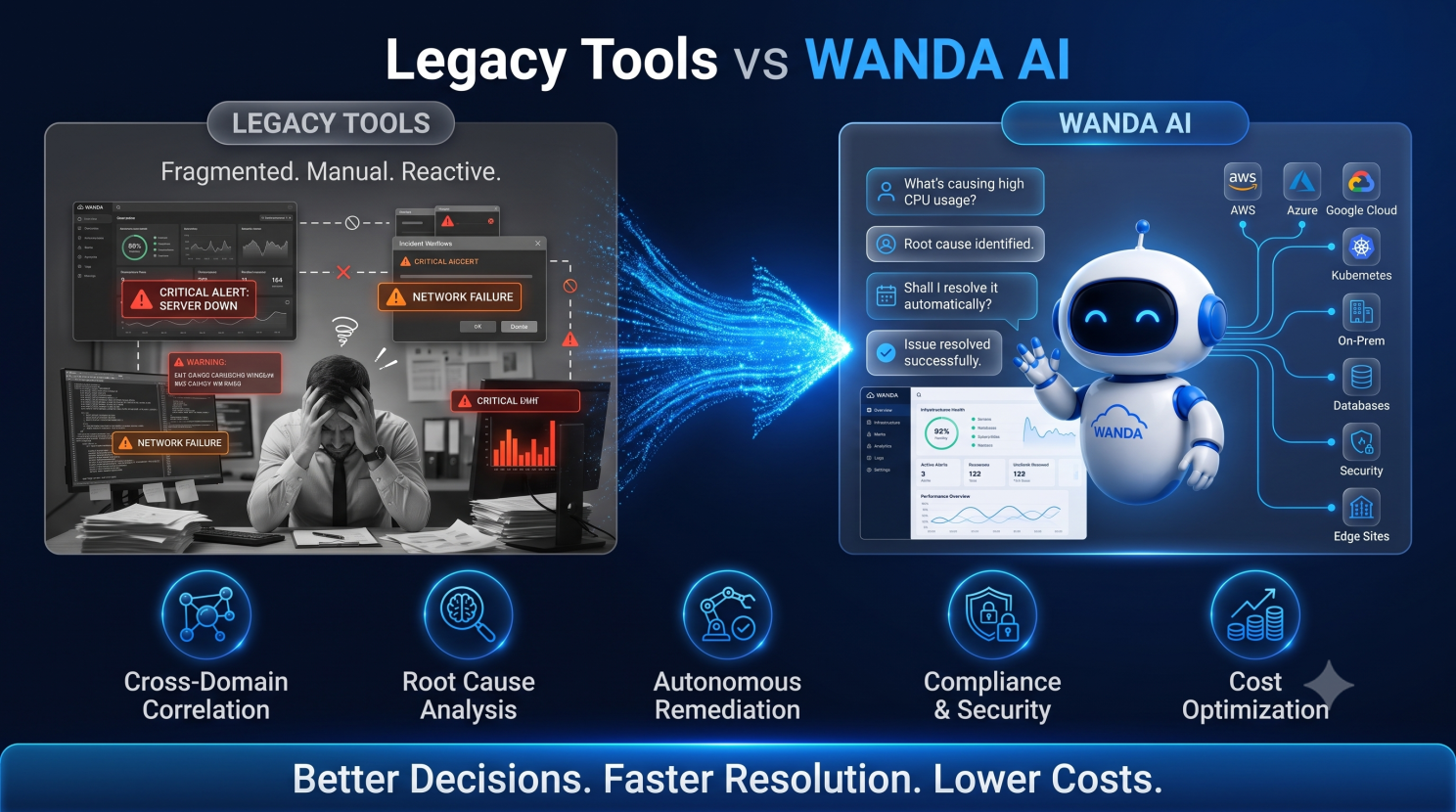
1. Interaction Model: Conversational vs. Dashboard-Driven
Wanclouds AI: No dashboards, no scripting, just answers. Teams can ask questions directly, such as what caused last night's database outage, which systems violate security baselines, or what changed before performance degraded. WANDA can also generate an executive summary of the last 24 hours, run a PCI compliance assessment, or flag end-of-life OSs and software on request.
Legacy monitoring & ITSM tools: Rely on static dashboards, alert floods, and manual runbooks. Getting an answer usually means a human hunting across multiple screens and correlating data by hand.
Why it matters: The official Wanclouds comparison sums it up directly: legacy tools show data, Wanclouds AI delivers answers and decisions.
2. Root Cause Analysis: Autonomous vs. Manual Triage
Wanclouds AI: Performs autonomous troubleshooting and root-cause analysis in seconds, with cross-layer correlation across infrastructure, application, network, and security layers. It also handles noise reduction and alert de-duplication, and builds incident context automatically, reducing MTTR without manual triage.
Legacy tools: Are largely human-dependent for triage, often described as "limited scope" or layered chatbots that don't reason across domains.
Why it matters: Wanclouds cites a typical customer outcome of a 70–80% reduction in incident resolution time and 60–70% reduction in unplanned downtime.
3. Environment and Vendor Coverage
Wanclouds AI: Supports on-premises data centers, edge devices, and public/private cloud environments. Device coverage spans compute (Linux, Windows, NVIDIA GPUs), containerized environments (Kubernetes, Red Hat OpenShift), networking (firewalls, routers, switches, load balancers, IP call managers, wireless access points), and databases/workloads. It integrates with monitoring platforms (Prometheus, Zabbix, SolarWinds), logging systems (Splunk, Loki, LogDNA, AWS CloudWatch), and ITSM/ticketing tools (ServiceNow, Jira), largely without requiring agents, and without vendor lock-in.
Legacy tools: Tend to specialize by layer or vendor, creating tool silos that require separate consoles for infrastructure, security, and ITSM.
Why it matters: Enterprises can create one or multiple AI assistants scoped to specific segments, for example, a dedicated assistant for on-premise VMware and a separate one for cloud, firewalls, or databases, rather than forcing everything through a single generic tool.
4. Compliance and Security Posture
Wanclouds AI: Provides continuous compliance and security posture management, with mapping to CIS, NIST, ISO, PCI, SOC2, Saudi NCA ECC, and DGA frameworks. It detects configuration drift, generates audit-ready evidence, runs security and risk assessments across vendors, manages software inventory risk, and can review or draft security policy documents.
Legacy tools: Compliance reporting is typically a manual, periodic exercise rather than a continuous, always-on process.
Why it matters: Wanclouds cites typical customer results of 70% fewer security incidents and a 90% reduction in compliance audit effort.
See content credentials
5. Memory and Institutional Knowledge
Wanclouds AI: Uses short- and long-term memory to retain past incidents, known failure patterns, recent chat history, organizational policies, and environment-specific context, meaning resolution gets faster over time and doesn't depend on tribal knowledge held by specific staff.
Legacy tools: Knowledge typically lives with individual engineers; when they leave, that context leaves with them.
Why it matters: This is especially relevant for large enterprises dealing with staff turnover, cited in the datasheet as a specific use case for knowledge retention.
6. Optimization: AI-Driven vs. Reactive
Wanclouds AI: Delivers ongoing cost optimization recommendations, capacity and utilization insights, right-sizing suggestions, and idle/waste detection as a built-in capability, not a bolt-on tool.
Legacy tools: Cost optimization is often a separate FinOps exercise disconnected from operational monitoring.
Why it matters: Wanclouds cites 30–40% infrastructure cost optimization as a typical customer outcome, on top of operational gains.
7. Backup, Migration, and Restore
Wanclouds AI: Supports backup, migration, and restore of VMs and data from on-premise to cloud, managed conversationally through the same AI assistant used for day-to-day operations.
Legacy tools: Backup/DR is frequently handled by a completely separate product from monitoring and ITSM, adding another vendor and console to manage.
8. Deployment Flexibility and Data Control
Wanclouds AI: Offers pay-as-you-go access, private instances in public cloud (AWS, GCP, Azure, IBM Cloud), fully managed on-premise deployment, and sovereign/regulated cloud regions. Default LLM usage is Anthropic or an equivalent model, with a private on-premise LLM option available where required. No customer data leaves the environment, no PII is shared (GDPR and SOC2 aligned), all interactions are logged and audited, and every state-changing action (create, update, delete) requires explicit human-in-the-loop confirmation.
Legacy tools: Deployment flexibility and this level of built-in AI governance are uncommon in traditional monitoring/ITSM stacks, which weren't designed with autonomous action in mind.
Why it matters: For regulated industries, the combination of data residency options and human-in-the-loop guardrails addresses a common objection to AI-driven infrastructure tools: that they might act autonomously without oversight.
Legacy Monitoring & ITSM vs. Wanclouds AI
Interface
- Legacy: Static dashboards
- Wanclouds AI: Conversational intelligence
Correlation
- Legacy: Manual, tool silos
- Wanclouds AI: Context-aware, cross-domain
Root Cause Analysis
- Legacy: Human-dependent
- Wanclouds AI: Autonomous reasoning
Coverage
- Legacy: Layered tools with limited scope
- Wanclouds AI: Unified intelligence layer
Assistance Model
- Legacy: Human-driven
- Wanclouds AI: AI-assisted and AI-driven
Access
- Legacy: Fixed reporting cycles
- Wanclouds AI: Ask anything, anytime
Expertise
- Legacy: Dependent on human skills
- Wanclouds AI: Multi-discipline, expert-level knowledge
From Manual IT Operations to Agentic AI
This shift from reactive tools to intelligent infrastructure management was also the focus of our recent webinar, “Stop Fighting Fires Manually: How Agentic AI Is Replacing IT War Rooms.”The session explored how agentic AI can move beyond simply monitoring infrastructure to understanding context, correlating events across complex environments, identifying root causes, and recommending or executing actions with human oversight.
The key takeaway was clear: the future of IT operations is not about adding another dashboard to an already crowded toolset. It is about giving infrastructure teams an intelligent layer that can understand their environment, learn from operational history, and help them move from alert → analysis → action → resolution faster.
Missed the webinar? You can see WANDA in action and discover how Wanclouds AI can help transform the way your team manages hybrid, multi-cloud, and on-premises infrastructure.
Click Here for the Webinar Recording
The Bottom Line
Wanclouds reports that customers typically achieve a 70–80% reduction in incident resolution time, 60–70% reduction in unplanned downtime, 30–40% infrastructure cost optimization, 70% fewer security incidents, and a 90% reduction in compliance audit effort, with a payback period of roughly 3 months and Year-1 ROI over 700%. Against that backdrop, the real question isn't just "what features does each platform have," but how much of your team's time is still spent reading dashboards and running manual runbooks versus getting direct answers and autonomous remediation.
Ready to See Wanclouds AI in Action?
Reach out to our team to schedule a personalized demo and discover how WANDA can help transform your infrastructure operations.