
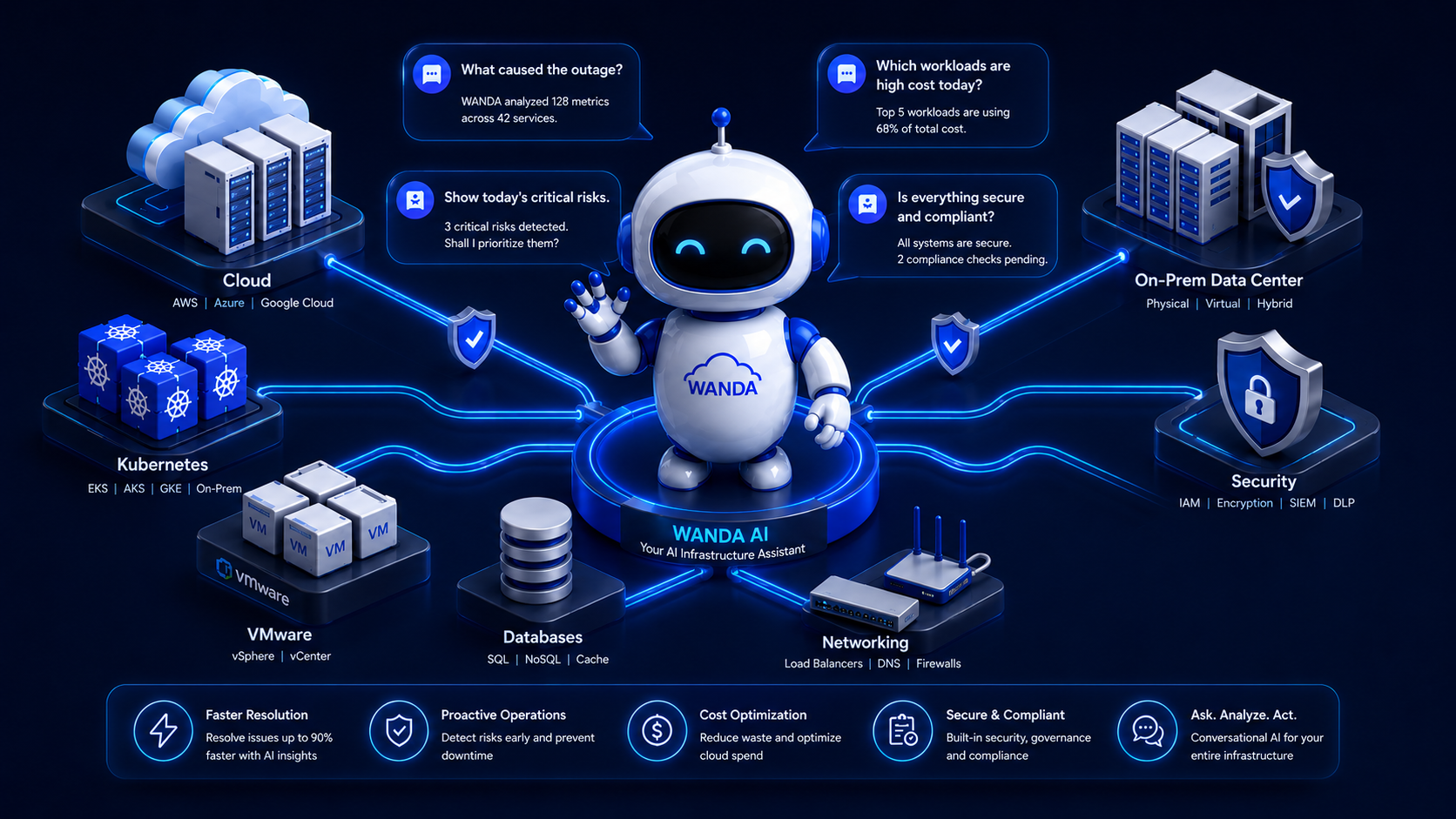
An AI SRE (Artificial Intelligence Site Reliability Engineer) is an AI-powered system that monitors infrastructure, detects anomalies, identifies root causes, and recommends or automates remediation to improve reliability. Unlike traditional monitoring tools, AI SRE platforms continuously learn from operational data and provide contextual, conversational assistance across cloud, hybrid, and on-premises environments.
Key Takeaways
- AI SRE combines artificial intelligence with Site Reliability Engineering to automate monitoring, troubleshooting, and operational decision-making.
- AI SRE platforms correlate logs, metrics, events, configurations, and infrastructure changes to identify root cause faster than traditional monitoring.
- Modern AI SRE agents reduce alert fatigue, improve Mean Time to Resolution (MTTR), and enable proactive incident prevention.
- Enterprises increasingly use AI SRE for multi-cloud, hybrid cloud, Kubernetes, VMware, networking, and security operations.
- WANDA extends beyond observability by acting as an autonomous infrastructure assistant that understands context, answers natural-language questions, and performs operational analysis across diverse environments, supporting conversational infrastructure management, autonomous root-cause analysis, compliance assessments, and multi-vendor integrations.
What Is an AI SRE?
Site Reliability Engineering has long been responsible for keeping applications, infrastructure, and digital services reliable. Traditionally, SRE teams rely on dashboards, alerts, runbooks, scripts, and years of operational experience to diagnose and resolve incidents.
But today's enterprise environments are dramatically more complex. Organizations now manage multi-cloud infrastructure, hybrid cloud environments, Kubernetes clusters, VMware and virtualized workloads, distributed applications, edge infrastructure, thousands of servers, multiple monitoring platforms, and millions of daily telemetry events.
As infrastructure scales, manual operations become increasingly difficult. Engineers spend valuable time switching between dashboards, correlating logs, reviewing configuration changes, and searching documentation before identifying the actual problem.
An AI SRE addresses this by acting as an intelligent operational assistant that continuously analyzes infrastructure, correlates information across systems, and provides actionable answers instead of raw data. Rather than interpreting dozens of dashboards, engineers can ask questions like:
- "What caused last night's outage?"
- "Which systems are violating security baselines?"
- "What changed before latency increased?"
- "Summarize the last 24 hours of infrastructure activity."
WANDA's agentic AI platform supports exactly this: natural-language interaction with infrastructure, autonomous troubleshooting, cross-domain correlation, compliance assessments, and AI-driven optimization across multi-vendor cloud and IT environments.
Why Traditional SRE Is Reaching Its Limits
Traditional monitoring solutions were designed for environments where infrastructure changed relatively slowly, and applications were hosted in centralized data centers. Modern infrastructure is different; a single enterprise may operate AWS, Azure, Google Cloud, IBM Cloud, VMware, Kubernetes, hundreds of SaaS services, network appliances, firewalls, storage platforms, and multiple observability products, each generating its own logs, metrics, events, alerts, and dashboards.
This often leads to alert fatigue, slow incident response, manual correlation, knowledge silos, rising operational costs, and longer Mean Time to Resolution. WANDA is built around the opposite approach: conversational intelligence, context-aware correlation, autonomous reasoning, and a unified intelligence layer in place of static dashboards, alert floods, manual runbooks, and isolated tools.
How Does an AI SRE Work?
At its core, an AI SRE continuously collects operational signals from across the infrastructure, builds context, reasons about system behavior, and assists — or in some cases automates, operational workflows. Instead of treating every alert independently, it correlates infrastructure metrics, system logs, application telemetry, configuration changes, security events, monitoring platforms, cloud APIs, historical incidents, and organizational knowledge into a unified operational view — determining not just what happened, but why, and what should happen next.
The AI SRE Workflow
Infrastructure
↓
Metrics + Logs + Events + Configurations
↓
AI Correlation Engine
↓
Root Cause Analysis
↓
Risk Assessment
↓
Recommended Actions
↓
Engineer Approval (Required for state-changing actions)
↓
Automated or Assisted Remediation
↓
Continuous Learning
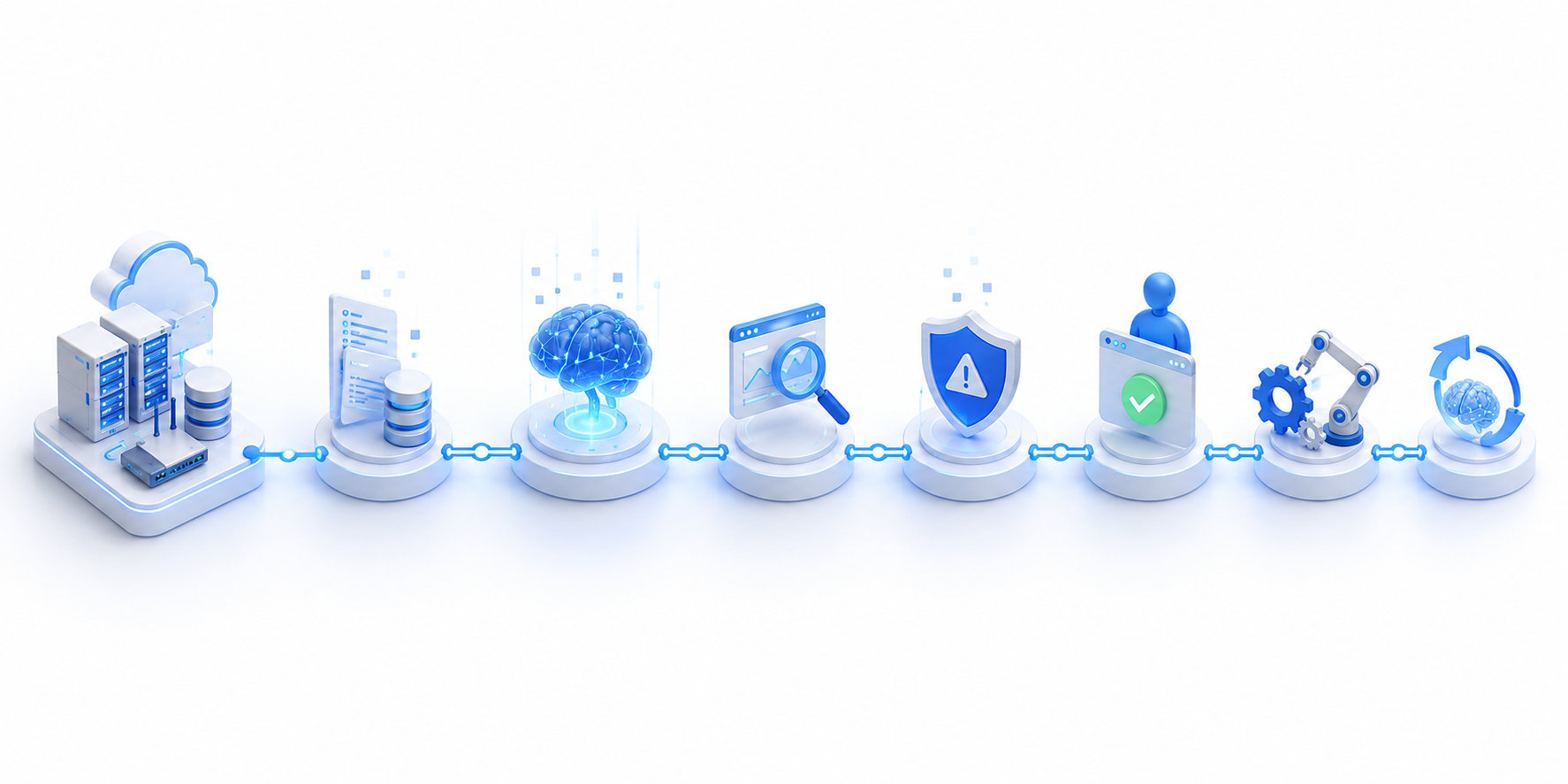
Unlike conventional monitoring platforms that primarily surface alerts, an AI SRE emphasizes contextual reasoning and operational guidance. WANDA follows the same pattern: cross-domain correlation, autonomous root-cause analysis, memory-driven operations, and conversational interaction rather than dashboards alone.
Core Components of an AI SRE Platform
1. Intelligent Monitoring: Rather than simply collecting telemetry, AI-powered monitoring identifies abnormal patterns before they become outages, anomaly detection, trend analysis, capacity forecasting, and infrastructure health scoring.
2. Context-Aware Correlation: One of the biggest challenges in operations is connecting unrelated signals. AI SRE platforms correlate metrics, logs, infrastructure changes, configuration drift, security events, and cloud resources to identify the most likely source of an incident instead of presenting isolated alerts.
3. Autonomous Root Cause Analysis: Traditional troubleshooting requires engineers to manually inspect dashboards and logs. An AI SRE automatically identifies correlated failures, detects infrastructure changes, reviews historical incidents, finds recurring patterns, and highlights probable root causes, significantly reducing investigation time. (For a deeper look at how this works in WANDA specifically, see AI Root Cause Analysis.)
4. Conversational Operations: One of the most transformative capabilities of modern AI SRE platforms is natural-language interaction. Instead of navigating multiple interfaces, engineers can ask: "Why is application latency increasing?", "Which Kubernetes cluster is consuming the most memory?", "What changed before the outage?", or "Show today's critical risks."
AI SRE vs. Traditional SRE
Both share the same objective, keeping services reliable, but the approaches are fundamentally different. Traditional SRE relies on human expertise, dashboards, monitoring tools, and manual runbooks; engineers investigate, correlate, and remediate themselves. This works well at smaller scale but becomes increasingly difficult with multi-cloud, Kubernetes, hybrid infrastructure, and distributed applications. AI SRE augments human engineers with autonomous reasoning, analyzing telemetry, correlating events across domains, identifying the most likely root cause, and recommending, or where appropriate automating, the next action.
Traditional SRE vs. AI SRE
Monitoring: Dashboards vs. Intelligent monitoring
Alert handling: Manual vs. AI prioritization
Root cause analysis: Human investigation vs. Autonomous correlation
Incident response: Manual runbooks vs. AI-assisted or automated
Infrastructure knowledge: Human experience vs. Persistent AI memory
Multi-cloud visibility: Multiple tools vs. Unified intelligence
Learning: Documentation vs. Continuous learning
User interaction: Dashboards & CLI vs. Natural language
WANDA follows this same evolution, replacing static dashboards, alert floods, and manual runbooks with conversational intelligence, autonomous reasoning, unified visibility, and expert-level AI assistance across infrastructure domains.
AI SRE vs. AIOps
These terms are often used interchangeably, but they describe different concepts.
AIOps focuses on applying machine learning and analytics to IT operations, detecting anomalies, reducing alert noise, and correlating operational data. AI SRE builds on these capabilities by acting as an operational partner that reasons about incidents, explains findings, answers questions, and can orchestrate remediation workflows.
Think of it this way: AIOps answers "Something unusual happened." AI SRE answers "Here's what happened, why it happened, which systems are affected, and here's the safest way to resolve it."
Modern AI SRE platforms typically include AIOps capabilities but extend them with conversational AI, infrastructure reasoning, knowledge retention, context-aware recommendations, autonomous troubleshooting, policy-aware remediation, and multi-agent collaboration.
AI SRE Agent Platforms. How They Compare
A newer generation of AI SRE agent startups, including Cleric, Traversal, and Resolve.ai, has emerged specifically to automate incident investigation for cloud-native, Kubernetes-heavy environments. These tools are worth knowing about if you're evaluating the category: they're generally strong at deep, code-and-telemetry-level investigation within modern application stacks.
Where WANDA differs is scope: most AI SRE agents are built for the application and Kubernetes layer specifically. WANDA extends the same autonomous reasoning across infrastructure, network devices, on-premise hardware, and compliance posture, plus ties it directly into backup, migration, and restore. If your incidents live entirely in cloud-native application code, a narrower AI SRE agent may suit you well. If your environment spans on-premise, network, and multi-cloud the way most real enterprises do, that's WANDA's specific strength. (See a WANDA AI Incident Response.)
Benefits of AI SRE
1. Faster Root Cause Analysis: Rather than manually reviewing logs, dashboards, configuration histories, and recent deployments, AI SRE platforms correlate this information automatically and highlight likely root causes in seconds, significantly reducing MTTR.
2. Reduced Alert Fatigue: Large enterprises often generate thousands, or even millions, of alerts every day. Many are duplicates; others are symptoms rather than actual failures. AI SRE platforms group related alerts, prioritize incidents, remove duplicates, identify causal relationships, and highlight business impact, so engineers focus on solving meaningful problems instead of triaging notifications.
3. Operational Knowledge Never Leaves: One of the biggest operational risks is losing institutional knowledge when experienced engineers change roles or leave. WANDA calls this Memory-Driven Operations, retaining past incidents, known failure patterns, recent interactions, organizational procedures, and environment-specific context to reduce dependence on tribal knowledge.
4. Natural Language Operations: Instead of navigating multiple dashboards, engineers can simply ask: "Why is Kubernetes Cluster A running slowly?", "Which firewall changed this morning?", or "Summarize today's production incidents." This lowers the learning curve, speeds investigations, and makes infrastructure expertise more accessible across teams.
5. Continuous Compliance: Many enterprises must comply with PCI DSS, NIST, ISO 27001, SOC 2, HIPAA, and CIS Benchmarks. AI SRE platforms can continuously evaluate infrastructure against these requirements, identify drift, and produce audit-ready evidence.
How an AI SRE Agent Works
An AI SRE agent is an autonomous software agent designed to assist with reliability engineering tasks. Rather than acting as a chatbot, it continuously observes operational signals, reasons over infrastructure context, and assists with decision-making:
Collect Infrastructure Signals
↓
Correlate Logs, Metrics & Events
↓
Identify Anomalies
↓
Determine Probable Root Cause
↓
Evaluate Business Impact
↓
Recommend or Trigger Remediation
↓
Learn from the Outcome
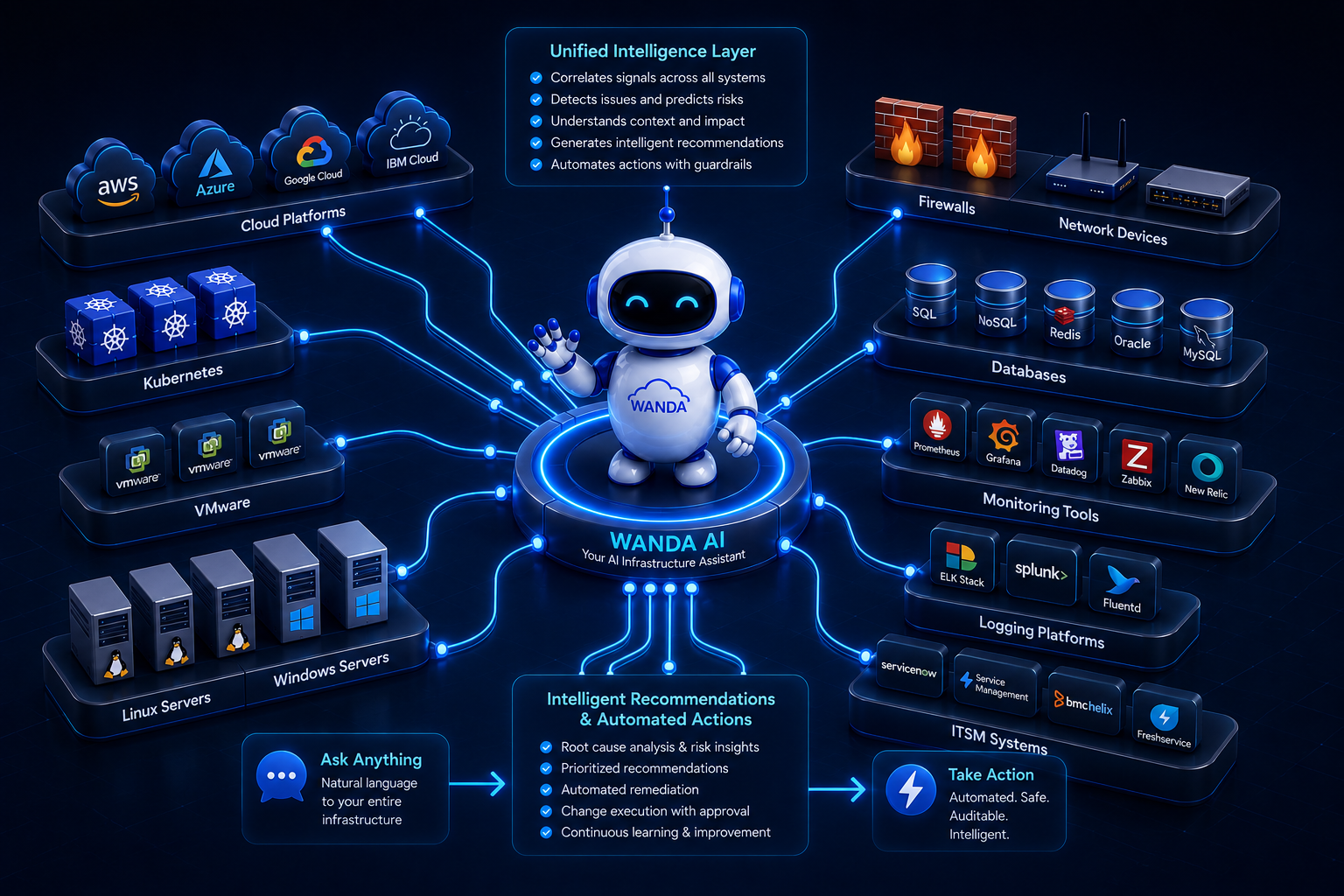
As organizations adopt agentic AI, multiple specialized agents may collaborate, one focused on networking, another on Kubernetes, another on cloud infrastructure, another on security. WANDA supports this directly: you can create one or multiple AI assistants for different infrastructure segments, integrating with existing monitoring, logging, and ITSM tools through MCPs.
Enterprise Use Cases
Multi-Cloud Operations: Modern enterprises rarely operate in a single cloud. AI SRE platforms provide unified visibility across AWS, Azure, Google Cloud, IBM Cloud, VMware, and on-premises infrastructure, reducing the need to switch between disconnected tools.
Kubernetes Reliability: AI SRE platforms help operations teams identify failing pods, detect resource bottlenecks, analyze deployment changes, diagnose networking issues, and recommend scaling actions.
Security Operations: AI SRE extends beyond performance monitoring into configuration drift detection, security baseline validation, compliance assessments, software inventory reviews, and policy gap identification. WANDA specifically supports reviewing security baselines, identifying unsupported software, running PCI compliance assessments, and mapping against NIST, ISO, SOC 2, and Saudi NCA ECC.
Executive Reporting: Instead of manually creating operational summaries, executives can request concise updates on daily infrastructure health, critical incidents, capacity risks, security posture, and cost optimization opportunities, bridging the gap between technical operations and business decision-making.
Where WANDA Fits
Many AI tools focus on a single operational function, observability, log analysis, or ITSM. WANDA takes a broader approach: an agentic AI platform that unifies operational data, understands infrastructure context, and supports engineers through natural-language interaction across compute, storage, network, security, and compliance, not just one layer of the stack.
Every state-changing action requires your explicit confirmation before it executes, and every interaction is logged and auditable, autonomous reasoning with a human still in control.
Real Results
| Metric | Result |
|---|---|
| Incident resolution time (MTTR) | 70–80% reduction |
| Unplanned downtime | 60–70% reduction |
| Compliance audit effort | 90% reduction |
Measuring Success with AI SRE
Organizations evaluating AI SRE initiatives typically track: Mean Time to Detect (MTTD), Mean Time to Resolution (MTTR), incident volume, alert-to-incident ratio, service availability (SLA/SLO attainment), change failure rate, operational cost per incident, and compliance audit effort.
Ready to See Autonomous Reliability Engineering in Action?
Want to see WANDA in action? Request a deployment assessment or schedule a demo. Or Explore WANDA Agentic AI Platform.