
Enterprises are under immense pressure to scale their digital initiatives while reining in ballooning cloud and IT operational costs. As multi-cloud environments expand, so do tool sprawl, alert fatigue, configuration drift, and the growing need for specialized engineers. Organizations that once relied on manual troubleshooting and fragmented monitoring stacks are realizing that this model is no longer sustainable.
That’s where AIOps comes into play. Modern AIOps platforms not only transform how teams monitor, analyze, and manage infrastructure, but they also deliver tangible cost savings of up to 50%, especially when combined with intelligent automation and always-on monitoring. Solutions like Wanclouds AI exemplify this shift by replacing routine operations work with AI-driven assistants that continuously monitor, troubleshoot, and optimize infrastructure across hybrid and Multi-cloud environments.
In this guide, we’ll break down how AIOps reduces cloud and IT operational costs, what capabilities matter most, and why enterprises are adopting AI-driven cloud management at record speed.
What Is AIOps?
AIOps, short for Artificial Intelligence for IT Operations, uses machine learning, natural-language interaction, and automation to:
- Monitor infrastructure proactively
- Detect anomalies and configuration drifts
- Automate root-cause analysis
- Reduce alert fatigue
- Predict risks and performance issues
- Optimize cloud resources and costs
Modern AIOps platforms don’t just surface alerts; they resolve issues automatically, provide recommendations, and offer real-time insights for cloud computing, infrastructure monitoring, server monitoring, and hybrid cloud management.
Why Traditional Cloud & IT Operations Are So Expensive
Most enterprises deal with several operational challenges that inflate cloud and IT budgets:
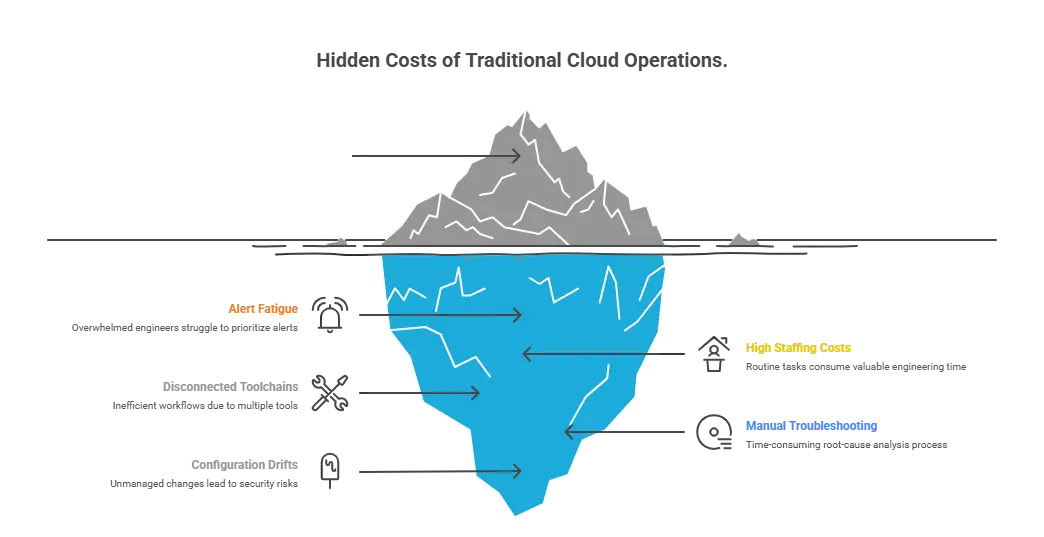
1. Alert Fatigue & Noisy Monitoring Tools
Disparate cloud monitoring tools generate thousands of alerts, making it difficult for engineers to prioritize issues. This delays response times and drives up mean-time-to-repair (MTTR).
2. High Staffing Costs
IT operations center (NOC) teams, SREs, and cloud support engineers spend 40–60% of their time on routine tasks, password resets, log reviews, performance investigations, and manual troubleshooting.
3. Disconnected Toolchains
Multiple tools for logging, monitoring, observability, cloud analytics, and incident management result in inefficiencies and integration overheads.
4. Manual Troubleshooting
Root-cause analysis can take hours, even days, when performed manually.
5. Configuration Drifts & Compliance Risks
Unmanaged changes across multi-cloud and on-prem environments introduce security and reliability risks that cost millions to remediate.
Read our latest blog Why Traditional IT & Cloud Management Is Failing.
How AIOps Reduces Cloud Management & IT Operational Costs by Up to 50%
1. Replace Routine Ops Tasks with Autonomous AI Assistants
Platforms like Wanclouds AI allow organizations to create multiple AI assistants, one for each workload, environment, or cloud platform. These assistants autonomously analyze logs, track configuration drifts, perform RCA, and monitor security risks without human intervention.
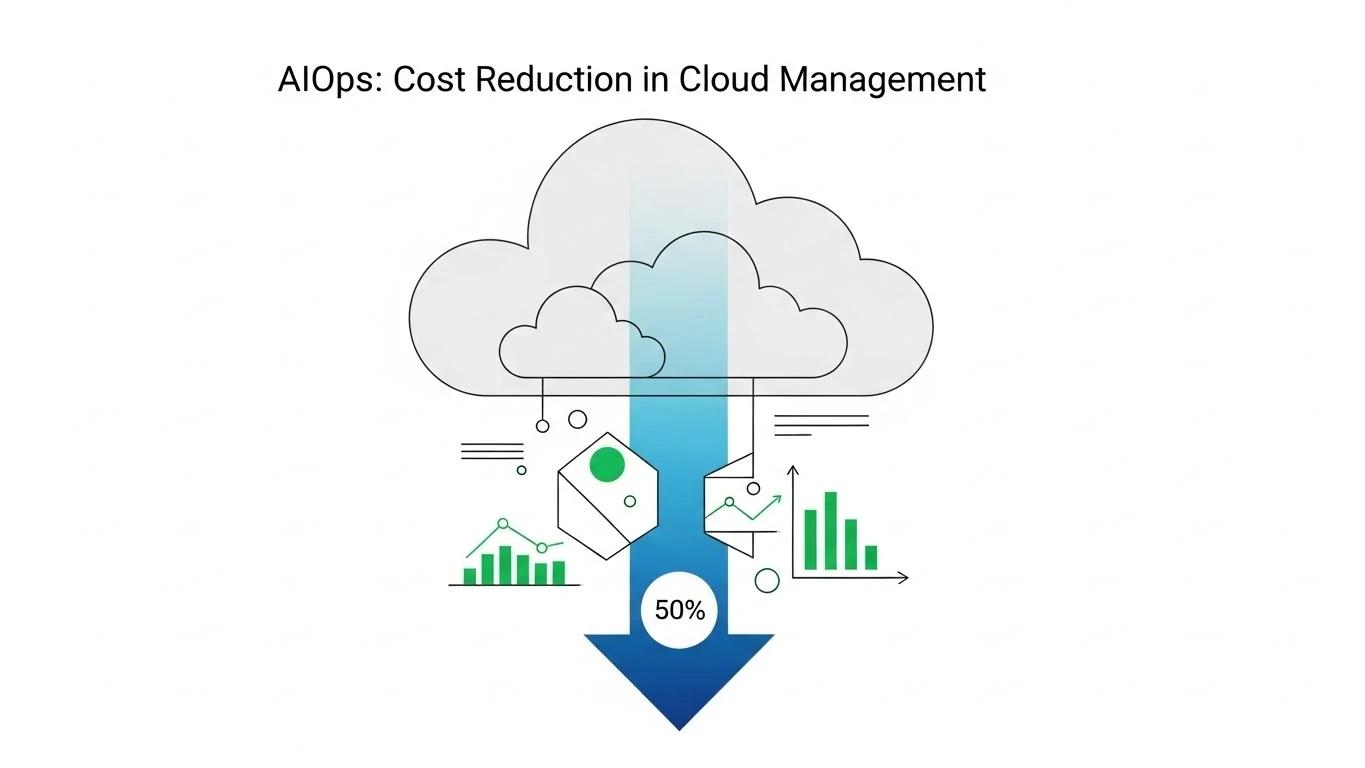
This directly replaces a large chunk of NOC/SRE repetitive work, contributing to up to 50% cost reduction in operations teams.
2. Drastically Reduce MTTR with Instant Root-Cause Analysis
AIOps platforms:
- Aggregate metrics, logs, events, and topology data
- Identify the root cause automatically
- Recommend fixes using natural language
- Resolve common issues in seconds instead of hours
Wanclouds AI claims resolution in seconds, significantly lowering operational overhead and downtime costs.
3. Optimize Cloud Spend Automatically
AIOps continuously monitors: Idle compute resources, Over-provisioned clusters, Storage growth, Unused SaaS licenses, Inefficient Kubernetes workloads.
By automating cloud cost optimization recommendations, enterprises prevent waste long before budget overruns occur.
4. Reduce Tool Sprawl with One Unified Platform
Instead of juggling multiple:
- Network monitoring tools
- Cloud monitoring tools
- Kubernetes monitoring dashboards
- DevOps tools
- Log analytics systems
AIOps unifies visibility across clouds, servers, networks, and workloads. Wanclouds AI integrates out-of-the-box with AWS CloudWatch, Prometheus, Splunk, IBM Cloud Monitoring, Cisco, SolarWinds, and others, forming a single source of truth for multi-cloud visibility and troubleshooting.
This consolidation alone can reduce tool licensing and integration expenses by 20–30%.
5. Prevent Outages with Proactive Monitoring
AIOps detects anomalies before they become service-impacting issues by leveraging:
- Predictive analytics
- Log pattern detection
- Always-on monitoring
- Risk and compliance scoring
Preventing even one major outage can save millions.
6. Improve Team Productivity & Reduce Hiring Costs
Engineers no longer need deep expertise in every cloud platform or tool. AIOps systems act as an intelligent knowledge layer.
Wanclouds AI describes itself as a “ChatGPT for your IT & Cloud Operations”, bridging expertise gaps and enabling even junior engineers to troubleshoot complex problems instantly.
This reduces dependency on highly specialized (and expensive) staffing.
Wanclouds AI: A Practical Blueprint for Cost-Efficient Operations
Wanclouds AI represents a new era of AIOps, one built around simplicity, intelligence, and enterprise readiness.
Its approach offers several advantages for cost-conscious organizations:
AI Assistants Tailored to Each Environment
Enterprises can create multiple AI assistants, one for on-prem workloads, one for AWS, one for Kubernetes clusters, and so on. Each assistant has full visibility into logs, configurations, and performance metrics for its domain.
Conversational Interaction With Infrastructure
Users can ask natural-language questions such as:
- “Why is my cluster running hot?”
- “Which nodes have drifted from baseline configurations?”
- “What is causing today’s spike in cloud costs?”
This dramatically lowers the barrier to troubleshooting and eliminates dependency on niche expertise.
End-to-End Automation
From identifying root causes to recommending actions to performing automated checks, Wanclouds AI reduces the need for manual intervention across the operations lifecycle.
Seamless Integration Without Rip-and-Replace
The platform connects with existing systems such as Kubernetes, AWS CloudWatch, Prometheus, Splunk, Cisco environments, IBM Cloud monitoring, and many others, preserving prior investments while elevating their value.
Always-On Monitoring and Risk Intelligence
Wanclouds AI continuously evaluates infrastructure against security benchmarks, performance thresholds, and compliance standards, ensuring proactive risk management.
These capabilities collectively allow IT leaders to achieve measurable and sustained reductions in operational overhead.
AIOps Use Cases That Directly Reduce IT Costs
Hybrid & Multi-Cloud Management
Unified visibility reduces time spent switching tools and manually correlating data.
Automated Incident Management
AI classifies, assigns, and in many cases resolves incidents automatically.
IT Automation & Workflow Automation
Eliminates repetitive tasks such as log checks, performance audits, and configuration validation.
Infrastructure Monitoring & Server Monitoring
AI automatically detects anomalies in compute, network, and storage layers.
Kubernetes Monitoring & Troubleshooting
AIOps identifies failing pods, misconfigured workloads, and scaling inefficiencies.
Compliance & Drift Detection
Automatically flags risks and prevents costly misconfigurations.
AI for DevOps & SRE Automation
Streamlines deployment pipelines and reduces manual intervention.
Why Enterprises Are Moving Toward AIOps-Driven Cloud Management
1. Minimal Onboarding Friction
Modern AIOps requires no rip-and-replace. Wanclouds AI integrates directly into existing tools and devices via APIs or MCPs, making adoption fast and frictionless.
2. Natural-Language Interaction
Teams can “chat with their infrastructure” and ask questions such as:
- “Why is my Kubernetes node overheating?”
- “Show me configuration drifts over the past 24 hours.”
- “Which VMs are overspending this month?”
This drastically cuts time spent navigating dashboards.
3. Enterprise-Grade Flexibility
Supports on-prem, AWS, Azure, GCP, IBM Cloud, and hybrid environments with full customization options.
How to Know If Your Enterprise Is Ready for AIOps
You should consider adopting AIOps if:
- You rely heavily on multi-cloud or hybrid cloud environments
- Your NOC/SRE teams are overloaded with alerts
- Troubleshooting takes longer than it should
- You face increasing cloud bills without clarity on why
- You maintain multiple monitoring/observability tools
- Compliance or security gaps frequently arise
- Engineers spend too much time on repetitive tasks
If any of these apply, AIOps will deliver immediate ROI.
The Future: Autonomous IT Operations
The shift toward AI-led infrastructure management is not a technology trend; it is a long-term operating model transformation. As enterprises continue to scale digital services while managing tighter budgets, AIOps becomes essential for maintaining speed, reliability, and financial discipline.
Solutions like Wanclouds AI demonstrate that the future of cloud and IT operations is autonomous, proactive, and seamlessly integrated. Organizations embracing this model now are positioning themselves for greater efficiency, stability, and innovation capacity.
Ready to Reduce Operational Costs and Modernize Your Cloud Strategy?
If your organization is evaluating how to streamline cloud management, reduce operational waste, and enhance reliability, AIOps offers a direct and measurable path forward.
Wanclouds AI offers an accelerated approach to adopting intelligent operations, without disrupting existing tools or workflows.