
The shift of businesses away from traditional on-premises infrastructure to Cloud environments becomes common, and as a result, they take advantages from the process like the increase of agility, enhanced cost efficiency, and improved innovation. But the on-prem to Cloud Migration is not just a simple process of connecting a device and letting it work on its own—it demands a lot of very careful planning to avoid disturbances.
This guide provides five practical tips to ensure a smooth and secure Cloud Migration. Whether you’re opting for a single provider or a Multi-cloud strategy, these best practices will help align your migration with your business goals.
Tip 1: Conduct a Comprehensive Assessment of Your On-Premises Environment
The foundation of a successful Cloud Migration is understanding the current infrastructure of an organization. Assessing what is in your on-premises setup in detail would help you to avoid unexpected problems in the future.
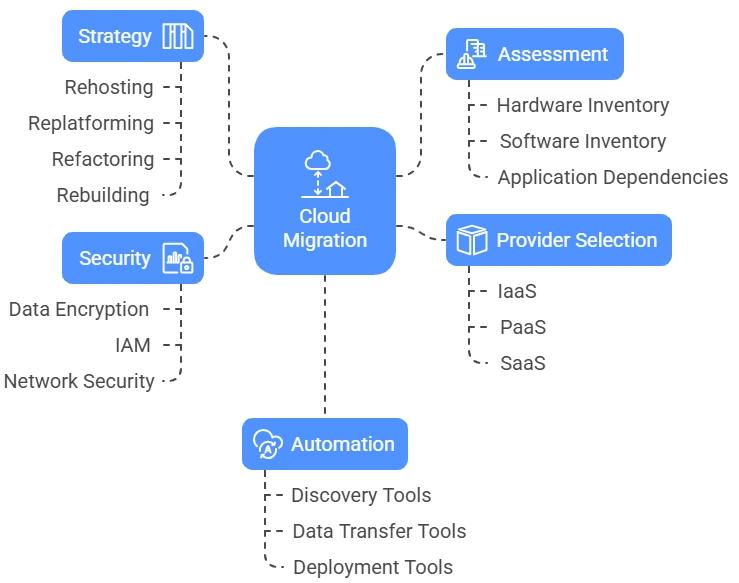
First and foremost, you should be aware of the contents of the hardware, software, and applications, including specific dependencies between them. Tools like the discovery agents or configuration management databases (CMDBs) can assist in this process by having an automated inventory report with all details listed.
Beyond listing assets, evaluate each application’s Cloud readiness. Some may need minor adjustments, while others require a complete overhaul. Consider factors like:
- Performance metrics
- Licensing constraints
- Data dependencies
This assessment helps estimate migration costs, allocate resources effectively, and avoid performance issues post-migration.
Tip 2: Define Your Cloud Migration Strategy and Goals
A well-defined roadmap is essential for a successful Cloud Migration. Start by establishing clear objectives—whether it's reducing operational costs, improving scalability, or enhancing Disaster Recovery.
Next, select a migration strategy that fits your applications’ needs. Common approaches include:
- Rehosting (Lift-and-Shift): Moves applications as-is to the Cloud. Quick and cost-effective but may not leverage cloud-native features.
- Replatforming: Makes slight optimizations, such as switching to managed database services. Offers a balance between speed and efficiency.
- Refactoring: Redesigns applications for cloud-native advantages like microservices or serverless computing. More resource-intensive but maximizes long-term benefits.
- Rebuilding: Completely redevelop applications for the Cloud. Ideal for outdated legacy systems requiring a fresh start.
Selecting the right approach minimizes risks and ensures a seamless transition. For more detailed information on Cloud Migration strategies, navigate to our detailed blog, Wanclouds Guide to the 7Rs of Cloud Migration.
Tip 3: Choose the Right Cloud Provider and Model
Selecting the right Cloud provider and service model is crucial for a smooth migration. The three main cloud service models include:
- Infrastructure as a Service (IaaS): Provides virtualized computing resources. Ideal for businesses requiring control over infrastructure.
- Platform as a Service (PaaS): This offers development and deployment platforms. Perfect for developers focusing on applications rather than infrastructure.
- Software as a Service (SaaS): This delivers fully managed software solutions like email and CRM systems.
After choosing a model, decide between a single-cloud or Multi-cloud approach. A single provider (AWS, Google Cloud, or IBM Cloud) simplifies management, whereas a multi-cloud strategy enhances flexibility, resilience, and cost optimization. Evaluate factors such as pricing, compliance support, and regional availability before making a decision.
Tip 4: Prioritize Security and Compliance
Security is a non-negotiable aspect of Cloud Migration. Cloud security follows a shared responsibility model: the provider secures the infrastructure, but you must protect your data, applications, and access controls.
To fortify security, implement:
- Data Encryption: Secure data in transit and at rest using strong encryption protocols.
- Identity & Access Management (IAM): Enforce multi-factor authentication and least-privilege access policies.
- Network Security: Utilize firewalls, Virtual Private Clouds (VPCs), and security groups to regulate traffic.
- Continuous Monitoring: Deploy anomaly detection tools and audit logs to maintain visibility and accountability.
Additionally, ensure compliance with industry regulations such as GDPR, HIPAA, or SOC2. Integrating security measures from the outset helps mitigate risks and build trust with stakeholders.
Tip 5: Leverage Cloud Migration Tools and Automation
Manual migrations are prone to errors and inefficiencies, making automation a game-changer. Cloud Migration tools streamline processes like discovery, data transfer, and application deployment.
A standout solution is VPC+ by Wanclouds, which automates discovery, assessment, and migration. Its key features include:
- Infrastructure visualization
- Cloud Cost Optimization
- Seamless Multi-cloud integration
Using automation tools reduces downtime, minimizes errors, and speeds up the migration process, allowing businesses to transition with confidence.
How Wanclouds Can Assist in Your On-Prem to Cloud Migration
Navigating Cloud Migration complexities is easier with an experienced partner. Wanclouds offers tailored solutions powered by its SaaS-based platform, VPC+, ensuring a hassle-free transition with:
- Automated Migration: Cuts down migration time from weeks to hours.
- Cost Optimization: Reduces cloud expenses by up to 50%.
- Cross-Cloud Compatibility: Supports hybrid and Multi-cloud strategies.
- Expert Guidance: Provides dedicated support throughout the journey.
Are you ready to transition to the Cloud? Start by filling out our request form or contact our sales team at [email protected].