
Technology has become an essential part of every business in the modern world. From communication to production, almost every sector depends on technological innovations. However, technology is not immune to failures and disasters. That’s why every business needs a Disaster Recovery plan to ensure the continuity and security of its operations.
Understanding DRaaS for SAP
SAP is the backbone for many enterprises, as their business-critical applications depend on SAP. Disaster Recovery as a Service allows businesses to back up their critical data and applications in the Cloud. For SAP-dependent companies, this means that if their primary systems fail, they can swiftly switch to the replicated environment, retrieve their data, and continue their business operations.
However, implementing DRaaS for SAP presents challenges that must be addressed properly. This article examines some of these challenges and provides strategies and tips to address them.
Challenges in the Implementation of DRaaS for SAP
Compatibility with Existing Systems
Compatibility is one of the major issues arising during the integration of Disaster Recovery as a Service for SAP. The Disaster Recovery provided by the different vendors may differ from your SAP infrastructure.
RPO and RTO Sequence
Your Recovery Point Objective (RPO) and Recovery Time Objective (RTO) targets must align with your business's requirements. However, achieving these objectives takes more work in the case of SAP.
Network Complexity
SAP systems rely on complex networks, making it challenging to ensure smooth connectivity between the primary and backup systems.
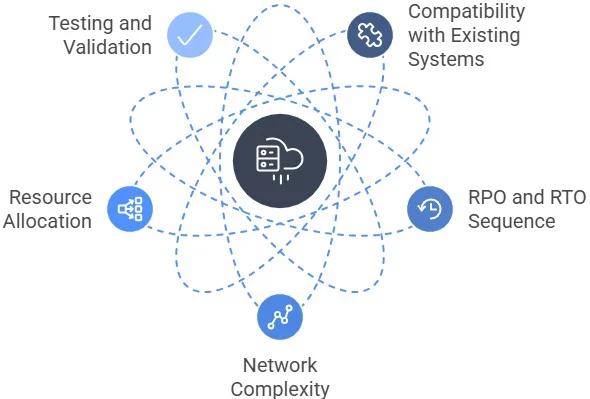
Resource Allocation
Allocating resources for both primary and backup environments demands careful planning. More resources can help performance, while over-provisioning can escalate costs.
Testing and Validation
Testing of the DRaaS setup is necessary to ensure its readiness. However, the testing can disrupt the primary environment and affect the flow of your business operations.
Strategies to Overcome Challenges
Thorough Compatibility Checks
Thoroughly check that the infrastructure of your DRaaS provider is compatible with your SAP systems. Failing to do so can lead to complexities during Disaster Recovery and increase downtime.
Define your RPO and RTO
Assess your business needs carefully and align RPO and RTO with your business's specific requirements. This will help in designing an effective DRaaS solution.
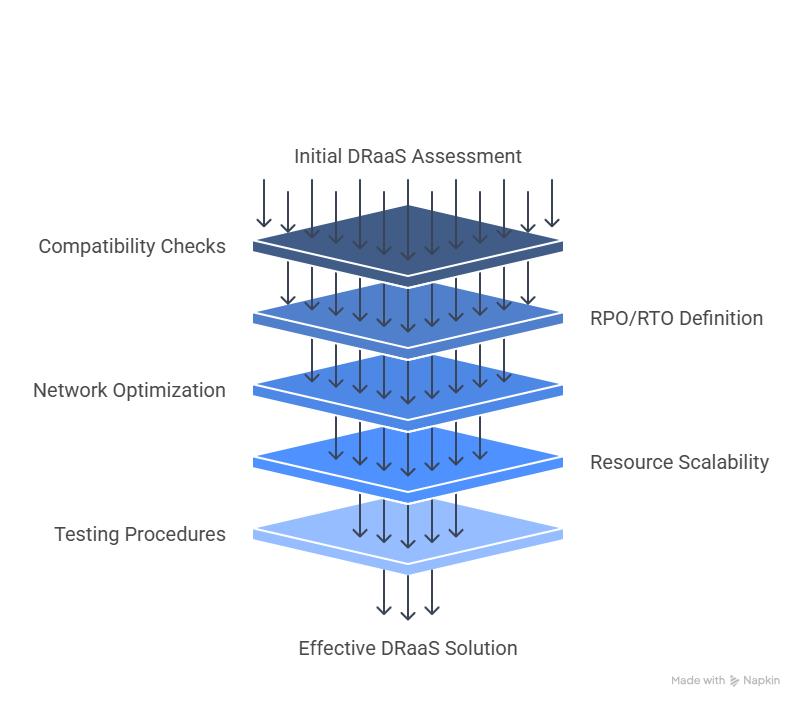
Network Redundancy and Optimization
Utilizing redundant network routes and bandwidth optimization can enhance the network's reliability. Load balancing as well as failover ensures network complexity management.
Scalable Resource Allocation
Ensure that the resources provided by your DRaaS provider are scalable and adaptable to meet your changing needs. This will help ensure that data storage remains efficient as your business expands.
Stringent Testing Procedures
Regular testing keeps systems prepared for real disasters. Properly design and implement your testing protocols and maintain the testing non-disruptively.
Effective Disaster Recovery for SAP with Wanclouds
If you're facing complexity, delays, or high costs in implementing DRaaS for your SAP systems, Wanclouds is here to simplify the journey. Our VPC+ DRaaS solution enables businesses to set up fast, flexible, and cost-effective Disaster Recovery for SAP workloads across On-Premises and Multi-Cloud environments.
Why Choose Wanclouds?
- On-Demand SAP DR in Minutes: No complex setups or scripts required.
- Hot, Warm, or Cold DR Scenarios: Tailored to meet your cost and performance needs.
- Hybrid Cloud Ready: Migrate from VMware to IBM Cloud, AWS, or any preferred Cloud.
- Non-Disruptive Testing: Validate your DR plan without interrupting operations.
- Secure & Scalable: Encrypted backups with flexible, incremental policies.
For further information, you can also refer to our Detailed Datasheet.
Also, to initiate contact, you can fill out our Request Form or contact one of our sales representatives at [email protected]
Conclusion
Disaster Recovery as a Service for SAP is complicated to implement, but its advantages and assurance are beyond question. Overcoming implementation difficulties, companies can ensure their SAP systems remain resilient in the face of disasters.