
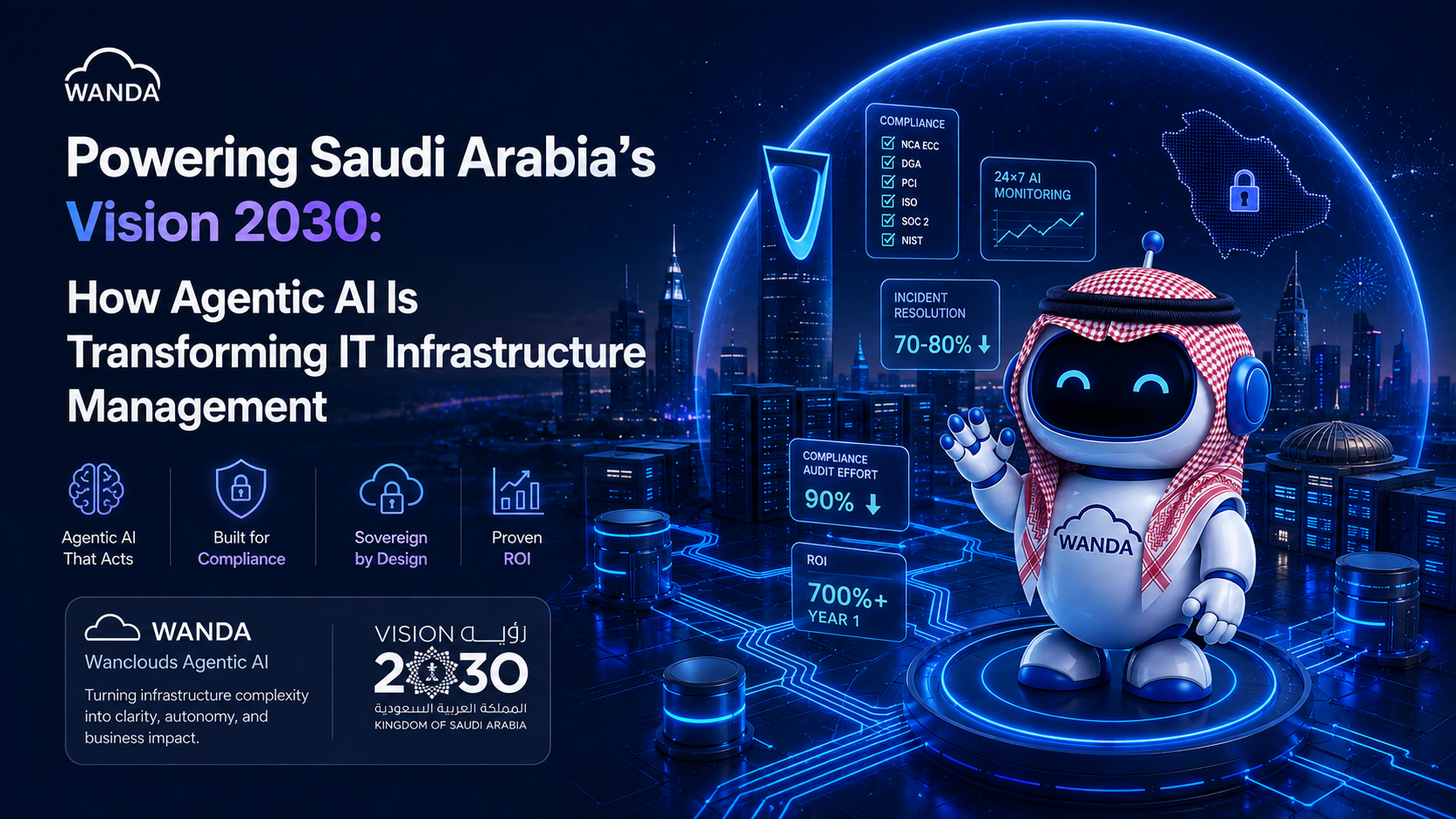
Saudi Arabia's Vision 2030 has set one of the most ambitious digital transformation agendas in the world. From smart cities and giga-projects like NEOM to fully digitized government services and a diversified, technology-driven economy, the Kingdom is building infrastructure at a pace few countries can match.
But there's a quiet challenge behind every one of these initiatives: the IT and cloud infrastructure powering them is becoming exponentially more complex. Multi-vendor systems, hybrid clouds, edge devices, and distributed data centers now sit at the core of everything from digital government platforms to smart grids, and managing all of it with traditional tools is starting to show its limits.
This is where agentic AI is stepping in, and it's why platforms like WANDA (Wanclouds Agentic AI) are becoming relevant to Saudi enterprises and government entities moving fast on their digital transformation goals.
The Hidden Bottleneck in Digital Transformation
Globally, IT infrastructure operations are estimated to be a $100 billion problem, filled with static dashboards, alert floods, manual runbooks, and a persistent shortage of specialized talent. For organizations in Saudi Arabia scaling digital services rapidly to meet Vision 2030 milestones, this bottleneck is even more pronounced. New systems get deployed faster than teams can be trained to monitor them, and IT operations teams are often left reacting to alerts rather than proactively managing risk.
Legacy monitoring and ITSM platforms weren't built for this scale or speed. They show data, not answers.
Agentic AI: From Dashboards to Decisions
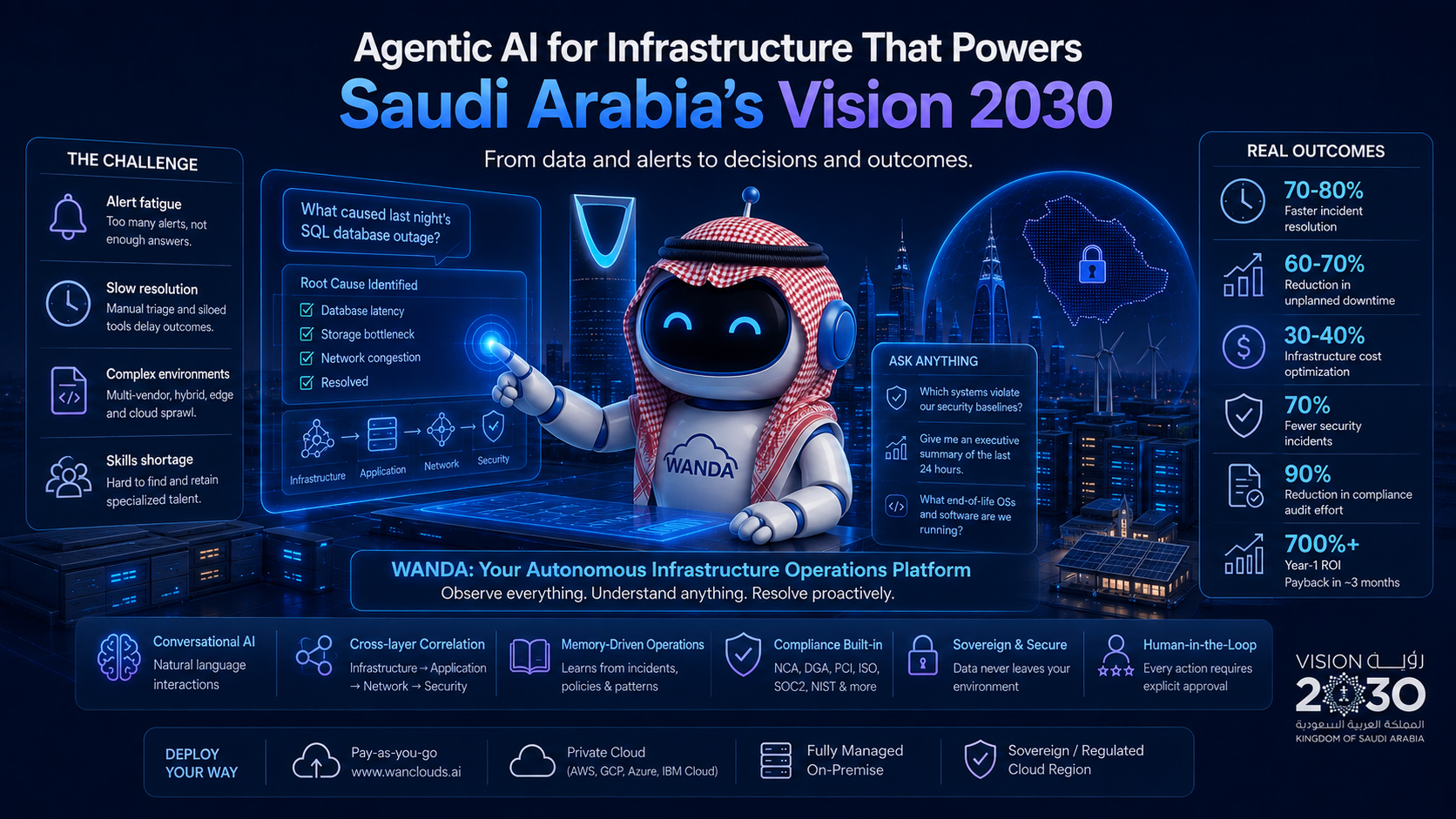
Agentic AI platforms like WANDA represent a fundamental shift in how IT infrastructure is managed. Instead of navigating dashboards or writing scripts, teams can simply chat with their infrastructure, asking natural-language questions like:
- "What caused last night's outage of the SQL database?"
- "Which systems violate our security baselines?"
- "Give me an executive summary of the last 24 hours."
- "Can you tell me what end-of-life OSs and software we're running?"
Behind these conversations is autonomous root-cause analysis, cross-layer correlation (infrastructure → application → network → security), and continuous learning from an organization's own environment, reducing mean time to resolution without manual triage.
Why This Matters for Saudi Arabia's Vision 2030 Specifically
1. Compliance is built for the region, not bolted on. Vision 2030 depends on public trust in digital government and financial services. WANDA maps directly to the compliance frameworks Saudi organizations already operate under, including NCA ECC, DGA, PCI, ISO, SOC2, and NIST, with drift detection, audit-ready evidence generation, and gap analysis against regulatory baselines built in. For government and financial services entities, this can reduce compliance audit effort by up to 90%.
2. Data sovereignty is non-negotiable, and it's supported. As the Kingdom pushes for greater control over sensitive national and citizen data, WANDA supports private cloud, fully managed on-premise, and sovereign or regulated cloud region deployment. No customer data leaves the environment, no personally identifiable information is shared, and every state-changing action requires explicit human confirmation, giving IT and compliance teams full control without slowing down operations.
3. It supports the infrastructure behind giga-projects and smart cities. From smart grid initiatives to IoT-driven utilities and distributed edge environments, WANDA is designed to monitor and correlate across exactly the kind of multi-vendor, hybrid infrastructure that underpins projects like NEOM and other national smart-city initiatives, with 24×7 monitoring and early detection of performance and security issues.
4. It closes the skills gap. As Saudi Arabia scales technology infrastructure faster than local talent pipelines can grow, WANDA's memory-driven operations, remembering past incidents, failure patterns, and organizational policies, help retain institutional knowledge even amid staff turnover, reducing dependency on scarce specialized expertise.
The Numbers Behind the Transformation
Organizations deploying agentic AI platforms like WANDA typically see:
- 70–80% reduction in incident resolution time
- 60–70% reduction in unplanned downtime
- 30–40% infrastructure cost optimization
- 70% fewer security incidents
- 90% reduction in compliance audit effort
- Payback period of approximately 3 months, with Year-1 ROI exceeding 700%
For organizations under pressure to deliver Vision 2030 milestones on time and within budget, this kind of operational efficiency isn't a nice-to-have; it's a competitive necessity.
Built for Saudi Government and Critical National Infrastructure
Two sectors stand out as especially well-aligned with Vision 2030 priorities:
Government & Public Sector: Continuous compliance monitoring across frameworks like NCA and DGA, unified visibility across multi-vendor government infrastructure, reduced downtime for citizen-facing digital services, and faster incident response without expanding headcount.
Energy, Utilities & Industrial: Monitoring of distributed edge and OT environments, early detection of performance and security issues, reduced operational risk in critical national infrastructure, and direct support for smart grid and IoT initiatives.
Flexible Deployment for Every Regulatory Requirement
Recognizing that not every Saudi organization has the same regulatory or infrastructure requirements, WANDA offers multiple deployment paths:
- Direct pay-per-use via www.wanclouds.ai
- Private instance in public cloud (AWS, GCP, Azure, IBM Cloud)
- Fully managed on-premise deployment
- Sovereign/regulated cloud region
Whether an organization needs full data residency within the Kingdom or simply wants to start with a pay-as-you-go model, WANDA's architecture is built to adapt rather than force a compromise.
The Bottom Line
Vision 2030 isn't just an economic diversification strategy; it's one of the largest digital infrastructure build-outs happening anywhere in the world right now. As Saudi enterprises and government entities scale, the organizations that succeed will be the ones that manage infrastructure complexity with the same ambition they're building it with.
Agentic AI platforms like WANDA offer a way to do exactly that, turning fragmented, multi-vendor infrastructure into a system that can be understood, questioned, and optimized in plain language, 24×7, without adding headcount or compromising on compliance and data sovereignty.
Ready to see what agentic AI can do for your infrastructure? Visit www.wanclouds.ai or reach out to [email protected] to learn more.