
Most AIOps and agentic AI platforms assume you're fine sending telemetry, logs, and prompts to a public cloud API. For a hospital, a bank, a defense contractor, or a government agency, that's often not a legal option, let alone a comfortable one. This guide covers what on-prem AIOps actually means, how it differs from a private LLM or a sovereign cloud deployment, and what to look for if your infrastructure can't send data outside your own walls.
What Is On-Prem AIOps?
On-prem AIOps refers to AI-driven IT operations, root cause analysis, alert correlation, compliance monitoring, running entirely inside an organization's own infrastructure, rather than through a cloud-hosted SaaS platform. Instead of sending logs, metrics, and prompts to an external vendor's servers, an on-prem AIOps deployment keeps data, models, and processing inside your data center or private cloud instance, which matters for organizations bound by data residency law, contractual data-handling terms, or internal security policy that a public cloud API can't satisfy.
Why This Matters Now
Interest in on-prem and sovereign AI deployment isn't a niche compliance concern anymore, it's becoming a mainstream enterprise requirement:
- Gartner's Predicts 2026: AI Sovereignty report projects that by 2030, more than three-quarters of European and Middle Eastern enterprises will repatriate workloads back to sovereign infrastructure specifically to reduce geopolitical risk.
- Industry research from Enterprise Strategy Group found that the majority of AI infrastructure already operates outside public cloud environments, driven largely by demand from regulated sectors like financial services.
- Data residency and data sovereignty are related but distinct concerns: residency is about where your data physically sits; sovereignty is about whose laws govern who can access it, a distinction that matters if your cloud vendor is incorporated in a jurisdiction with broad data-access laws, regardless of which region your data is stored in.
On-Prem AIOps vs. Air-Gapped vs. Sovereign Cloud. What's the Difference?
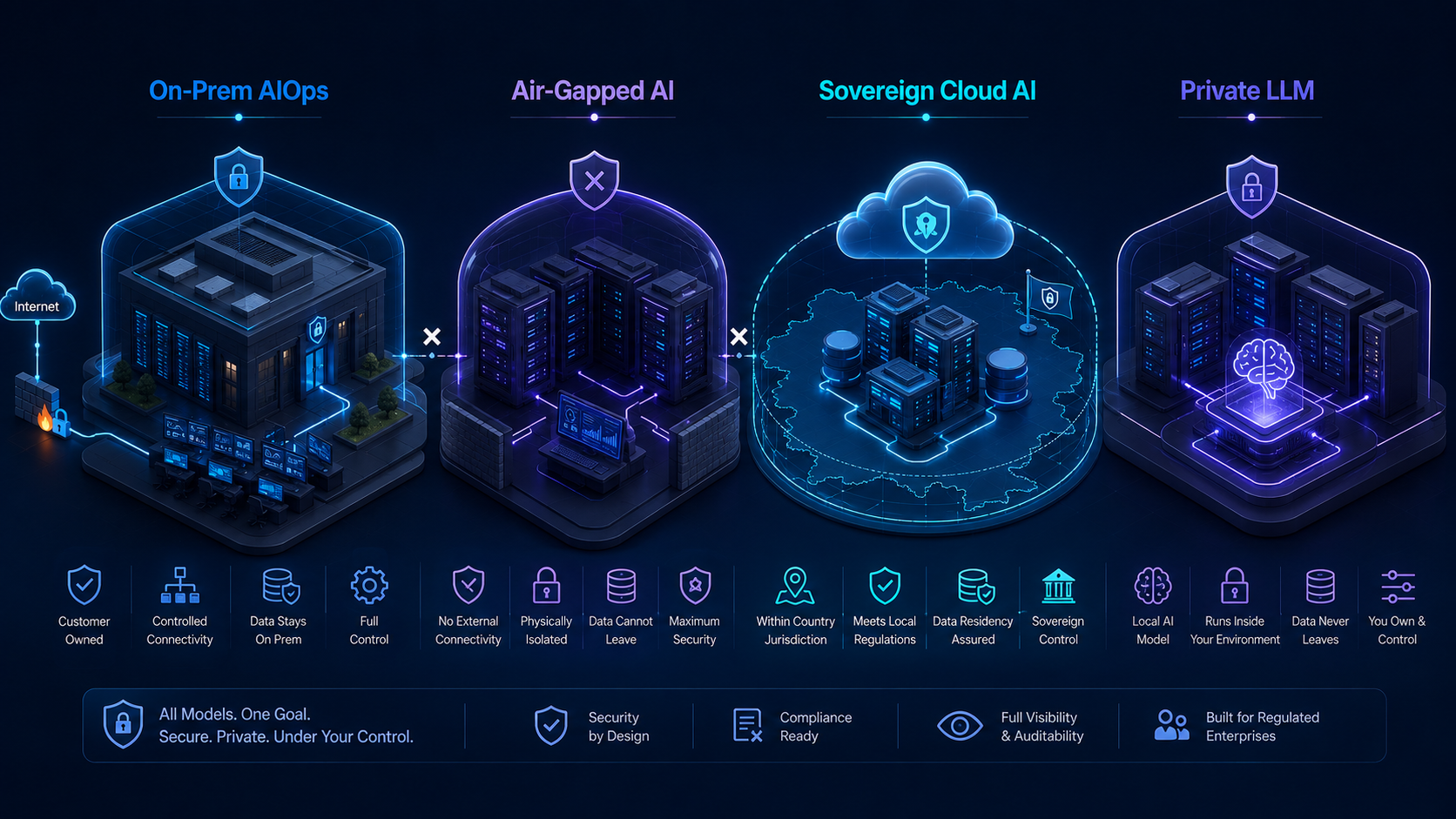
These terms get used interchangeably, but they're not the same thing:
| Deployment model | What it means | Best for |
|---|---|---|
| On-prem AIOps | AI operations software runs on infrastructure inside your own data center | Teams that need full control but still have internet connectivity |
| Air-gapped deployment | Same as on-prem, but with no external network access at all | Defense, classified environments, the most security-sensitive workloads |
| Sovereign cloud AI platform | Runs in a cloud region legally and operationally bound to a specific jurisdiction | Organizations needing data sovereignty without managing physical hardware themselves |
| Private LLM deployment | The AI model itself runs inside your environment, whether on-prem, air-gapped, or in a private cloud | Anyone who needs prompts and outputs to never reach a third-party model provider |
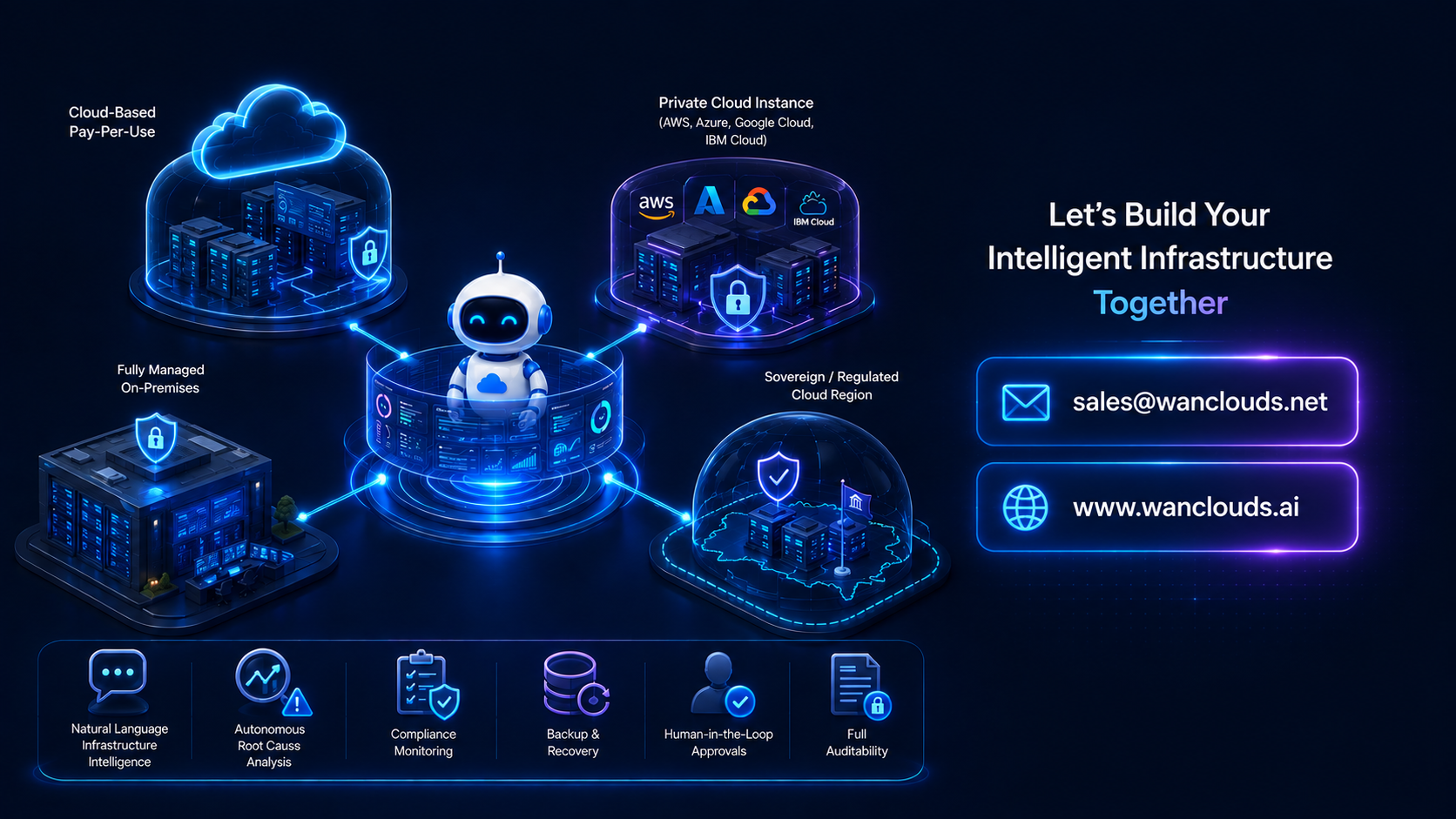
WANDA supports all four: pay-as-you-go, private cloud instance (AWS, GCP, Azure, IBM Cloud), fully managed on-premise, or a sovereign/regulated cloud region, so the deployment model is a configuration choice, not a different product.
What Makes an AI Assistant Genuinely "On-Premise"?
Not every product that claims "on-prem support" actually keeps everything local. A common gap in this market: the core platform runs on-prem, but the generative AI layer still calls out to a cloud-hosted service, meaning the moment you use the AI assistant, you've broken your own air gap.
A genuinely on-premise AI assistant should mean:
- The interface runs locally, no cloud dependency for the assistant itself.
- The reasoning/inference layer runs locally too, not just the data collection.
- No telemetry or prompts leave your network, including for model improvement or logging on the vendor's side.
Private LLM for Infrastructure. What It Actually Means
"Private LLM" gets used two different ways, and it's worth being precise about which one you need:
- Hosting your own general-purpose LLM: standing up infrastructure to run a model like Llama or Mistral yourself, for building your own applications. This is an infrastructure engineering project in its own right.
- A private LLM powering a purpose-built IT operations assistant: where the model exists specifically to reason about your infrastructure, and runs privately so your infrastructure data and prompts never leave your environment.
WANDA is the second kind. The default model is Anthropic or an equivalent provider, with a private, on-premise LLM option available and evaluated per deployment requirements, so you get agentic reasoning over your infrastructure without standing up and maintaining your own model-hosting stack.
Secure AI for Regulated Industries
Security and compliance aren't an add-on for WANDA, they're built into how it operates:
- Human-in-the-loop by default: every create, update, or delete operation requires your explicit confirmation.
- Full audit trail: every interaction and action is logged.
- No PII leaves your environment: aligned with GDPR and SOC 2.
- Compliance mapping across CIS, NIST, ISO, PCI, SOC2, Saudi NCA ECC, DGA, and FISMA.
This is what secure AI for regulated industries looks like in practice for the sectors that need it most:
- Financial services: 24×7 monitoring of mission-critical systems, proactive threat detection, audit-ready compliance reporting.
- Healthcare: monitoring of medical systems and hospital networks, protection of sensitive patient data, support for telemedicine platforms.
- Government & public sector: continuous compliance monitoring (FISMA, NIST, PCI, HIPAA, NCA), unified visibility across multi-vendor government infrastructure.
- Energy, utilities & industrial: monitoring of distributed edge and OT environments, early detection of performance and security issues.
Data Residency, Solved by Design
A data residency AI platform needs to answer one question clearly: where does the data actually go when you ask it a question? For WANDA, the answer is: nowhere it isn't supposed to. Deployment options include a private instance in your public cloud of choice (AWS, GCP, Azure, IBM Cloud), a fully managed on-premise deployment, or a sovereign/regulated cloud region, so data residency requirements determine your deployment configuration, not whether you can use the platform at all.
How WANDA Delivers On-Prem AIOps
| Deployment option | Description |
|---|---|
| Direct (pay-per-use) | Available at wanclouds.ai for teams that don't need dedicated infrastructure |
| Private instance, public cloud | Deployed in your AWS, GCP, Azure, or IBM Cloud account |
| Fully managed on-premise | Runs entirely inside your own data center |
| Sovereign/regulated cloud region | Bound to a specific jurisdiction for data sovereignty requirements |
Every option includes the full set of WANDA's capabilities, natural-language infrastructure chat, autonomous root cause analysis, compliance monitoring, and backup/restore, with security guardrails and human-in-the-loop confirmation built in regardless of deployment model.
Choose the Deployment Model That Matches Your Risk Profile
On-prem AIOps is not simply about installing AI software inside a data center. A secure deployment must account for where infrastructure data is stored, where AI inference occurs, whether outbound connectivity is required, and which legal jurisdiction governs access.
For regulated organizations, the right platform should provide the same operational capabilities across deployment models without forcing teams to compromise on data residency, security controls, or AI functionality.
WANDA supports flexible deployment across shared cloud, private cloud, customer-managed infrastructure, and regulated or sovereign environments, allowing organizations to choose the architecture that fits their security and compliance requirements.
Want to evaluate WANDA for an on-prem, private, or sovereign environment? Request a deployment assessment or schedule a demo.