
If you run infrastructure across more than one cloud, you already know the real cost isn't compute; it's context switching. A different console for AWS, another for Azure, a third for your on-prem VMware cluster, a Kubernetes dashboard bolted on top, and a Slack channel full of alerts nobody has time to correlate. By the time you've pieced together what actually happened, the incident is usually already resolved by trial and error, not root cause analysis.
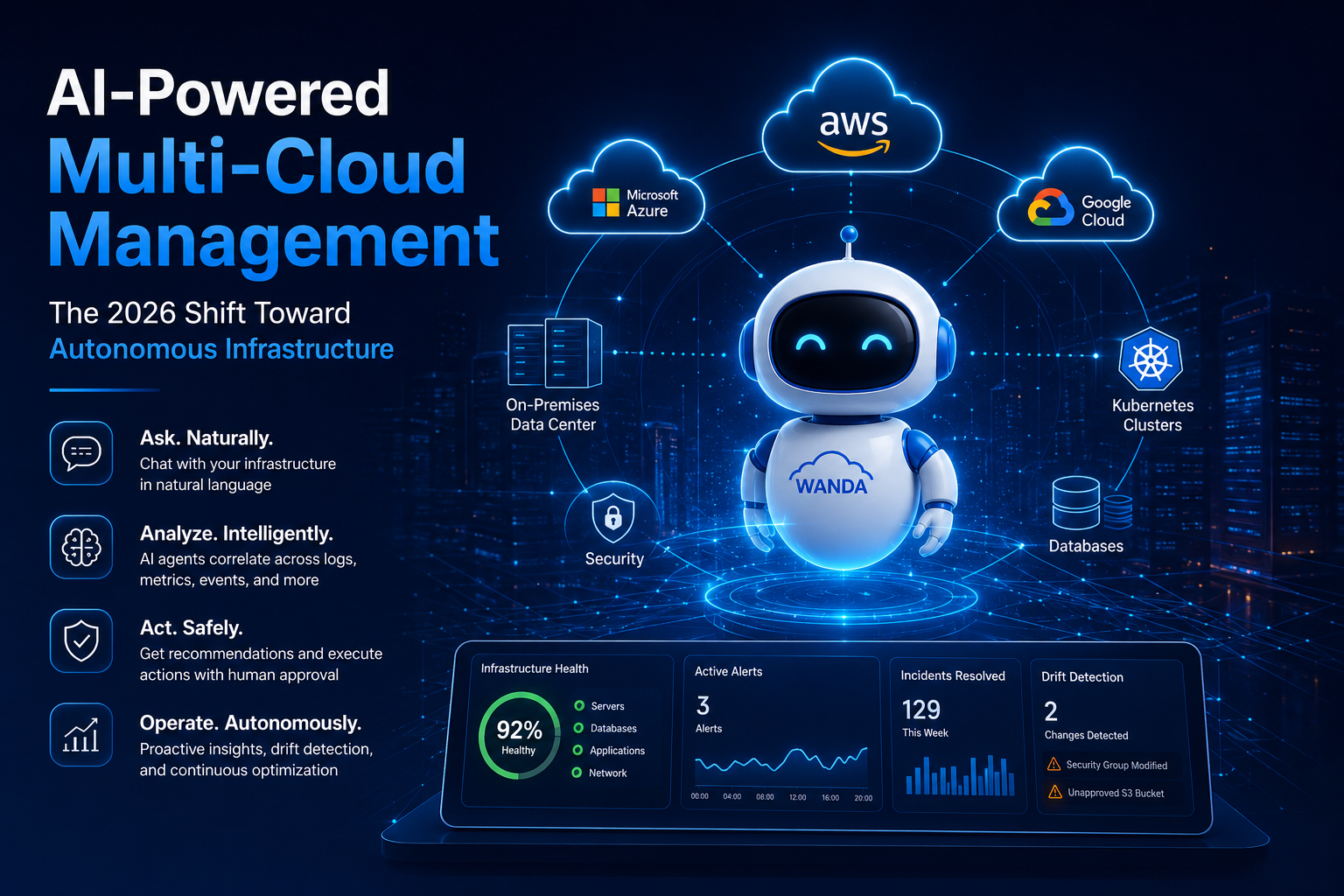
That's the problem multi-cloud management was supposed to solve, and largely hasn't. In 2026, the shift underway isn't another dashboard consolidation play; it's a move toward autonomous infrastructure, where AI agents don't just visualize your environment but actively reason about it, troubleshoot it, and act on it (with a human still holding the keys for anything that changes state).
Why Multi-Cloud Got Harder, Not Easier
Multi-cloud and hybrid cloud adoption grew for good reasons: redundancy, cost arbitrage, data residency, avoiding vendor lock-in. But operationally, it fragmented everything:
- Tool silos. Your cloud provider's native monitoring doesn't talk to your on-prem tooling, which doesn't talk to your network gear, which doesn't talk to your ticketing system.
- Alert floods. More environments mean more monitoring agents, more thresholds, more noise, and no single place to de-duplicate any of it.
- Manual runbooks. Tribal knowledge lives in wiki pages and the heads of your most senior engineers, not in a system that can act on it at 3 a.m.
- Skills gap. Few engineers are equally fluent in Kubernetes networking, firewall policy, database performance, and cloud cost optimization, but incidents don't respect those boundaries.
The result: Infrastructure and IT operations are frequently cited as a market with enormous inefficiency baked in, precisely because the tooling shows you data without giving you decisions. Dashboards tell you something is wrong. They rarely tell you why, and almost never tell you what to do about it — let alone do it for you.
What "Autonomous Infrastructure" Actually Means
"Autonomous infrastructure" gets thrown around loosely, so it's worth being precise. It doesn't mean AI making unsupervised changes to production. It means three specific capabilities layered on top of your existing environment:
1. Natural-language interaction with infrastructure. Instead of building a custom Grafana panel or grepping through logs across three systems, you ask a question, "what caused last night's outage on the SQL DB?" or "which systems violate our security baseline?" and get an answer grounded in your actual environment, not a generic LLM guess.
2. Autonomous root-cause and cross-layer correlation. The value isn't in any single log line or metric; it's in connecting infrastructure, application, network, and security signals into one incident narrative. That's exactly the kind of pattern-matching-across-domains work that's tedious for humans and well-suited to an AI agent with the right access.
3. Human-in-the-loop action. Autonomous doesn't mean unsupervised. The credible implementations of this pattern keep every state-changing operation- create, update, delete— behind explicit human confirmation, while automating the analysis and recommendation work that used to consume most of an engineer's day.
Hybrid Cloud Automation: The Boring Part That Matters Most
A lot of AIOps marketing focuses on the flashy "chat with your infra" use case. The less glamorous but arguably more valuable shift is in hybrid cloud automation, specifically backup, migration, and restore workflows that span on-premises and the cloud.
Moving VMs and data from on-prem to cloud (or between clouds) has historically meant custom scripts, migration tooling with narrow vendor support, and a lot of manual verification. Agentic AI platforms are increasingly handling this as a managed capability: an AI assistant that understands your on-prem VMware environment and your cloud target, and can execute backup/migrate/restore operations through integrations rather than one-off scripts, still gated by human approval for anything destructive or state-changing.
Cloud Observability Is Becoming a Byproduct, Not a Destination
Traditional observability stacks. Prometheus, Zabbix, Splunk, CloudWatch, and the rest aren't going away. If anything, agentic AI platforms are designed to sit on top of them via integrations (commonly through MCP — Model Context Protocol — connections) rather than replace them. The shift is in what you do with that telemetry.
Instead of observability being an end in itself (a dashboard you stare at), it becomes raw material for an AI layer that:
- Correlates logs, metrics, events, and configuration drift across tools automatically
- Reduces alert noise through de-duplication rather than forwarding every threshold breach
- Builds incident context automatically, so triage starts with a narrative instead of a blank investigation
- Retains memory of past incidents, known failure patterns, and environment-specific context, so resolution gets faster over time instead of starting from zero on every ticket
That last point matters more than it sounds. Most monitoring tools have no memory. Every incident is investigated as if it's the first time it happened, even when a nearly identical outage occurred six months ago, and someone documented the fix in a ticket nobody will find again. Memory-driven operations, where the system retains organizational policies, past incidents, and chat history, are what turn a chatbot-on-top-of-dashboards into something that actually reduces dependency on tribal knowledge.
Infrastructure as Code Meets Configuration Drift Detection
IaC solved provisioning consistency, but it didn't solve drift, the slow divergence between what your Terraform or Ansible defines and what's actually running in production. Manual drift audits are one of the most tedious, lowest-leverage tasks in infrastructure operations, and also one of the easiest to get wrong under time pressure.
Agentic AI approaches to this problem track configuration state and best-practice adherence continuously, flagging drift as it happens rather than during a scheduled quarterly audit. Paired with compliance mapping CIS, NIST, ISO, PCI, SOC 2, and increasingly region-specific frameworks- this turns audit preparation from a multi-week scramble into something closer to "pull the report."
Kubernetes Management AI: Solving for Complexity, Not Just Scale
Kubernetes and Red Hat OpenShift environments compound the multi-cloud problem instead of simplifying it. You get another layer of abstraction, another set of failure modes (pod crashes, resource contention, misconfigured network policies), and another tool that needs to be correlated against everything else.
The practical use case for AI here isn't replacing kubectl; it's cross-layer reasoning: connecting a pod-level issue to the node it's running on, the cloud provider's underlying compute, and any recent config changes, in one query, instead of manually pivoting between four tools to build that picture yourself.
On-Prem/Cloud Hybrid: Why "No Agents Required" Is a Bigger Deal Than It Sounds
One underrated barrier to adopting any new ops tooling is deployment friction, installing agents on every server, firewall, and network device before you get any value. Agentless (where possible) integration matters specifically in hybrid environments, where some infrastructure is behind strict network boundaries and agent rollout is a project in itself, not a checkbox. Connecting via existing APIs, MCPs, and telemetry sources, rather than requiring new software on every endpoint, is what makes hybrid on-prem/cloud coverage actually achievable in a reasonable timeframe.
Where Wanclouds Fits
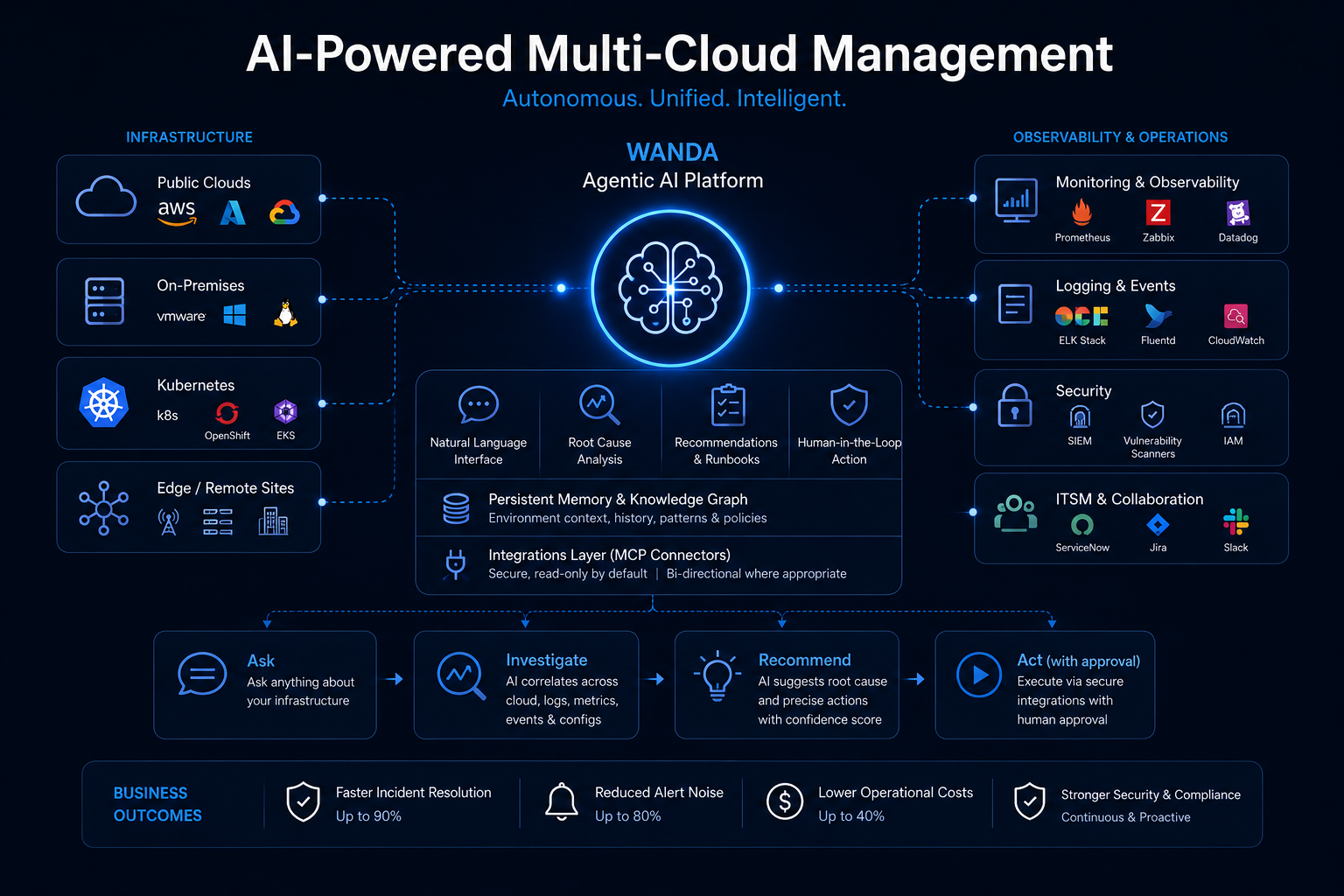
This is the exact problem Wanclouds built WANDA (Wanclouds AI Assistant) to address: an agentic AI platform purpose-built to operate, analyze, and optimize multi-vendor, hybrid, and distributed IT infrastructure. Rather than another dashboard, WANDA lets teams ask natural-language questions about their environment, get autonomous root-cause analysis across infra, app, network, and security layers, and run on-demand compliance assessments against frameworks like CIS, NIST, ISO, PCI, and SOC 2, while keeping every state-changing action gated behind human confirmation.
It connects to on-premises datacenters, edge infrastructure, and public/private clouds, integrating with existing monitoring (Prometheus, Zabbix, Solarwinds), logging (Splunk, Loki, AWS CloudWatch), and ITSM tools (ServiceNow, Jira) via MCP, largely without requiring new agents on every device. Teams can stand up separate AI assistants for different domains- VMware, cloud, firewalls, databases- depending on how their environment is organized, and it's available both as pay-as-you-go from wanclouds.ai and as a fully managed private deployment for organizations with data residency or regulatory requirements.
The Practical Takeaway
Multi-cloud and hybrid environments aren't consolidating anytime soon; if anything, edge, GPU compute, and containerized workloads are adding more surface area, not less. The tools that reduce operational load in 2026 won't be the ones with the prettiest dashboards. They'll be the ones that turn fragmented telemetry into an answer you can act on, with a human still deciding what "act on it" means.
If your team is spending more time correlating alerts across tools than actually fixing what's broken, that's the signal it's time to look at where agentic AI fits into your stack, not as a replacement for your engineers, but as the layer that gives them expert-level context before they even open a ticket.
Want to see how WANDA works with your specific environment? Reach out at [email protected] or visit wanclouds.ai to get started.