

Most enterprises no longer run IT infrastructure in one place. A typical environment today spans on-premise datacenters, two or three public clouds, edge locations, and a growing footprint of containerized workloads on Kubernetes or Red Hat OpenShift. Each of those environments comes with its own dashboards, its own alerting logic, and its own operational quirks, and IT teams are expected to keep all of it secure, compliant, and performant with the same headcount they had five years ago.
This is exactly the problem AIOps was built to solve. If you are new to the concept, our cornerstone guide on what AIOps is, how it works, and its core benefits is a good place to start. This article goes one layer deeper and focuses specifically on the hardest version of the problem: using AIOps to manage hybrid and multi-cloud environments where infrastructure, vendors, and compliance requirements rarely line up neatly.
Key takeaways
- Hybrid and multi-cloud environments are hard to manage because visibility, alerting, and compliance are fragmented across vendors, clouds, and on-premise systems.
- AIOps platforms unify that fragmented data into a single intelligence layer so IT teams get one view, one set of correlated alerts, and one place to ask questions.
- Agentic AIOps platforms like Wanclouds AI (WANDA) go further than dashboards: they reason across your infrastructure in natural language and can act autonomously, with human approval required for any change.
- Real deployments report 70–80% faster incident resolution, 30–40% infrastructure cost optimization, and a typical payback period of around three months.
Why Hybrid and Multi-Cloud Environments Are So Hard to Manage
Hybrid and multi-cloud operations are difficult because every environment speaks a different operational language. On-premise VMware clusters, AWS or Azure accounts, Kubernetes namespaces, and a stack of firewalls, routers, and switches each generate their own logs, metrics, and alerts, usually in tools that were never designed to talk to each other.
A few patterns show up in almost every multi-cloud environment we see:
Tool silos. Compute, networking, security, and cloud cost data often live in separate platforms, so no single person has a complete picture of what is actually happening across the environment.
Alert floods. When five or six monitoring tools are each generating their own notifications for the same underlying problem, teams spend more time triaging noise than fixing anything.
Manual runbooks. Step-by-step recovery procedures written for one platform rarely translate cleanly to another, which means tribal knowledge becomes the real source of truth, and that knowledge walks out the door when an engineer leaves.
Inconsistent compliance posture. A configuration that satisfies PCI DSS in one cloud account can quietly drift out of compliance in another, and most teams only find out during an audit.
Vendor lock-in pressure. Many monitoring and ITSM tools are built around a single ecosystem, which makes it harder to add a new cloud provider or on-premise platform without retooling.
None of these problems are caused by any single bad tool. They are caused by the complexity that has outgrown the operating model of dashboards, scripts, and tribal knowledge.
What Makes Hybrid and Multi-Cloud Operations Different
Hybrid and multi-cloud management is harder than single-environment IT because there is no shared control plane. A public cloud account, an on-premise VMware environment, and a fleet of edge devices each have different APIs, different identity models, and different default telemetry formats. Add data residency requirements, where certain workloads or datasets must stay within a specific region or jurisdiction, and the operational complexity compounds further.
This is the gap AIOps is designed to close: not by replacing any individual platform, but by sitting above all of them and correlating what they are each reporting into a single, coherent picture.
How AIOps Helps IT Teams Manage Hybrid and Multi-Cloud Environments
AIOps helps hybrid and multi-cloud teams by replacing fragmented, vendor-specific monitoring with one AI-driven intelligence layer that understands infrastructure across every environment at once. Instead of stitching together insights from a dozen tools, IT teams get a single place to ask questions, investigate incidents, and act, regardless of where a given workload actually lives.
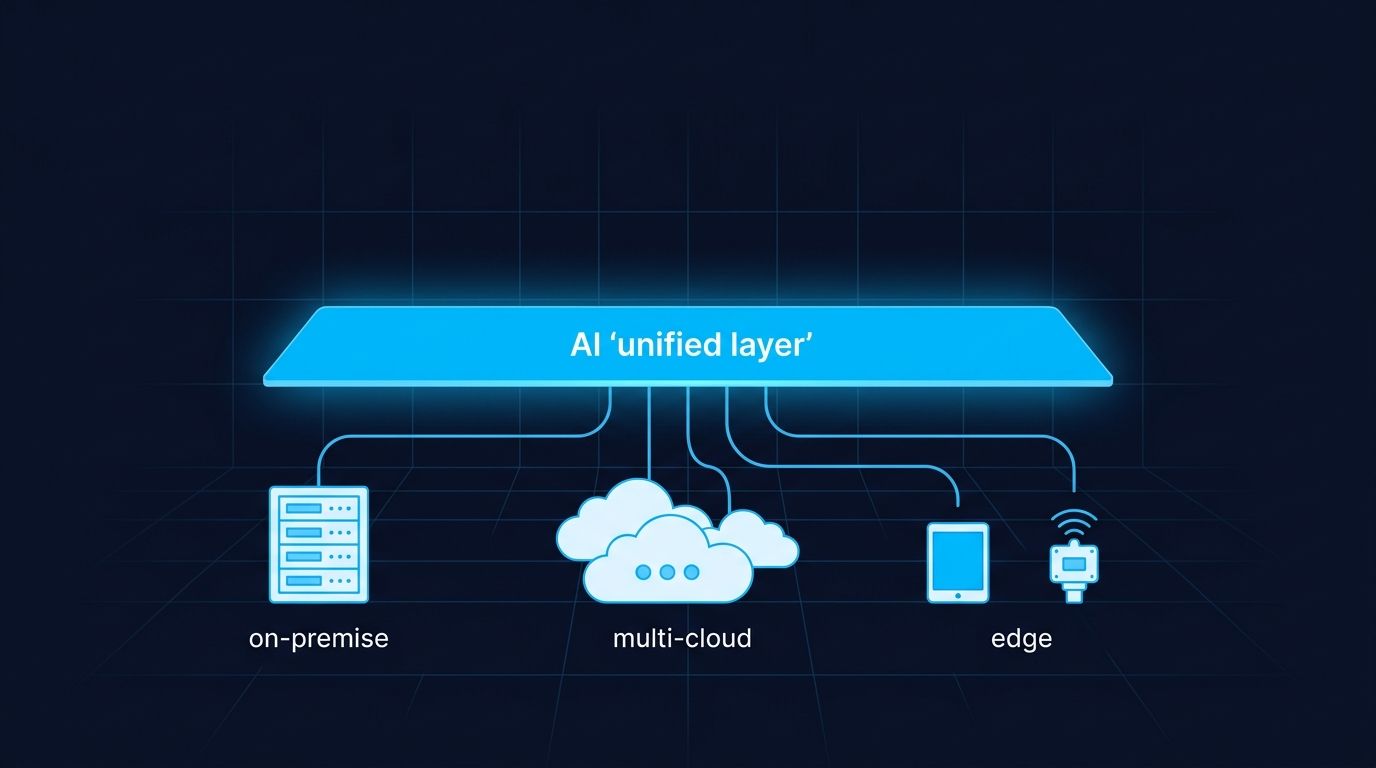
Unified, Natural-Language Visibility Across Every Vendor and Cloud
Rather than asking engineers to learn five different dashboards, an agentic AIOps platform lets them ask plain-language questions and get answers from across the entire environment. Wanclouds AI's WANDA, for example, supports natural-language interaction with infrastructure spanning Linux and Windows servers, VMware, Kubernetes, firewalls, routers, switches, and both public and private clouds, with no dashboards and no scripting required.
You can also create one or multiple AI assistants depending on how your environment is segmented, for example, a dedicated assistant for your on-premise VMware estate, a separate one for your cloud deployment, and another scoped to your firewall and database infrastructure, all connecting through direct integrations or via MCP (Model Context Protocol) to monitoring tools like Prometheus, Zabbix, and SolarWinds, logging platforms like Splunk and AWS CloudWatch, and ITSM systems like ServiceNow and Jira.
Autonomous Root Cause Analysis That Spans On-Prem, Cloud, and Edge
When an incident touches more than one environment, for example a network change on-premise that causes a performance issue in a cloud-hosted application, traditional tools struggle because no single platform has visibility into both sides. AIOps closes that gap through cross-layer correlation that connects infrastructure, application, network, and security signals into one incident timeline, automatically. WANDA builds this incident context on its own and works to identify what changed and why, rather than leaving engineers to manually cross-reference logs from unrelated systems.
Noise Reduction and Faster MTTR Across Distributed Systems
The more environments you run, the more redundant alerts you get for the same underlying issue. AIOps reduces that noise through intelligent de-duplication, so a single root cause generates one actionable alert instead of a flood of duplicate notifications from every monitoring tool that happened to detect it. That noise reduction, combined with automatically built incident context, is what drives mean time to repair (MTTR) down without adding manual triage steps.
Consistent Compliance and Security Posture Across Multiple Providers
Maintaining a consistent compliance posture across AWS, Azure, on-premise systems, and edge infrastructure is one of the most common pain points in hybrid operations, because each environment can drift independently. AIOps platforms with built-in compliance mapping can run on-demand assessments against frameworks like CIS, NIST, ISO, PCI, SOC2, HIPAA, and region-specific standards such as Saudi NCA ECC and DGA, regardless of which cloud or datacenter the underlying systems sit in. WANDA can also review existing security policy documents, identify gaps against a chosen framework, flag configuration drift, and generate audit-ready evidence on demand, which is a meaningfully different experience from manually reconciling spreadsheets across business units.
AI-Driven Cost Optimization Across Multi-Cloud Spend
Cost visibility tends to fall apart the moment workloads are spread across more than one cloud provider, since each platform reports usage and billing differently. AIOps platforms address this with capacity and utilization insights, right-sizing suggestions, and idle and waste detection that work the same way regardless of which cloud the resource lives in, giving finance and IT a single, comparable view of where spend is going and where it can be reduced.
Memory That Persists Across Environments and Vendors
A major advantage of agentic AIOps over traditional monitoring is memory. WANDA retains context on past incidents, known failure patterns, recent interactions, organizational policies, and environment-specific details, and applies that memory across every connected environment rather than starting from zero each time. In a hybrid setup where the same type of failure might show up differently on-premise versus in the cloud, that persistent, cross-environment memory is what shortens resolution time as the platform learns your infrastructure.
Safer Migration, Backup, and Restore Between On-Premise and Cloud
Hybrid environments are rarely static. Workloads move between on-premise and cloud as organizations modernize, and that movement is one of the riskiest operations in IT. AIOps platforms that support backup, migration, and restore of virtual machines and data, connected via MCP, give teams a consistent, AI-assisted way to move workloads without losing visibility mid-migration, reducing the operational risk that normally comes with shifting infrastructure between environments.
Multi-Cloud AIOps in Action: The Kinds of Questions IT Teams Can Ask
One of the clearest signs that AIOps is working is that engineers stop opening dashboards and start asking questions instead. In a hybrid or multi-cloud context, that might look like:
- "Can you tell me what end-of-life operating systems and software we are running across our environment?"
- "Review my existing policies and identify gaps against HIPAA."
- "Which systems violate our security baselines, and in which environment are they running?"
- "What changed right before performance degraded on that application?"
Each of these questions naturally spans multiple systems, multiple vendors, and in many cases multiple clouds, which is exactly the kind of question legacy, single-purpose dashboards were never built to answer.
Business Impact: What Hybrid and Multi-Cloud Teams Can Expect
Based on results reported by Wanclouds AI customers, organizations that adopt agentic AIOps for hybrid and multi-cloud operations typically see a 70–80% reduction in incident resolution time, a 60–70% reduction in unplanned downtime, and 30–40% infrastructure cost optimization. Customers also report 70% fewer security incidents and a 90% reduction in compliance audit effort, with a typical payback period of around three months and a Year-1 ROI exceeding 700%. These figures will naturally vary by environment size and complexity, but they illustrate the scale of improvement possible when fragmented, manual operations are replaced with a unified, AI-driven intelligence layer.
Choosing the Right Deployment Model for Hybrid and Multi-Cloud Environments
Hybrid and multi-cloud organizations often have specific requirements around data residency, regulatory compliance, and operational control, so deployment flexibility matters as much as the AI capabilities themselves. Wanclouds AI supports several deployment options to fit different requirements:
- Direct, pay-per-use at wanclouds.ai for teams that want to get started quickly without a long procurement cycle.
- Private instance in a public cloud such as AWS, GCP, Azure, or IBM Cloud, for teams that want dedicated infrastructure within their existing cloud footprint.
- Fully managed on-premise deployment, with Wanclouds managing the deployment and ongoing maintenance on a 24x7 basis.
- Sovereign or regulated cloud regions, for organizations with strict data residency or jurisdictional requirements.
Across all deployment models, no customer data, including personally identifiable information, leaves the customer's environment, in line with GDPR and SOC2 requirements. Security guardrails are built in to prevent unauthorized changes to infrastructure, every interaction and action is logged and audited, and any state-changing operation, meaning a create, update, or delete action, requires explicit human confirmation before it is executed. For hybrid and multi-cloud teams in particular, this human-in-the-loop control matters because it means the platform can recommend and even draft remediation across every connected environment without ever making an unreviewed change to production systems.
Bringing It Together
Hybrid and multi-cloud infrastructure is not going to get simpler, and adding more dashboards is not the fix. AIOps gives IT teams a way to manage that complexity by unifying visibility, automating root cause analysis, and maintaining consistent compliance and cost discipline across every vendor and cloud they run. Agentic platforms like Wanclouds AI (WANDA) take that further by letting teams simply ask their infrastructure questions and get answers, with human-in-the-loop controls ensuring nothing changes in production without explicit approval.
To see how this applies to your specific hybrid or multi-cloud environment, you can read our full guide on what AIOps is and how it works, explore Wanclouds AI, or reach out to contact us to discuss deployment options for your environment.