
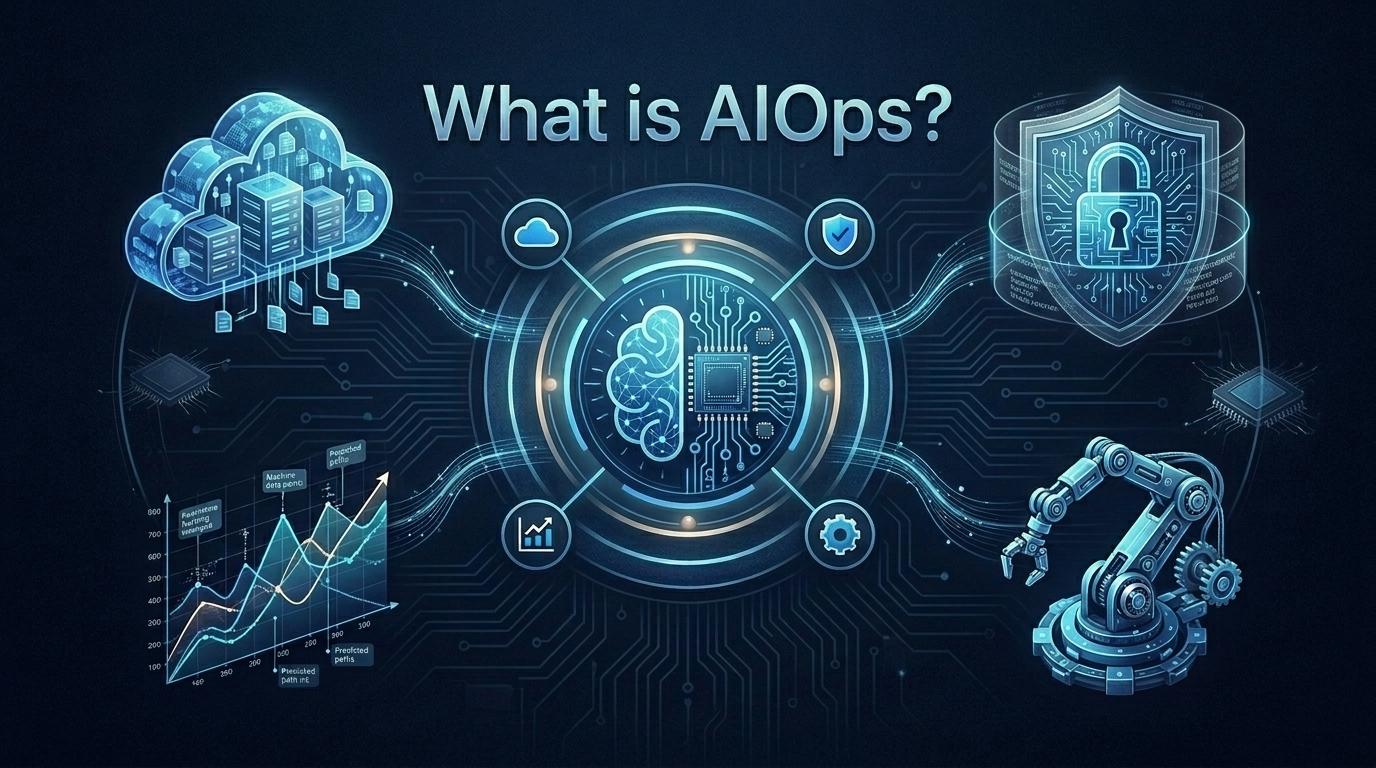
What is AIOps?
IT infrastructure is one of the most complex challenges modern enterprises face, and it is getting harder every year. Millions of alerts, fragmented dashboards, siloed teams, and skyrocketing operational costs have turned IT management into a $100 billion problem.
AIOps — short for Artificial Intelligence for IT Operations — is the answer that the industry has been converging on.
AIOps is the application of artificial intelligence (AI) capabilities, including machine learning (ML) and natural language processing (NLP), to automate, streamline, and optimize IT operations. Rather than having teams manually sift through mountains of alerts and logs, AIOps platforms ingest data from across your IT environment, identify patterns, detect anomalies, pinpoint root causes, and in many cases resolve issues, all autonomously and in real time.
In simple terms: AIOps turns your IT infrastructure from something you react to into something you actively control.
Why is AIOps Important?
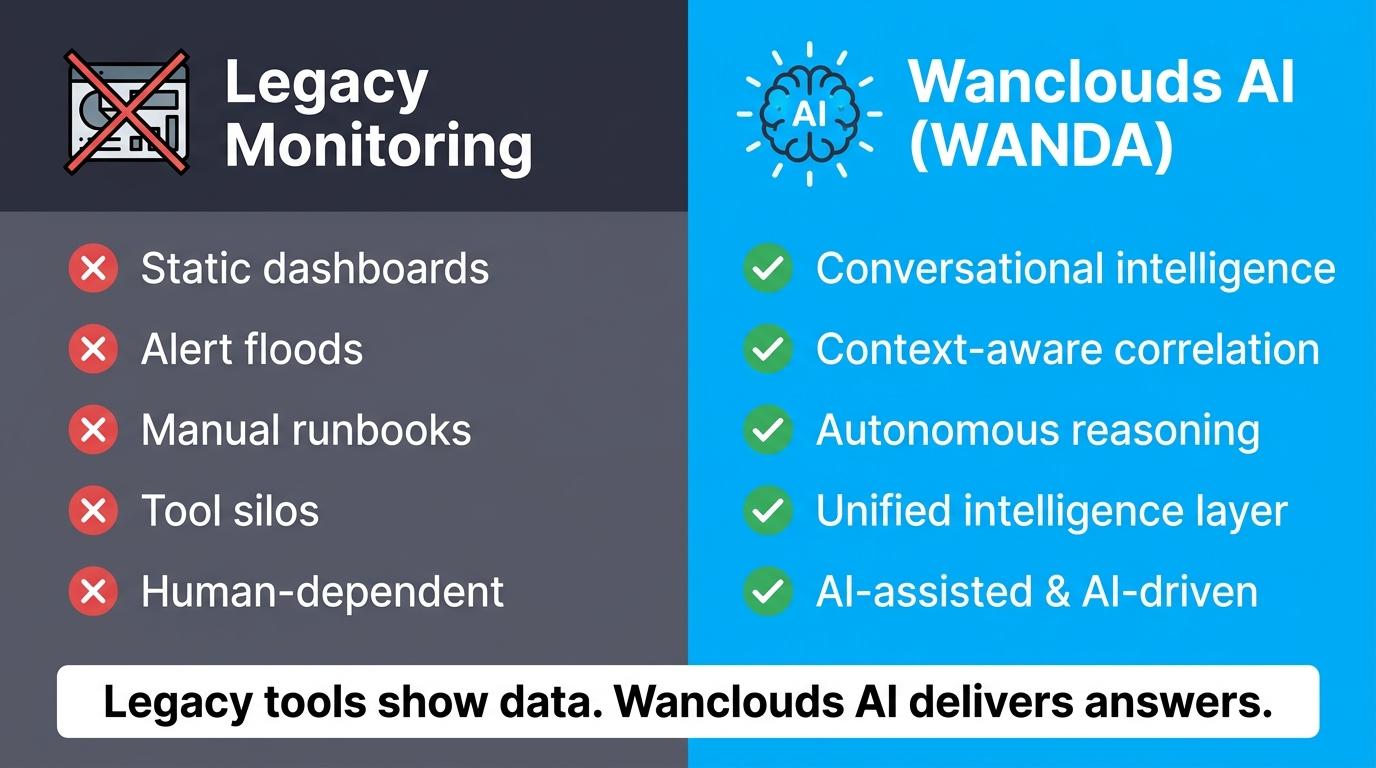
Traditional IT monitoring tools were built for a simpler era. Static dashboards, alert floods, manual runbooks, and tool silos may have worked when infrastructure was predictable and contained. Today, with hybrid cloud, multi-vendor environments, distributed workloads, and Kubernetes clusters spanning on-premise and cloud, those legacy approaches simply cannot keep up.
Here is why AIOps has become critical:
The data volume problem. Modern enterprise environments generate billions of log entries, metrics, and events daily. No human team can meaningfully process this at speed.
The skills gap. IT and cloud operations require deep, cross-domain expertise, compute, networking, storage, security, and compliance, which is difficult and expensive to maintain across a team.
The cost of downtime. Unplanned outages cost enterprises an average of hundreds of thousands of dollars per hour. Slow mean time to repair (MTTR) is not just a technical problem; it is a business risk.
The complexity of hybrid and multicloud. Managing dependencies across on-premise datacenters, public clouds (AWS, Azure, GCP), containerized environments, and edge devices is impossible without intelligent automation.
AIOps addresses all of these challenges simultaneously.
How Does AIOps Work?
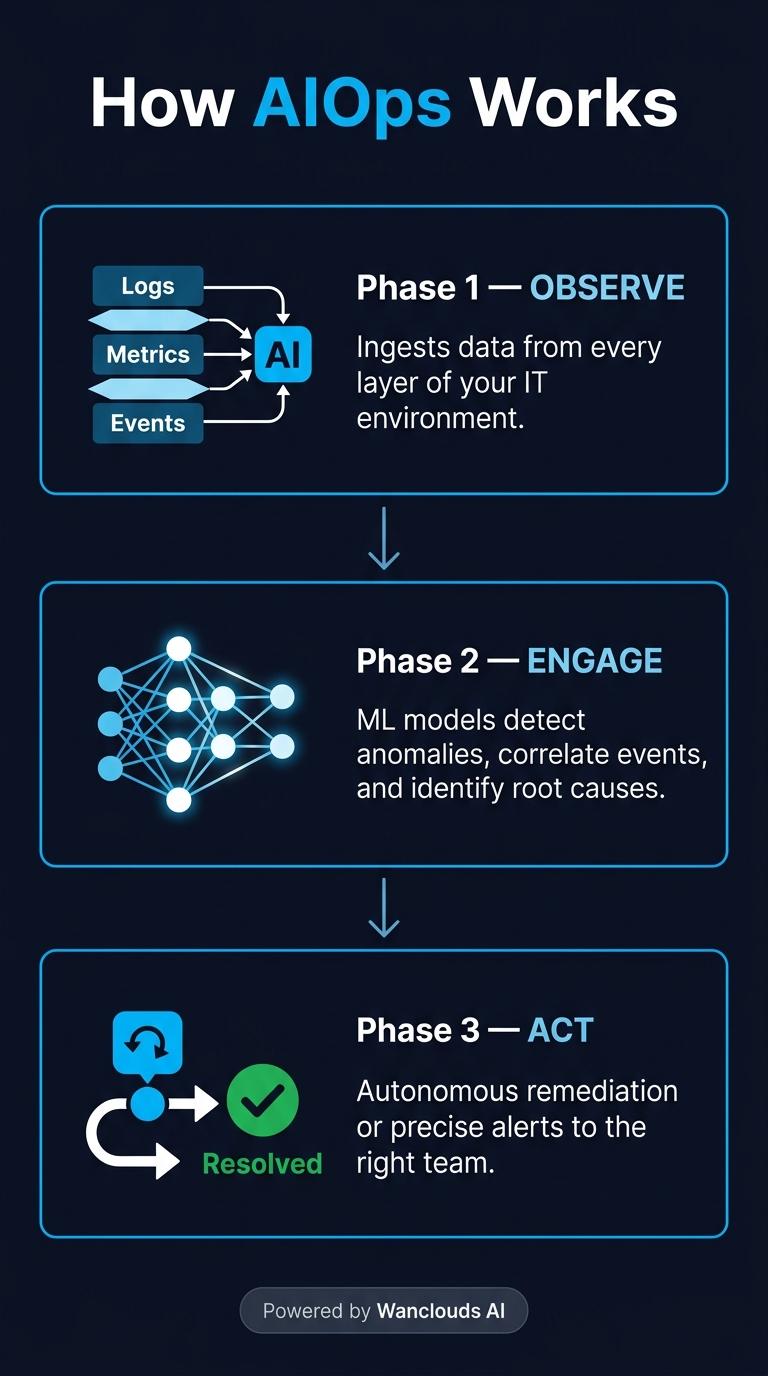
AIOps platforms work by following a continuous, intelligent cycle across three key phases:
1. Observe
AIOps begins with data collection, aggregating telemetry from every layer of your IT environment. This includes system logs, performance metrics, network traffic, event data, incident tickets, infrastructure configurations, and application demand signals. Unlike legacy tools that look at one layer at a time, AIOps platforms correlate data across compute, storage, networking, security, and applications simultaneously.
2. Engage
Once data is ingested, AI and ML models get to work. They separate meaningful signals from noise, identify anomalies against established baselines, correlate related events across different domains, and build full incident context automatically. Operations teams receive precise, actionable alerts instead of floods of raw notifications. In many cases, the platform surfaces probable root causes before engineers even begin investigating.
3. Act
This is where AIOps truly changes the game. Based on the insights generated, AIOps platforms can automate responses, routing alerts to the right team, triggering remediation scripts, scaling resources proactively, or even resolving issues without human intervention. Over time, the AI models continue to learn from your environment, making future incident handling faster and more accurate.
Key Components of AIOps
Understanding the building blocks of AIOps helps clarify what to look for in a platform:
Machine Learning (ML):
The foundation of AIOps. ML algorithms analyze historical and real-time data to detect anomalies, establish baselines, and predict future incidents before they impact users.
Natural Language Processing (NLP):
Enables teams to interact with their infrastructure conversationally, asking questions in plain language and receiving clear, contextual answers instead of navigating complex dashboards.
Big Data Analytics:
AIOps platforms ingest massive volumes of structured and unstructured data from disparate sources and make sense of it at scale, in real time.
Automation:
From alert routing to autonomous remediation, automation is what turns AIOps insights into action, reducing human workload and dramatically compressing MTTR.
Cross-Domain Correlation:
True AIOps connects the dots across infrastructure layers from a network anomaly to its downstream application impact to a security implication, giving teams a complete picture instead of isolated data points.
AIOps Use Cases
AIOps is not a single-purpose technology. Its applications span the full breadth of IT and cloud operations:
Root Cause Analysis
When an outage or performance degradation occurs, the most pressing question is always "why?" AIOps platforms correlate events across logs, metrics, configurations, and network data to identify the true root cause, not just the surface symptom, in seconds rather than hours.
Anomaly Detection
AIOps continuously monitors infrastructure for deviations from normal behavior. Whether it is a sudden spike in CPU usage, an unusual authentication pattern, or a network bottleneck, anomaly detection flags issues early, often before they escalate into full incidents or security breaches.
Application Performance Monitoring (APM)
Modern applications run across microservices, APIs, and distributed cloud infrastructure. AIOps brings together performance metrics from all these layers, giving teams visibility into application health that traditional monitoring simply cannot provide.
Cloud Automation and Optimization
AIOps solutions help organizations manage complex cloud and hybrid environments, provisioning resources, optimizing capacity, detecting idle or wasteful spending, and ensuring workloads run where they perform best at the lowest cost.
Compliance and Security Posture Management
AIOps platforms can continuously assess infrastructure against compliance frameworks such as PCI DSS, HIPAA, NIST, SOC2, and others, detecting configuration drift, generating audit-ready reports, and flagging security risks before they become violations.
Cloud Migration Support
Moving workloads from on-premise to cloud or between clouds is operationally risky. AIOps provides the visibility and dependency mapping needed to reduce migration risk, catch issues early, and maintain performance throughout the transition.
DevOps Acceleration
AIOps and DevOps are natural partners. By providing automated observability, faster incident response, and proactive issue detection, AIOps gives DevOps teams the safety net they need to deploy faster without sacrificing reliability.
AIOps vs. DevOps: What is the Difference?
These two terms often appear together, but they serve different purposes.
DevOps is a methodology focused on bridging the gap between software development and IT operations, accelerating the software delivery lifecycle through CI/CD pipelines, collaboration, and automation of build and deployment processes.
AIOps is focused on the operational intelligence layer, using AI to monitor, analyze, and optimize the IT environments that software runs on. Where DevOps speeds delivery, AIOps ensures those environments remain healthy, performant, and resilient after deployment.
Used together, AIOps and DevOps create a comprehensive approach to managing the full software lifecycle from code to production to continuous optimization.
AIOps vs. MLOps vs. SRE: Clearing Up the Confusion
MLOps is a framework for integrating machine learning models into production software — covering model training, evaluation, and deployment. AIOps, by contrast, uses ML as a tool to improve IT operations rather than being about ML deployment itself.
Site Reliability Engineering (SRE) is an engineering discipline that applies software practices to operations, automating reliability checks and system operations. AIOps complements SRE by providing the AI-driven insights and predictive analytics that help SRE teams resolve incidents faster and reduce toil.
Domain-Centric vs. Domain-Agnostic AIOps
When evaluating AIOps platforms, you will encounter two broad categories:
Domain-agnostic AIOps platforms collect data from a wide range of sources across multiple operational domains, networking, security, storage, and applications — offering a holistic view of enterprise IT health. They excel at broad visibility but may lack depth in specific areas.
Domain-centric AIOps tools are purpose-built for specific environments or industries. They are trained on domain-specific datasets and can provide highly precise insights and recommendations for their area of focus. A network-centric platform, for instance, can distinguish between a DDoS attack and a misconfiguration with far greater accuracy.
The right choice depends on your organization's primary pain points, infrastructure complexity, and the level of specialization you need.
Benefits of AIOps
The business case for AIOps is compelling and measurable:
Faster MTTR. By automating root cause analysis and alert correlation, AIOps platforms compress incident resolution from hours to minutes, or handle it autonomously without human involvement at all.
Lower operational costs. Automated issue detection and response reduce the labor-intensive work of manual monitoring and runbook execution. Teams can do more with less and focus on higher-value work.
Reduced unplanned downtime. Predictive analytics catch issues before they become outages, protecting revenue and customer experience.
Better observability and collaboration. A unified intelligence layer replaces siloed tools, giving all teams, IT, DevOps, security, and leadership a common, accurate view of infrastructure health.
Continuous compliance. AIOps platforms that include compliance monitoring reduce audit effort significantly, with always-current posture assessments and audit-ready evidence generation.
Scalability. As infrastructure grows more complex, AIOps scales with it, learning continuously and adapting to new environments, configurations, and failure patterns.
How Wanclouds AI (WANDA) Takes AIOps Further
Most AIOps platforms give you better dashboards and smarter alerts. Wanclouds AI takes a fundamentally different approach; it replaces the dashboards entirely.
WANDA (Wanclouds Agentic AI) is an enterprise-grade agentic AI platform purpose-built for multi-vendor, hybrid, and distributed IT and cloud infrastructure. Rather than visualizing data for humans to interpret, WANDA understands your infrastructure, reasons across it, and acts autonomously.
Chat With Your Infrastructure
WANDA enables natural-language interaction with your entire IT environment. Instead of navigating dashboards, your team can simply ask:
- "What caused last night's SQL DB outage?"
- "Which systems violate our security baselines?"
- "What changed before performance degraded?"
- "Give me an executive summary of the last 24 hours."
- "Run a PCI compliance assessment."
No dashboards. No scripting. Just answers.
Autonomous Root Cause Analysis and Correlation
WANDA performs cross-layer correlation, connecting infrastructure events to application behavior to network conditions to security signals, automatically. It reduces alert noise through intelligent de-duplication, builds full incident context on its own, and drives MTTR down without manual triage.
Memory-Driven Operations
Unlike tools that treat every incident in isolation, WANDA remembers your environment, past incidents, known failure patterns, recent interactions, organizational policies, and environment-specific context. This memory enables faster resolution over time and reduces dependency on tribal knowledge that walks out the door when engineers leave.
Continuous Compliance and Security Posture
WANDA provides on-demand compliance and security assessments across frameworks, including CIS, NIST, ISO, PCI, SOC2, HIPAA, Saudi NCA ECC, and DGA. It detects configuration drift, generates audit-ready evidence, performs software inventory and risk assessments, and can even review and create security policy documents.
AI-Driven Optimization
WANDA continuously identifies cost optimization opportunities, right-sizing recommendations, idle and waste detection, capacity and utilization insights, helping organizations achieve 30–40% infrastructure cost reduction.
Broad Environment Support
WANDA connects to on-premise datacenters, edge devices, public and private clouds, Kubernetes and OpenShift environments, networking devices (firewalls, routers, switches, load balancers), databases, and workloads, as well as existing monitoring platforms (Prometheus, Zabbix, SolarWinds), logging systems (Splunk, Loki, AWS CloudWatch), and ITSM tools (ServiceNow, Jira). No agents required where possible. No vendor lock-in.
Conclusion
AIOps is no longer an emerging concept; it is rapidly becoming the operational standard for any organization running a complex, distributed IT infrastructure. By combining machine learning, big data analytics, and intelligent automation, AIOps transforms IT operations from reactive and manual to predictive and autonomous.
Wanclouds AI goes a step further, delivering a true agentic AI experience where your team can simply talk to your infrastructure and get answers, no dashboards, no manual triage, no tool hopping.
Ready to transform how your team operates IT and cloud infrastructure? Visit wanclouds.ai or contact the team at [email protected] to get started.