
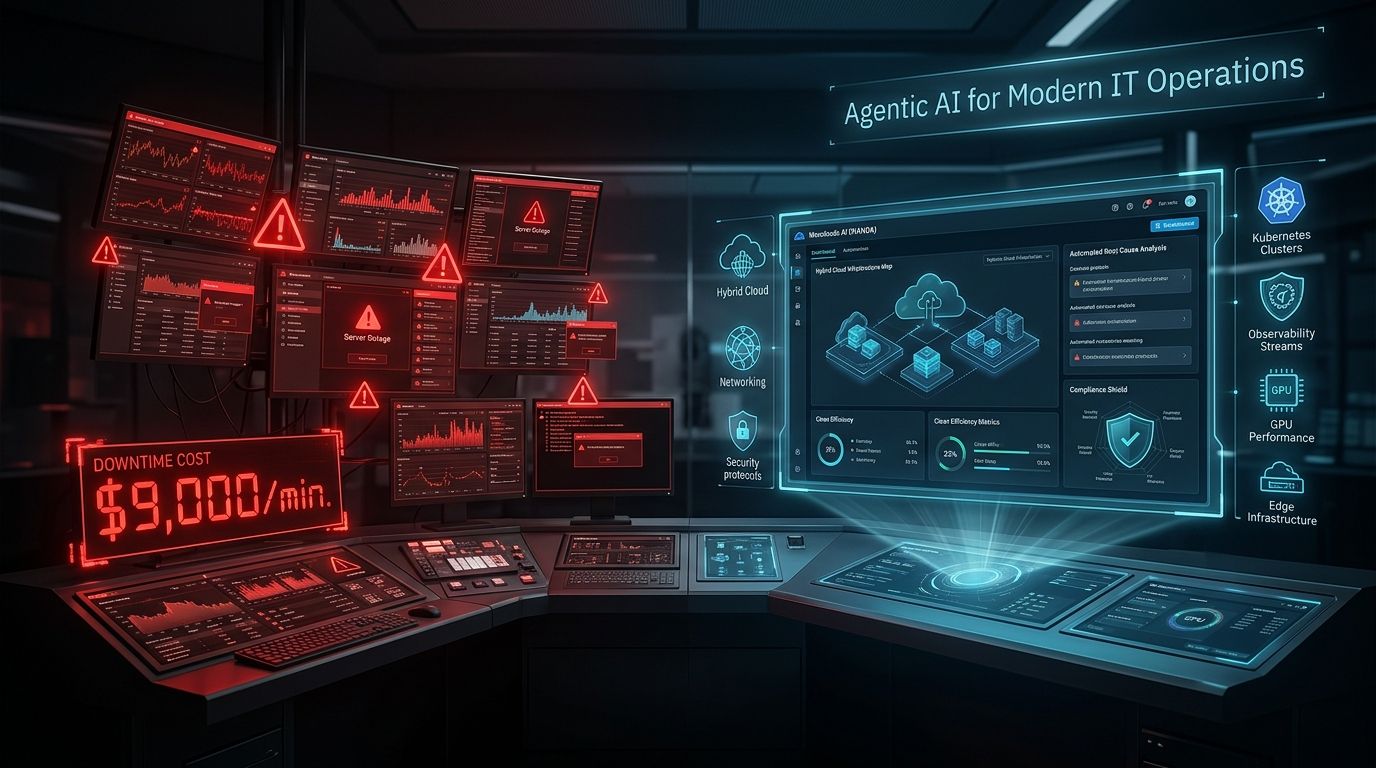
2:07 AM. A payment gateway slows to a crawl.
Dashboards light up across the organization. CPU alerts fire from one platform. Database warnings surface in another. Network anomalies appear somewhere else entirely. Tickets pile up. Customers notice the slowdown before the infrastructure team understands what failed.
By the time engineers isolate the root cause, the organization is already down hundreds of thousands of dollars.
Without agentic AI: Engineers spend 3+ hours manually correlating alerts across disconnected tools. MTTR balloons. Revenue bleeds by the minute.
With Wanclouds AI (WANDA): Within minutes of the first alert, the system has correlated signals across infrastructure layers, identified the root cause, and surfaced a recommended remediation path, before most teams have finished their first Slack thread.
This is not a future promise. It is what modern agentic AI operations look like today.
Downtime Is Now a Business Crisis, Not Just a Technical Issue
Infrastructure outages used to be contained within the IT department. Today, they ripple instantly into revenue, customer trust, compliance posture, and business continuity.
Industry estimates place the average cost of enterprise downtime at roughly $9,000 per minute. Large-scale outages at major organizations can exceed $1 million per hour. These are not hypothetical numbers; they reflect the real financial exposure organizations accept every time an incident drags on.
"The average cost of enterprise downtime is $9,000 per minute. Every delayed response directly impacts the bottom line."
What makes this situation more frustrating is that enterprises are not lacking tools. Most organizations already operate sophisticated monitoring systems, observability platforms, SIEM solutions, logging pipelines, ticketing systems, and cloud dashboards.
Yet despite all that visibility, incident resolution still takes far too long.
The problem is no longer access to data. The problem is turning that data into answers fast enough to matter.
The Hidden Cost of Modern Infrastructure Complexity
Enterprise infrastructure has changed dramatically over the last decade. Applications no longer run inside a single data center managed by a single operations team. Organizations now operate across hybrid and multi-cloud environments, edge locations, Kubernetes clusters, distributed applications, SaaS ecosystems, and multi-vendor hardware stacks.
Every layer produces telemetry. Every platform generates alerts. Every tool speaks a different language.
The result is operational overload. Engineers spend hours correlating logs, comparing alerts, reviewing configuration changes, and manually piecing together incident timelines across disconnected systems. Critical information is scattered across monitoring tools, ticketing systems, chat threads, and the tribal knowledge of a handful of experienced employees.
The more infrastructure grows, the harder it becomes to operate efficiently using traditional approaches. And that is exactly where legacy IT operations models begin to fail.
Why Legacy Monitoring Tools Are Falling Behind
Traditional ITSM and observability platforms were designed to display information. They were never designed to reason through operational complexity autonomously.
Most platforms can tell you that a server is unhealthy or that latency has spiked. Very few can explain why it happened, which systems are affected downstream, what changed beforehand, and what action should happen next.
That gap creates the most expensive bottleneck in enterprise IT today: manual investigation.
During a major outage, teams jump between dashboards, logs, tickets, and chat channels, trying to reconstruct the sequence of events. Multiple teams become involved. Escalations grow. Mean Time to Resolution expands minute by minute while the business absorbs the financial impact.
Modern infrastructure generates too much telemetry and too much operational complexity for humans to manually correlate everything in real time. This model simply does not scale anymore.
The Shift Toward Agentic AI Operations
A major transformation is underway across enterprise infrastructure operations. Organizations are increasingly adopting agentic AI systems capable of understanding infrastructure context, correlating operational signals, learning from historical incidents, and helping teams resolve problems faster.
Unlike traditional AI assistants that only summarize information, agentic AI is designed to reason through operational workflows. It identifies relationships across infrastructure layers, detects anomalies, prioritizes signals, recommends remediation actions, and continuously improves from past operational behavior.
This represents a fundamental shift in how IT operations are managed. Instead of relying entirely on human-driven monitoring and investigation, enterprises are beginning to move toward AI-assisted operational intelligence that works continuously in the background.
The goal is not simply better dashboards. The goal is dramatically faster decisions and significantly lower downtime.
Introducing WANDA: Wanclouds Agentic AI for IT Operations
WANDA is an enterprise-grade agentic AI platform purpose-built for modern IT and cloud infrastructure operations. Rather than overwhelming teams with more alerts and more dashboards, WANDA delivers operational understanding.
It continuously analyzes infrastructure behavior across hybrid and distributed environments, correlates signals across systems, and provides actionable intelligence in real time. The platform is designed to operate across cloud, on-premises, edge, and multi-vendor environments without requiring organizations to replace their existing operational stack.
From Dashboard Hunting to Conversational Operations
One of the most significant changes agentic AI introduces is the ability to interact with infrastructure conversationally. Engineers no longer manually search through dozens of dashboards or construct complex queries during incidents. Instead, they can ask direct operational questions:
- "What caused last night's database outage?"
- "What changed before application latency increased?"
- "Which systems are currently violating security policies?"
- "Summarize critical operational incidents from the last 24 hours."
And WANDA responds with context, not just metrics. Here is what that looks like in practice:
Engineer: "What caused last night's database outage?"
WANDA: "At 02:11 AM, a configuration change to the connection pool limit on db-prod-03 reduced max connections from 500 to 50. This coincided with a traffic spike on the payments service, causing connection exhaustion within 4 minutes. Three upstream services were affected. The change was deployed by the infra-automation pipeline at 02:09 AM."
That distinction, context instead of isolated metrics, matters enormously during high-pressure operational events where every minute directly impacts revenue.
Autonomous Root Cause Analysis Changes Everything
In traditional operations models, root cause analysis is often the slowest and most expensive part of incident management. Teams manually compare infrastructure alerts, application logs, network telemetry, and recent configuration changes to determine what triggered an outage.
WANDA automates much of this investigative process. By correlating signals across infrastructure, applications, security systems, and network layers simultaneously, the platform rapidly identifies likely root causes while filtering out duplicate and irrelevant alerts.
This dramatically reduces alert fatigue and accelerates Mean Time to Resolution. Incidents that previously required hours of investigation can often be analyzed in minutes. For organizations operating mission-critical systems, that reduction directly translates into measurable financial savings and improved operational resilience.
Continuous Compliance, Not Periodic Audits
Frameworks such as PCI DSS, HIPAA, SOC2, NIST, CIS, and FISMA require continuous oversight across increasingly complex infrastructure environments. Yet many organizations still rely on periodic audits and heavily manual review processes, an approach that creates gaps in visibility and significantly increases operational overhead.
WANDA addresses this by continuously evaluating infrastructure posture, detecting configuration drift, identifying policy violations, and generating audit-ready evidence automatically. Instead of scrambling to prepare for quarterly audits, organizations gain continuous visibility into their compliance posture in real time.
Infrastructure Optimization as a Continuous Process
Overprovisioned cloud resources, idle workloads, unused compute capacity, and inefficient scaling decisions quietly inflate operational spending month after month. Most teams simply do not have enough time to continuously analyze infrastructure utilization manually.
WANDA continuously evaluates utilization patterns, identifies inefficiencies, detects idle resources, and recommends optimization opportunities across environments. For many enterprises, the resulting savings become one of the fastest measurable returns from AI-driven operations.
The Business Case, By the Numbers
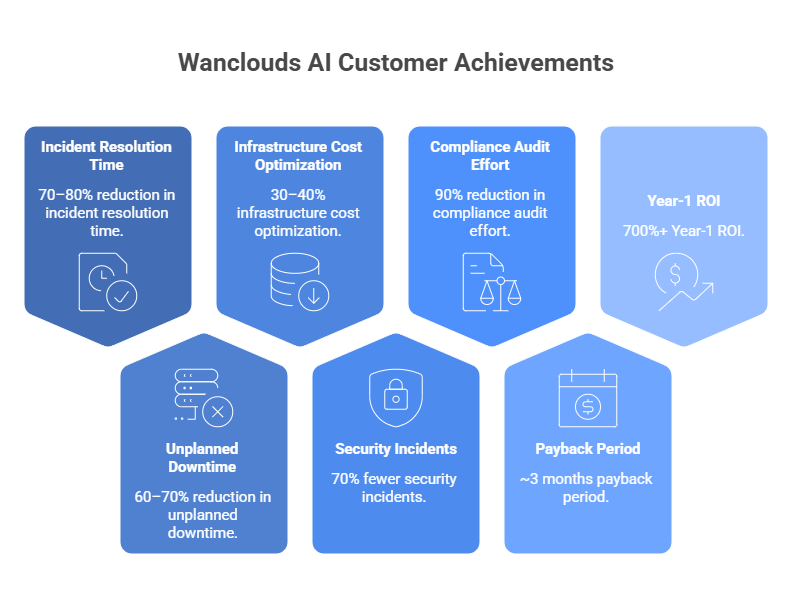
Typical Wanclouds AI customers achieve the following outcomes:
- 70–80% reduction in incident resolution time
- 30–40% infrastructure cost optimization
- 90% reduction in compliance audit effort
- ~3 months payback period
- 700%+ Year-1 ROI
Which Industries Need This Most?
Financial Services
At 3:45 AM on a Tuesday, a core banking API begins returning intermittent 503 errors. Without agentic AI, the on-call team spends 90 minutes correlating alerts before isolating a misconfigured load balancer rule pushed in an overnight deployment. With WANDA, the root cause surfaces within four minutes. MTTR drops from hours to minutes, and regulatory reporting requirements are automatically documented throughout.
- Mission-critical 24×7 monitoring and proactive threat detection
- Audit-ready compliance reporting for PCI DSS and SOC2
- Dramatically reduced response time for service-impacting incidents
Healthcare
A telemedicine platform serving 50,000 daily patients experiences application latency spikes during peak hours. Manual investigation across fragmented monitoring tools takes hours. WANDA identifies the pattern, a storage I/O bottleneck correlated with scheduled backup jobs, and recommends a scheduling adjustment, resolving the issue before patient impact reaches a critical threshold.
- Monitoring of medical systems and hospital networks
- Continuous HIPAA compliance posture assessment and documentation
- Performance optimization for telemedicine platforms
Energy, Utilities & Industrial
Distributed edge and OT environments demand early detection. WANDA monitors smart grid and IoT initiatives, flags performance and security issues before they escalate, and reduces operational risk across critical infrastructure where a delayed response can have consequences far beyond financial cost.
- Early anomaly detection across distributed edge environments
- OT/IT convergence monitoring
- Reduced operational risk in critical infrastructure
Government & Public Sector
Continuous compliance monitoring across FISMA, NIST, PCI, HIPAA, and NCA frameworks, with unified visibility across multi-vendor government infrastructure, reduced downtime for citizen-facing digital services, and faster incident response without expanding headcount.
Large Enterprises & Conglomerates
Fragmented monitoring tools, unpredictable capacity planning, and knowledge lost to staff turnover are among the most expensive operational challenges at scale. WANDA consolidates visibility, improves service reliability across every business unit, and preserves institutional knowledge, so the organization does not lose operational expertise every time a senior engineer leaves.
The Future of IT Operations Will Be AI-Assisted
The traditional operational model built around dashboards, static alerts, and manual investigation is reaching its limit. Modern infrastructure environments are too large, too distributed, and too dynamic for humans alone to manage efficiently at scale.
The next generation of IT operations will be defined by systems that understand operational context, learn continuously from incidents, correlate signals autonomously, reduce investigative effort, and accelerate remediation in real time.
Organizations adopting agentic AI today are not merely upgrading tools. They are redesigning how operations function entirely. And in an environment where every minute of downtime carries measurable financial consequences, the organizations that resolve incidents fastest will gain a decisive operational advantage.
Learn More: