
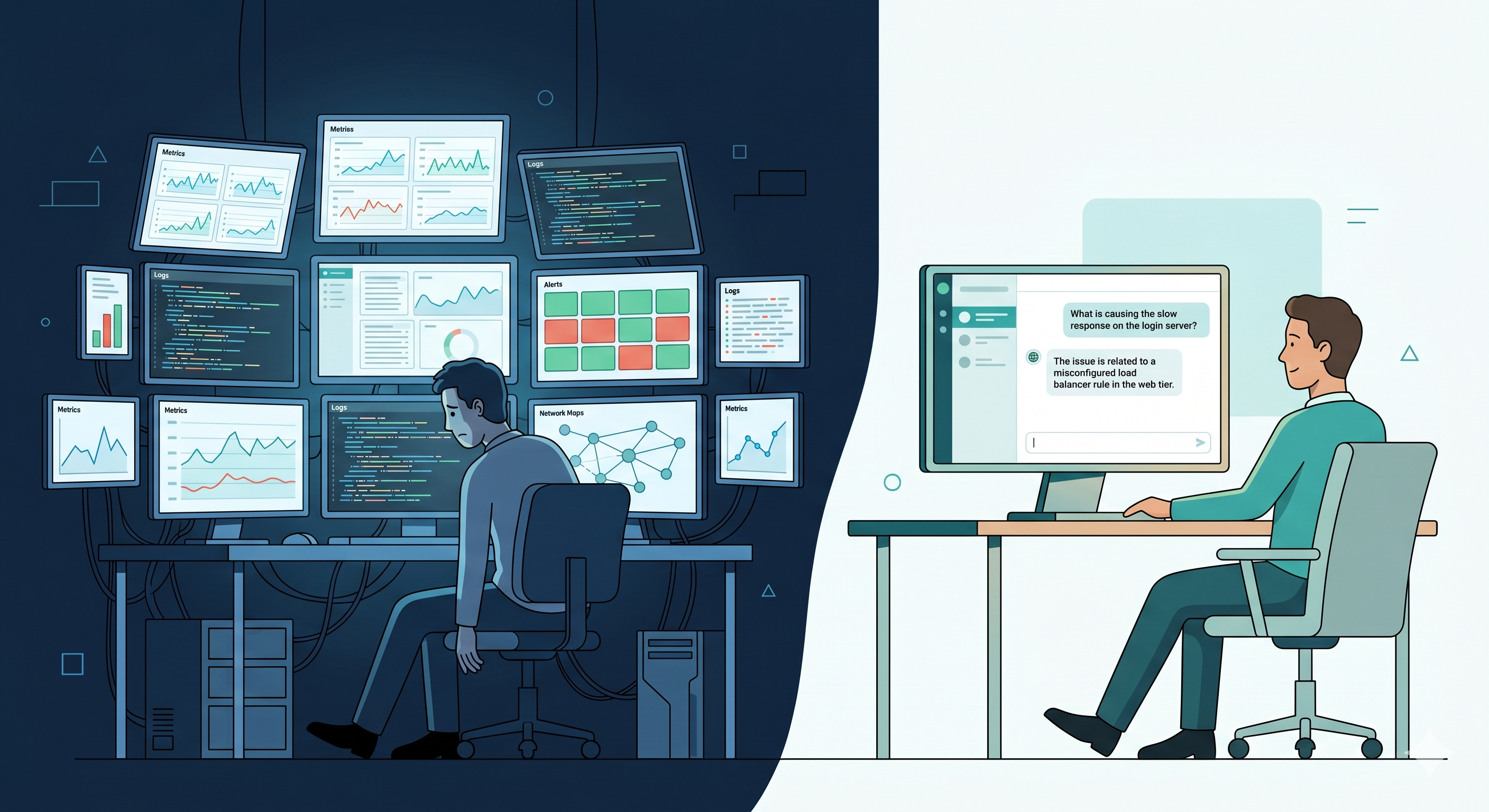
There is a paradox sitting at the heart of modern IT operations.
Enterprises today have more visibility into their infrastructure than at any point in history. Dashboards everywhere. Alerts are firing around the clock. Logging pipelines are ingesting millions of events per hour. Monitoring platforms watch every CPU tick, every network hop, every container restart.
And yet, when something breaks, the average incident still takes between 90 minutes and 4 hours to resolve.
More tools. More data. More alerts.
Same slow, painful, human-dependent triage process.
Something is fundamentally broken with how we think about IT operations. And the answer is not another dashboard.
The Monitoring Trap
Ask any senior SRE or IT operations lead how their incident response actually works, and you will hear a version of the same story.
An alert fires, usually at the worst possible time. Someone gets paged. They log into one tool to check metrics, a second to search logs, a third to pull up recent changes, and a fourth to cross-reference network events. Then they start a Slack thread to rope in the right people, because no single person holds the full picture.
Somewhere between tool three and tool five, a pattern starts to emerge. Eventually, maybe 45 minutes in, maybe two hours, someone puts it together. A misconfigured firewall rule. A memory leak was introduced in last Tuesday's deployment. A cascading failure triggered by a third-party API timeout.
The fix itself often takes minutes. The investigation took hours.
This is not a people problem. Your engineers are skilled. It is not a data problem. You have plenty of it. It is a correlation problem. Your tools were built to show you data from their own domain. None of them were built to think across all of them at once.
Why More Tools Do Not Equal Faster Resolution
The instinctive response to an ops problem is to buy another tool. Need better log search, add Splunk. Need infrastructure metrics, add Prometheus. Need network visibility, add another layer. We need compliance reporting; please add another platform.
Each tool does its job well in isolation. But isolation is exactly the problem.
When an incident spans compute, storage, network, and application layers simultaneously, which most serious incidents do, no single tool sees the whole picture. Your engineers become translators, manually carrying context from one system to another, trying to build a coherent narrative from five different data sources that were never designed to talk to each other.
The result is what researchers call alert fatigue compounded by context switching. Your team is not slow. They are being asked to do something no human should have to do at 2am: hold the entire state of a complex distributed system in their head while simultaneously operating five different tools with five different query languages.
That is not an engineering problem. That is an architecture problem.
What Agentic AI Changes
The shift that Wanclouds AI represents is not incremental. It is architectural.
Instead of adding another tool that shows you more data, Wanclouds AI sits across all of your existing data sources, your monitoring platforms, your logging systems, your ITSM tools, your cloud APIs, your on-prem devices, and builds a unified, continuously updated understanding of your entire environment.
When something goes wrong, you do not log into five tools. You ask a question.
"What caused the latency spike on our production cluster last night?"
Wanclouds AI pulls the relevant logs, correlates them with infrastructure metrics, checks recent configuration changes, maps the network path, and surfaces a root-cause analysis with a recommended remediation. In seconds. In plain language. No query language. No dashboard navigation. No Slack thread required.
This is what agentic AI means in practice. Not a smarter alert. Not a prettier dashboard. An intelligent system that reasons across your entire stack the way a senior engineer would, except it does it in seconds rather than hours, and it never sleeps.
The Numbers Behind the Shift
The business case for this kind of AI is not theoretical.
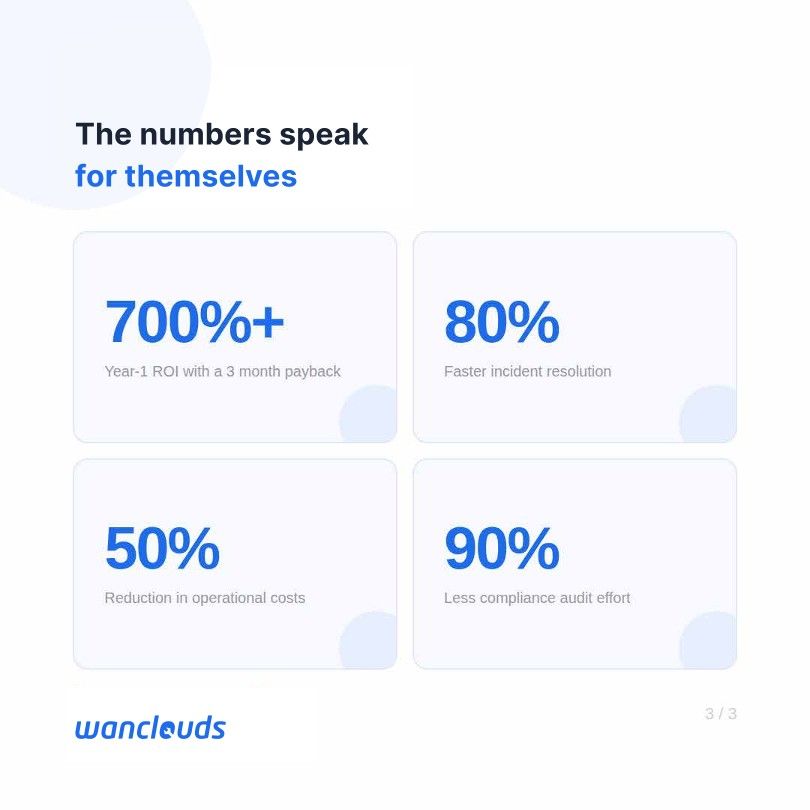
Organisations deploying Wanclouds AI are seeing a 70 to 80% reduction in incident resolution time. Not because their engineers got faster. Because the investigation work that used to take hours is now done automatically before a human even picks up the ticket.
Unplanned downtime drops by 60 to 70 percent. Not because fewer things break, but because problems are caught and resolved before they cascade into outages.
Infrastructure costs fall by 30 to 40%. Because the AI continuously surfaces idle resources, right-sizing opportunities, and wasteful configurations that no one had time to review manually.
Compliance audit effort drops by 90 percent. Because instead of spending weeks manually pulling evidence for a PCI or HIPAA audit, your team runs an assessment and gets a prioritised, audit-ready report in minutes.
The payback period is approximately three months. Year-one ROI consistently exceeds 700 percent.
These are not projections. They are outcomes from organisations that replaced the 12-tool juggling act with a single intelligent operations layer.
What This Looks Like in Practice
A financial services team running a hybrid environment, AWS for their customer-facing applications, on-prem VMware for core banking workloads, used to spend an average of two and a half hours per major incident. Their on-call rotation was burning out. Senior engineers were leaving.
After deploying Wanclouds AI, the same incidents now have a root cause identified within minutes. The engineers still make the call on remediation, human-in-the-loop control means nothing changes without explicit approval, but they are making that call with full context already assembled, rather than spending two hours assembling it themselves.
A government IT team managing multi-vendor infrastructure across 40 sites was spending four weeks preparing for their annual compliance audit. After deploying Wanclouds AI, the same audit preparation now takes two days. The AI continuously monitors against NIST, CIS, and their sector-specific compliance frameworks and generates evidence automatically.
Neither of these teams replaced their existing tools. Wanclouds AI connected to what they already had.
The Question Worth Asking
If your team is still managing incident response the same way it was managed five years ago, with humans manually correlating signals across disconnected tools, the question is not whether AI can help. The evidence on that is clear.
The question is how much longer the status quo is sustainable.
The tools problem is real. Alert fatigue is real. The talent shortage in IT operations is real. And the gap between the complexity of modern infrastructure and the ability of traditional monitoring platforms to make sense of it is growing every year.
Wanclouds AI was built for exactly this moment. Not to replace your engineers, but to give them back the hours they are currently losing to work that a machine can do better and faster.
Take Control of Your Cloud: Get Started with Wanclouds AI Today
Wanclouds AI is available on a freemium basis at wanclouds.ai. No credit card required. Connect your existing infrastructure and start asking questions.
For enterprise deployments, including fully private on-premise instances and sovereign cloud options, reach out to the team at [email protected] or book a personalised demo at wanclouds.net.