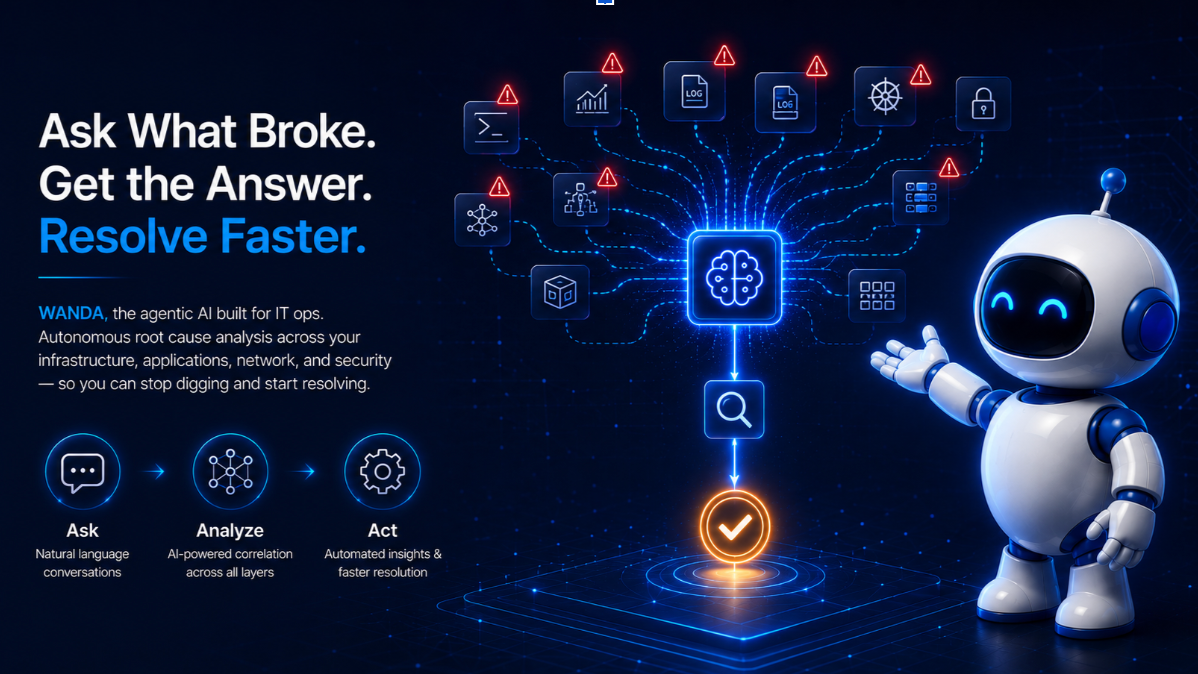
If you work in IT ops, you know the drill: something breaks at midnight, and the next two hours aren't spent fixing it; they're spent finding it. Logs here, metrics there, a Slack thread full of "did anyone change anything?", and five dashboards that all show a piece of the picture but none show the whole thing.
That's the exact problem WANDA, Wanclouds' agentic AI, was built to eliminate with Autonomous Root Cause Analysis.
What Makes This Different From "Just Another AIOps Tool"
Most AIOps tools got good at one thing: correlating logs and metrics faster than a human can. That's useful, but it's still just detection with better math.
WANDA goes a layer deeper. It doesn't just flag that something's wrong — it reasons across your entire environment: infrastructure, applications, network, and security, all in a single pass. Ask it a question in plain English, and you get a full, evidence-backed answer. No dashboards to build. No queries to write.
Literally ask things like:
- "What caused last night's outage of the SQL DB?"
- "What changed before performance degraded?"
- "Give me an executive summary of the last 24 hours."
And WANDA answers with the reasoning behind it, not just a red dot on a screen
How It Actually Works
1. Cross-Layer Correlation: WANDA doesn't look at logs in isolation. It correlates signals across infra, app, network, and security layers at the same time, so it sees the full chain of cause and effect, not one broken link.
2. Noise Reduction & Alert De-Duplication: By the time WANDA answers, it's already collapsed 40 related alerts into the one real incident they represent. No triaging a flood that's actually a single fire.
3. Automatic Incident Context: What changed, when, and what else it affected, all built automatically. No manual digging across five tools to reconstruct the story.
4. MTTR Reduction Without Manual Triage: Because correlation, noise reduction, and context are already done before you even ask, resolution starts at "here's the answer" — not "let me start investigating."
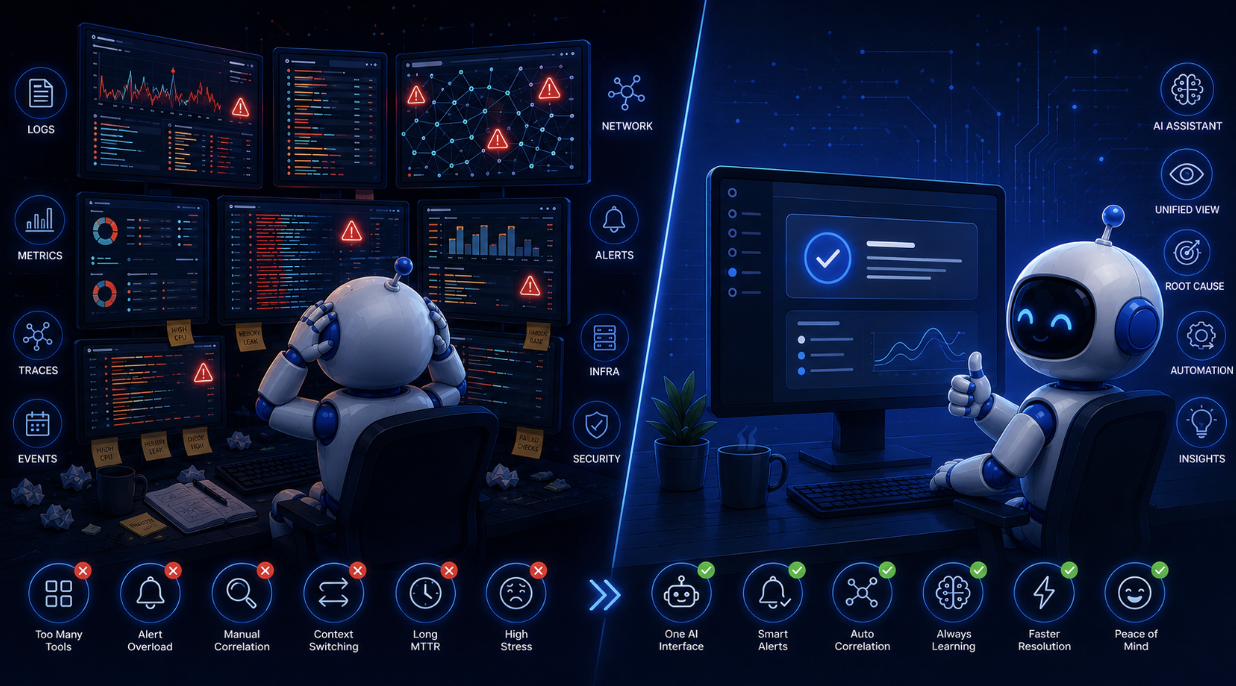
Built for What You Actually Run. Not a Clean Lab Environment
This isn't RCA for a single, tidy stack. WANDA performs autonomous root cause analysis across:
- Compute— Linux, Windows, NVIDIA GPU servers
- Virtualization— VMware
- Containers— Kubernetes, Red Hat OpenShift
- Network— firewalls, routers, switches, load balancers, wireless access points
- Databases & workloads
- Monitoring/logging— Prometheus, Zabbix, SolarWinds, Splunk, Loki, LogDNA, AWS CloudWatch, and more via MCP
- ITSM/ticketing— ServiceNow, Jira
No agents required where possible. No vendor lock-in.
From Explaining the Incident to Resolving It
Here's the real differentiator: legacy monitoring tells you something's wrong. Smarter AIOps tools correlate the data for you. WANDA goes one step further because it reasons autonomously across your full environment; it doesn't just explain the incident; it can recommend the fix and, with your confirmation, take action.
That's the line between automated root cause analysis and autonomous troubleshooting. One explains. The other helps you resolve.
The Numbers
Typical Wanclouds AI customers see:
- 70–80%reduction in incident resolution time (MTTR)
- 60–70%reduction in unplanned downtime
- 70%fewer security incidents
That's not "AI-powered" as a buzzword; that's hours of 2 a.m. investigation collapsed into seconds of getting a straight answer.
See It in Action
We regularly walk through WANDA's root cause analysis live, showing how it traces an incident across layers, cuts through alert noise, and gets to "here's what broke and why" in real time. If you want to see it work on a real scenario rather than take our word for it, book a personalized demo.
You can also grab the full breakdown of WANDA's capabilities in the solution brief.
Curious how this would perform against your own stack? Drop a comment or reach out; happy to walk through a scenario from your environment.
