
In 2026, geopolitical disruption is no longer a distant risk; it is a daily operational reality for enterprises across the globe.
From regional conflicts in the GCC to regulatory shifts in Europe and infrastructure instability in emerging markets, businesses are facing increasing pressure to protect their data, applications, and operations. The challenge is no longer just about competition or innovation. It is about survival in an unpredictable global environment.
Organizations that rely on traditional disaster recovery approaches are finding themselves exposed to downtime, compliance risks, and financial losses. As a result, enterprises are now turning to AI-powered Disaster Recovery as a Service (DRaaS) to build resilient, future-ready infrastructure.
What Is the Biggest Data Risk from Geopolitical Disruption in 2026?
The biggest risk is regional dependency combined with slow and outdated disaster recovery systems.
When workloads and data are tied to a single geographic location, any disruption, whether due to conflict, sanctions, or outages, can bring operations to a halt.
Common risks enterprises face:
- Regional cloud outages are affecting entire zones
- Data loss due to untested or outdated backups
- Regulatory restrictions on cross-border data movement
- Increased cyberattacks during geopolitical instability
- Lack of visibility across multi-cloud environments
Key takeaway: If your infrastructure depends on one region, your business is at risk. For more, read our latest blog.
Why Traditional Disaster Recovery Fails in Modern Geopolitical Crises
Traditional disaster recovery models were designed for isolated failures—not global or regional disruptions.
They typically involve:
- Manual intervention
- Static backup schedules
- Limited cross-region capabilities
- Slow recovery timelines (hours or days)
In today’s environment, this approach is no longer sufficient.
Why it fails:
- Disruptions escalate faster than recovery processes
- Multi-cloud environments create operational complexity
- Human-driven response introduces delays and errors
- Lack of real-time intelligence prevents proactive action
This is why enterprises are shifting toward AI-driven resilience models.
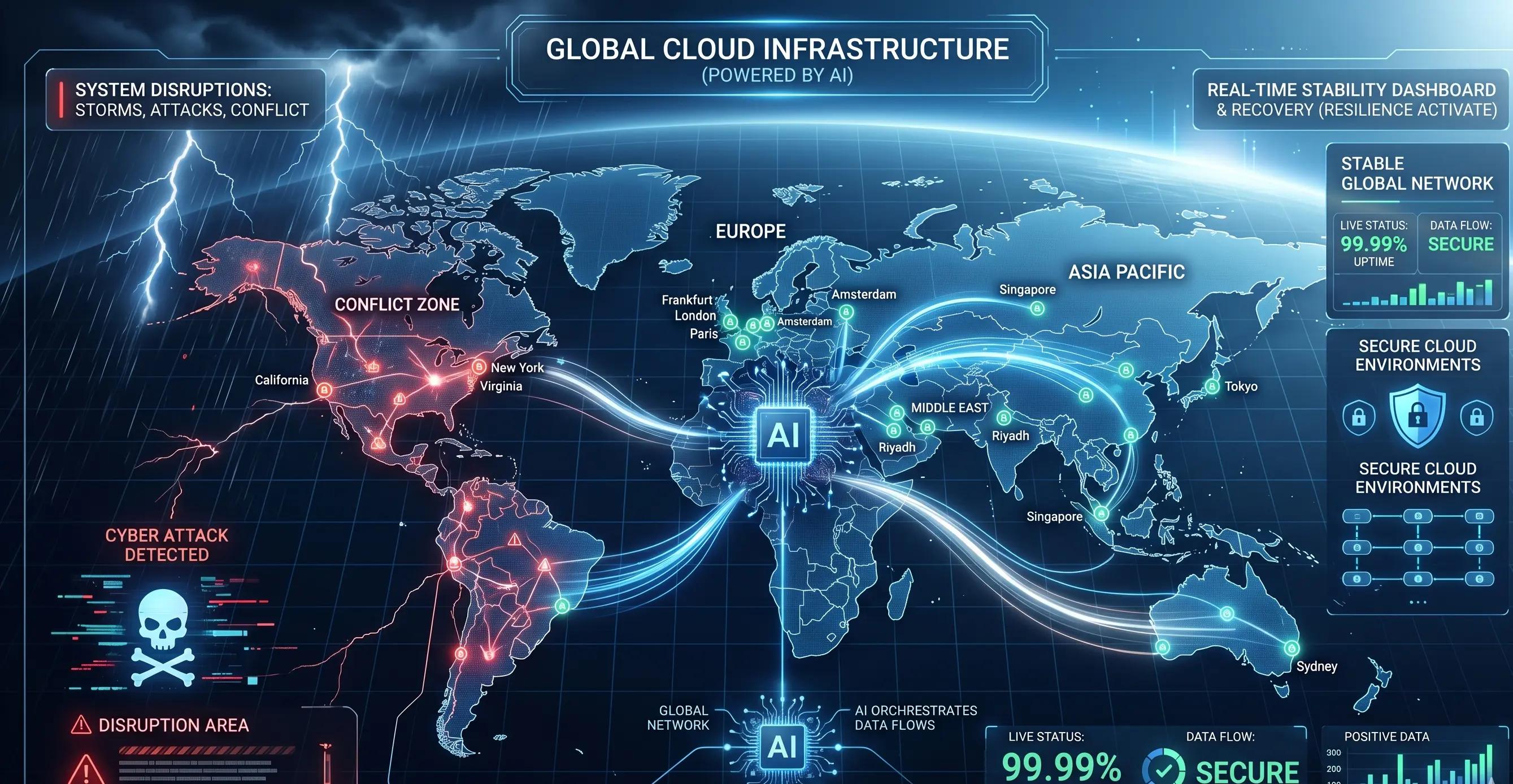
What Is AI-Powered Disaster Recovery (DRaaS)?
AI-powered DRaaS combines disaster recovery infrastructure with intelligent automation, real-time monitoring, and predictive analytics.
Instead of reacting to failures, AI systems:
- Continuously monitor infrastructure health
- Detect anomalies before they become critical
- Automate failover across regions and cloud providers
- Optimize recovery processes in real time
This transforms disaster recovery from a reactive process into a proactive resilience strategy.
How Wanclouds AI Helps Enterprises Stay Resilient
Wanclouds delivers a fully managed AI-powered Backup and Disaster Recovery as a Service (DRaaS) solution designed specifically for modern, geopolitically complex environments.
It enables enterprises to protect, migrate, and recover workloads across secure cloud regions in Europe, the United States, and Asia Pacific, ensuring business continuity even during regional disruptions.
1. Real-Time Monitoring and AI-Driven Root Cause Analysis
Wanclouds AI continuously monitors infrastructure across hybrid and multi-cloud environments.
What it does:
- Detects anomalies instantly
- Performs root cause analysis (RCA) in seconds
- Identifies performance and availability risks
Why it matters:
During geopolitical disruptions, delays in identifying issues can lead to prolonged downtime. AI eliminates this delay by providing instant insights and actionable intelligence.
2. Automated Cross-Region Failover for Global Resilience
One of the biggest risks in 2026 is geographic dependency.
Wanclouds solves this by enabling:
- Cross-region disaster recovery across the EU, the US, and APAC
- Automated failover and failback
- Workload mobility across AWS, Azure, GCP, and IBM Cloud
For enterprises in the GCC and high-risk regions, this means:
- Data and applications can be isolated outside conflict zones
- Operations continue even if a local region goes down
3. Near-Zero Downtime with AI-Optimized Recovery
Modern businesses cannot afford long recovery times.
Wanclouds delivers:
- Near-zero Recovery Point Objective (RPO)
- Near-zero Recovery Time Objective (RTO)
Result:
- Minimal data loss
- Recovery in minutes instead of hours or days
- Continuous availability of mission-critical applications
AI ensures that recovery workflows are optimized and executed instantly, without manual intervention.
4. Unified Multi-Cloud Management with Intelligent Insights
Managing multiple cloud environments can increase complexity and risk.
Wanclouds simplifies this with:
- A unified platform for AWS, Azure, GCP, and IBM Cloud
- Centralized visibility across hybrid environments
- AI-driven recommendations and optimization
Benefit:
Enterprises gain full control over their infrastructure while reducing operational overhead and risk exposure.
5. Built-In Security, Compliance, and Data Sovereignty
Geopolitical disruption often comes with regulatory challenges.
Wanclouds ensures:
- Encrypted backups and secure data transfer
- Compliance with GDPR, SOC 2, and enterprise standards
- Geographic isolation of sensitive data
For regions like Europe and the GCC, where data sovereignty laws are strict, Wanclouds enables organizations to:
- Store and recover data in compliant regions
- Avoid legal and financial penalties
6. Continuous Testing and AI-Driven Optimization
One of the most overlooked aspects of disaster recovery is testing.
Wanclouds includes:
- Automated disaster recovery drills
- Continuous validation of recovery readiness
- AI-driven optimization of DR configurations
Outcome:
Your recovery plan is always tested, validated, and ready, eliminating uncertainty during real-world disruptions.
Key Benefits of Wanclouds AI-Powered DRaaS
- Ensure business continuity during regional outages and conflicts
- Reduce risk exposure through geographic isolation
- Recover workloads in minutes with automated failover
- Lower infrastructure costs by eliminating secondary data centers
- Simplify operations with a fully managed service
- Future-proof infrastructure with cloud-native and AI-driven capabilities
How to Build a Geopolitically Resilient Data Strategy
To stay resilient in 2026, enterprises should:
- Adopt cross-region disaster recovery
- Use AI-driven monitoring and automation
- Implement multi-cloud and hybrid strategies
- Ensure compliance with global data regulations
- Continuously test and validate recovery plans
Wanclouds enables all of these within a single, unified platform.
The Future of Disaster Recovery: Intelligent, Automated, Global
Geopolitical risks will continue to evolve. The question is not whether disruptions will happen, but when and where.
Organizations that rely on manual, outdated systems will struggle to keep up.
Those who adopt AI-powered disaster recovery will gain:
- Faster response times
- Greater operational resilience
- Competitive advantage in uncertain markets
From Risk to Resilience with Wanclouds AI
In a world defined by uncertainty, resilience must be intelligent.
Wanclouds AI transforms disaster recovery from a reactive necessity into a proactive, automated, and strategic capability.
By combining:
- AI-driven operations
- Multi-cloud flexibility
- Cross-region resilience
- Fully managed DRaaS
Wanclouds enables enterprises to stay secure, compliant, and operational, no matter the geopolitical landscape.
Take the Next Step
Geopolitical disruption is unpredictable, but your recovery strategy doesn’t have to be.
Stop reacting to disruptions. Start staying ahead of them. Explore how Wanclouds AI can help you build a resilient, future-ready disaster recovery strategy today.