
A Turning Point for Healthcare IT
Healthcare organizations around the world are at a crossroads. For years, on-premise data centers were seen as the safest place to host electronic health records (EHRs), imaging data, and patient portals. But by 2026, the equation has changed.
Driven by rising operational costs, AI-powered analytics, and stricter compliance requirements, many hospitals are evaluating Cloud Migration in healthcare not as a future plan, but as a current necessity.
According to industry forecasts, over 68% of healthcare providers will have moved at least part of their workloads to the cloud by 2026. The question is no longer if but how fast healthcare systems can modernize safely.
1. Understanding the Difference: On-Prem vs Cloud in Healthcare
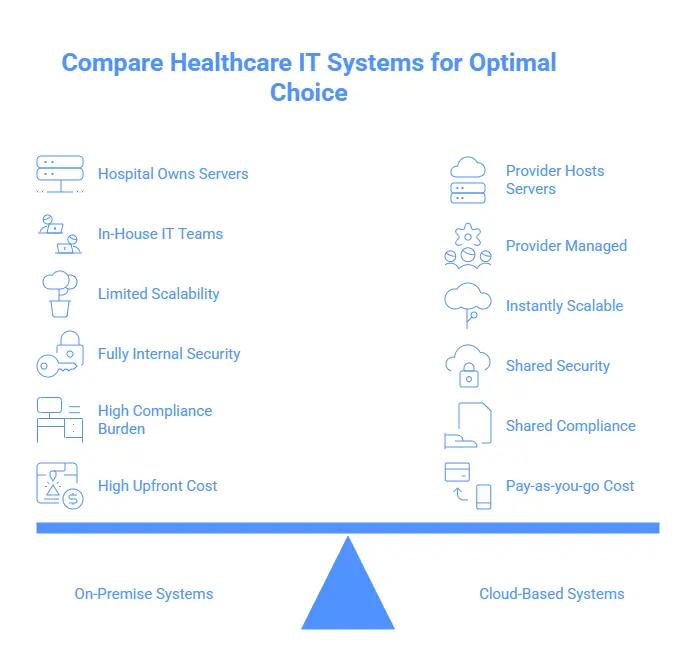
| Aspect | On-Premise Systems | Cloud-Based Systems |
|---|---|---|
| Infrastructure Ownership | Hospital owns and manages servers | Hosted by cloud providers (AWS, Azure, GCP) |
| Maintenance | Requires in-house IT teams | Managed by provider |
| Scalability | Limited by physical capacity | Instantly scalable |
| Security Management | Fully internal | Shared responsibility model |
| Compliance Burden | High – organization must prove compliance | Shared with provider’s certified infrastructure |
| Cost Model | High upfront CapEx | Pay-as-you-go OpEx |
Historically, on-prem systems offered control and familiarity. But as healthcare data volumes explode, driven by telehealth, IoT devices, and AI diagnostics, cloud platforms are emerging as the faster, more resilient choice.
2. Why Cloud Migration in Healthcare Is Accelerating
a. Scalability for Data-Intensive Workloads
Hospitals generate petabytes of data annually, from EHRs and imaging (PACS/DICOM) to wearable devices. Storing and analyzing this data on-prem is increasingly impractical. Cloud environments provide elastic storage and compute power that expand on demand, enabling large-scale analytics and AI research without costly hardware refreshes.
b. Enhanced Collaboration and Remote Access
The pandemic highlighted the need for secure remote access. Cloud-hosted health applications allow clinicians, researchers, and partners to collaborate seamlessly across locations while maintaining HIPAA-level security.
c. Cost Efficiency and Predictable Spending
Cloud models convert capital expenses (hardware, power, cooling) into predictable operational costs. With pay-as-you-go pricing, healthcare organizations pay only for what they use, critical for budget-conscious hospitals and regional networks.
d. Foundation for AI and Advanced Analytics
AI-driven insights, like predictive patient outcomes or diagnostic imaging analysis, require powerful cloud infrastructure. Migrating to the cloud opens the door to machine learning frameworks and data lakes that accelerate innovation.
3. Addressing Security and Compliance Concerns
For many hospital leaders, security and compliance remain the biggest barriers to adoption. The good news: major cloud providers and migration partners like Wanclouds have built solutions specifically designed to meet and exceed healthcare compliance requirements.
HIPAA and PHI Protection
- Cloud providers such as AWS, Azure, and GCP maintain HIPAA-eligible services and sign Business Associate Agreements (BAAs).
- Encrypted data transmission and role-based access controls protect PHI at rest and in transit.
- Detailed logging and auditing simplify compliance validation during assessments.
Shared Responsibility Model
Security in the cloud is a shared model:
- The provider secures the physical infrastructure and native cloud services.
- The healthcare organization secures applications, data, and access controls. This division allows hospitals to focus on patient-facing innovation rather than hardware upkeep.
Disaster Recovery and Data Resilience
Cloud environments offer multi-region redundancy, enabling near-zero downtime and rapid recovery in case of system failure, critical for emergency departments and life-support systems. Solutions like Wanclouds Cloud Migration as a Service (MaaS) include automated disaster-recovery planning and failover options built into the migration workflow.
4. EHR Cloud Migration: Lessons from the Field
Migrating Electronic Health Records (EHR) remains one of the most complex yet rewarding steps in digital transformation.
Hospitals often face challenges such as:
- Maintaining data integrity and patient history accuracy
- Avoiding downtime during migration
- Integrating legacy applications and imaging archives
- Meeting data sovereignty requirements across regions
Best Practices for EHR Cloud Migration
- Assessment and Discovery – Map existing systems, dependencies, and compliance gaps.
- Phased Migration – Move non-critical workloads first to validate processes.
- Automated Backups and Failover Testing – Ensure recoverability before cutover.
- Validation and Compliance Audit – Verify encryption, access, and PHI handling before go-live.
Wanclouds’ Migration-as-a-Service approach helps automate this process using policy-based orchestration, reducing manual risk and ensuring compliance from day one.
5. Performance and Downtime: The Real-World Comparison
On-Prem Limitations
- Scheduled maintenance windows often disrupt clinical access.
- Hardware aging leads to slow performance and higher downtime risk.
- Scaling requires weeks or months of procurement and setup.
Cloud Advantages
- 99.99% uptime SLAs across multi-zone deployments.
- Auto-scaling for traffic spikes (e.g., during flu season or pandemic surges).
- Zero-downtime migration tools from partners like Wanclouds minimize disruption to clinicians and patients.
In practice, hospitals that migrated their EHRs and analytics workloads report 40–60% fewer service interruptions post-migration.
6. Financial Impact: From CapEx to OpEx
One of the most attractive aspects of healthcare data cloud migration is the shift in financial models:
- On-prem requires heavy upfront hardware and software investments.
- Cloud offers operational flexibility, allowing smaller hospitals to scale digital infrastructure without incurring capital costs.
According to a 2024 HIMSS survey, 57% of healthcare IT leaders said cloud migration reduced infrastructure costs by over 25% while increasing system reliability.
Additionally, integrating FinOps (Financial Operations) principles, such as cost tagging, usage visibility, and continuous optimization, can further stretch tight healthcare budgets.
7. Common Myths About Cloud Migration for Hospitals
| Myth | Reality |
|---|---|
| Cloud isn’t secure enough for healthcare | Cloud infrastructure meets or exceeds HIPAA and ISO 27001 certifications |
| Migration causes long downtime | With proper planning, live migration minimizes downtime |
| Compliance is harder in the cloud | Automated auditing tools simplify HIPAA and GDPR reporting |
| Cloud is more expensive long-term | Pay-as-you-use models often reduce TCO over 3–5 years |
8. Preparing for Healthcare Cloud Migration in 2026
To stay ahead, healthcare leaders should prioritize:
- Vendor Neutrality – Choose multi-cloud strategies to avoid lock-in.
- Governance Automation – Implement policy-as-code frameworks for ongoing compliance.
- Zero-Trust Security Models – Protect against insider threats and ransomware.
- Data Interoperability – Design for open APIs and FHIR standards to enable seamless data sharing.
- Sustainability and Green Cloud – Reduce energy use by leveraging efficient cloud data centers.
9. How Wanclouds Supports Healthcare Cloud Migration
Wanclouds specializes in On-prem to Cloud Migration, offering an end-to-end migration framework tailored for regulated industries such as healthcare.
Their platform automates:
- Discovery and dependency mapping across hybrid environments
- Compliance checks for HIPAA, HITRUST, and ISO frameworks
- Disaster recovery and backup orchestration
- Zero-downtime migration with rollback safety
By combining automation, governance, and visibility, Wanclouds helps hospitals modernize faster, without compromising compliance or patient care continuity.
Conclusion: Modernization Without Compromise
As 2026 approaches, the debate over on-prem vs cloud in healthcare is no longer about whether the cloud is ready; it’s about whether organizations can afford to stay behind.
Cloud-based infrastructure offers speed, safety, and scalability that legacy systems simply can’t match. When paired with the right migration partner, the transition becomes not a risk, but an opportunity to enhance patient outcomes and operational resilience.
If your organization is planning its next phase of healthcare cloud adoption, consider partnering with experts who understand the balance between innovation and compliance. Wanclouds’ Cloud Migration as a Service helps hospitals, clinics, and health networks modernize confidently, with automation, governance, and zero-downtime assurance.
Visit wanclouds.net to learn how to accelerate your secure healthcare cloud transformation.