The Problem: Visibility Gaps in a High-Stakes Environment
Saudi Arabia's energy sector sits at the center of the Kingdom's economic identity, and increasingly, at the center of its digital transformation. Oil and gas operations, power generation, water utilities, and the emerging smart grid infrastructure supporting NEOM and other giga-projects now run on a mix of legacy operational technology (OT) and modern IT systems, often layered on top of decades-old industrial equipment never designed to be monitored digitally.
This IT/OT convergence creates a structural blind spot. Operations teams have deep expertise in the physical systems, turbines, pipelines, substations, SCADA networks, but limited visibility into how those systems' digital layers behave. IT teams, meanwhile, understand servers, networks, and security, but rarely have context on the operational processes those systems support. When something goes wrong at the intersection of the two, neither team has the full picture, and diagnosis stalls while the two sides try to compare notes manually.
The cost of that stall is real money. Splunk's 2026 "Hidden Costs of Downtime" report, produced with Oxford Economics, found that energy and utilities companies face average annual downtime costs of $364 million, the second-highest figure of any sector measured, trailing only technology and information services. Separately, Siemens' industry research puts unplanned operational downtime at roughly 11% of total revenue across the world's largest industrial companies, with energy and oil & gas among the hardest-hit sectors given the sheer scale of continuous, high-value operations involved.
For Saudi energy companies, three factors make this problem sharper than the global average:
- Distributed, remote infrastructure. Pipelines, substations, and edge devices are spread across vast geography, often far from centralized monitoring teams.
- Fragmented tooling. Legacy SCADA and industrial monitoring systems rarely integrate cleanly with modern IT observability platforms, leaving gaps between OT alerts and IT context.
- Regulatory and safety stakes. An undetected anomaly in critical energy infrastructure isn't just a financial risk, it's a safety and national-infrastructure risk, subject to frameworks like NCA ECC in addition to standard operational SLAs.
Source: Splunk & Oxford Economics — The Hidden Costs of Downtime 2026
The Solution: A Unified, AI-Driven Monitoring Layer
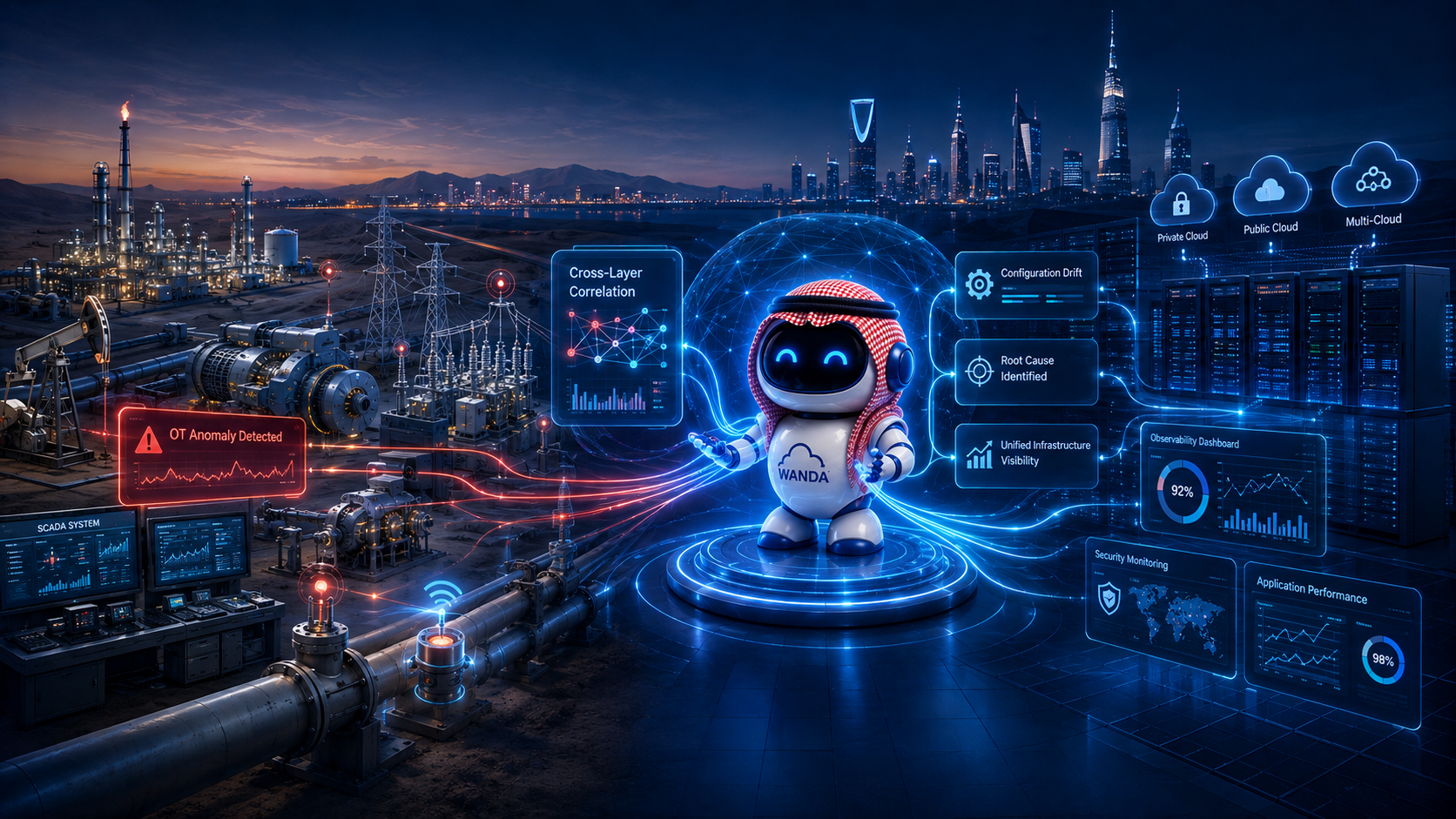
Closing this gap doesn't mean ripping out existing SCADA, monitoring, and logging systems — it means adding an intelligence layer that sits across all of them and correlates what each one sees. Agentic AI platforms are built to connect directly to infrastructure devices as well as existing monitoring and logging solutions, without requiring agents installed on every endpoint where that's not feasible, a critical requirement for legacy OT equipment that often can't support modern software agents at all.
Once connected, the platform enables plain-language interaction with infrastructure that previously required specialized tribal knowledge to interpret:
- "What caused the pressure anomaly on Line 4 last night?"
- "Which substations currently show configuration drift from baseline?"
- "Give me a security and operational posture summary for the last 24 hours."
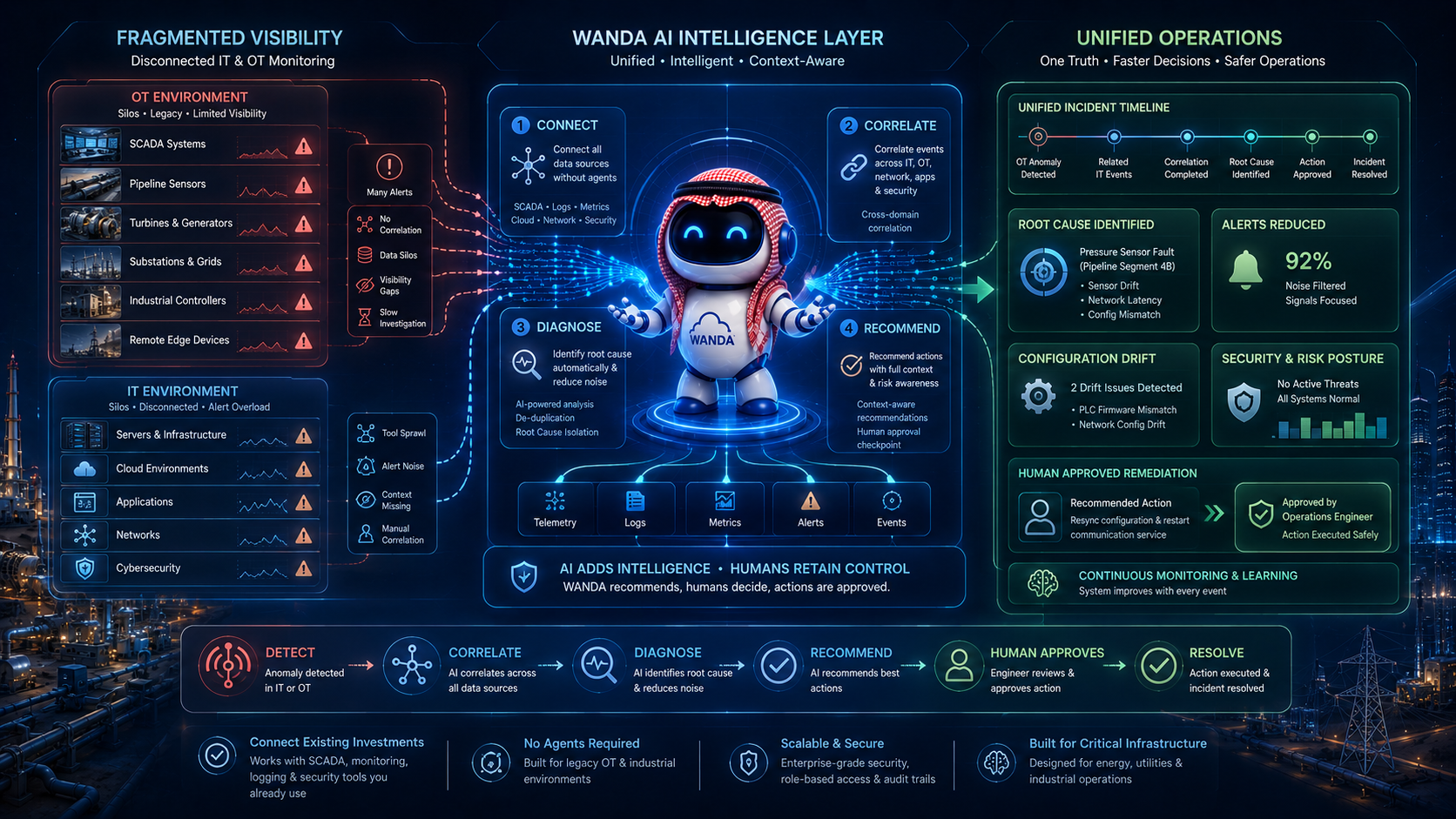
Underneath these questions, the platform performs cross-layer correlation, tracing an event from infrastructure to application to network to security, so that an anomaly detected at the OT layer is automatically connected to any related IT-side signal, instead of requiring two separate teams to independently notice a pattern. Alert de-duplication filters the noise that typically buries real signals in distributed environments with thousands of sensors and endpoints reporting simultaneously.
Critically, this doesn't mean full autonomy over physical systems. Any state-changing action, adjusting a configuration, restarting a service, applying a fix still requires explicit human confirmation. The AI accelerates detection and diagnosis; engineers retain control over execution, which matters enormously in environments where an incorrect automated action could have physical, not just digital, consequences.
The Results: What Changes Operationally
When IT and OT monitoring are unified under a single intelligence layer, three things change measurably:
Faster root-cause identification. Instead of operations and IT teams independently investigating the same incident from different angles, cross-domain correlation delivers a unified incident picture within seconds, cutting the diagnostic phase that typically consumes the majority of resolution time.
Continuous compliance posture, not periodic audits. Drift detection and configuration tracking run continuously against frameworks relevant to critical infrastructure, generating audit-ready evidence automatically rather than requiring a scramble before each review cycle, directly reducing the operational burden tied to regulatory reporting.
Proactive detection before failure, not after. AI-driven optimization surfaces capacity and utilization insights and flags early indicators of performance degradation, shifting maintenance and intervention from reactive ("fix it after it breaks") to predictive, the same principle already proven in early detection of performance and security issues across distributed edge and OT environments.
Taken together, these shifts are how organizations move from downtime being a $364-million-a-year line item toward it becoming a manageable, shrinking one, without requiring teams to abandon the specialized SCADA and monitoring investments already in place.
Getting Started
For Saudi energy and utilities organizations evaluating this approach, the practical starting point isn't a full IT/OT overhaul; it's connecting an intelligence layer to existing systems and letting cross-domain correlation start surfacing patterns that neither IT nor operations teams could see independently. The infrastructure investment already made in SCADA, monitoring, and logging tools stays in place; what changes is whether those tools finally talk to each other.
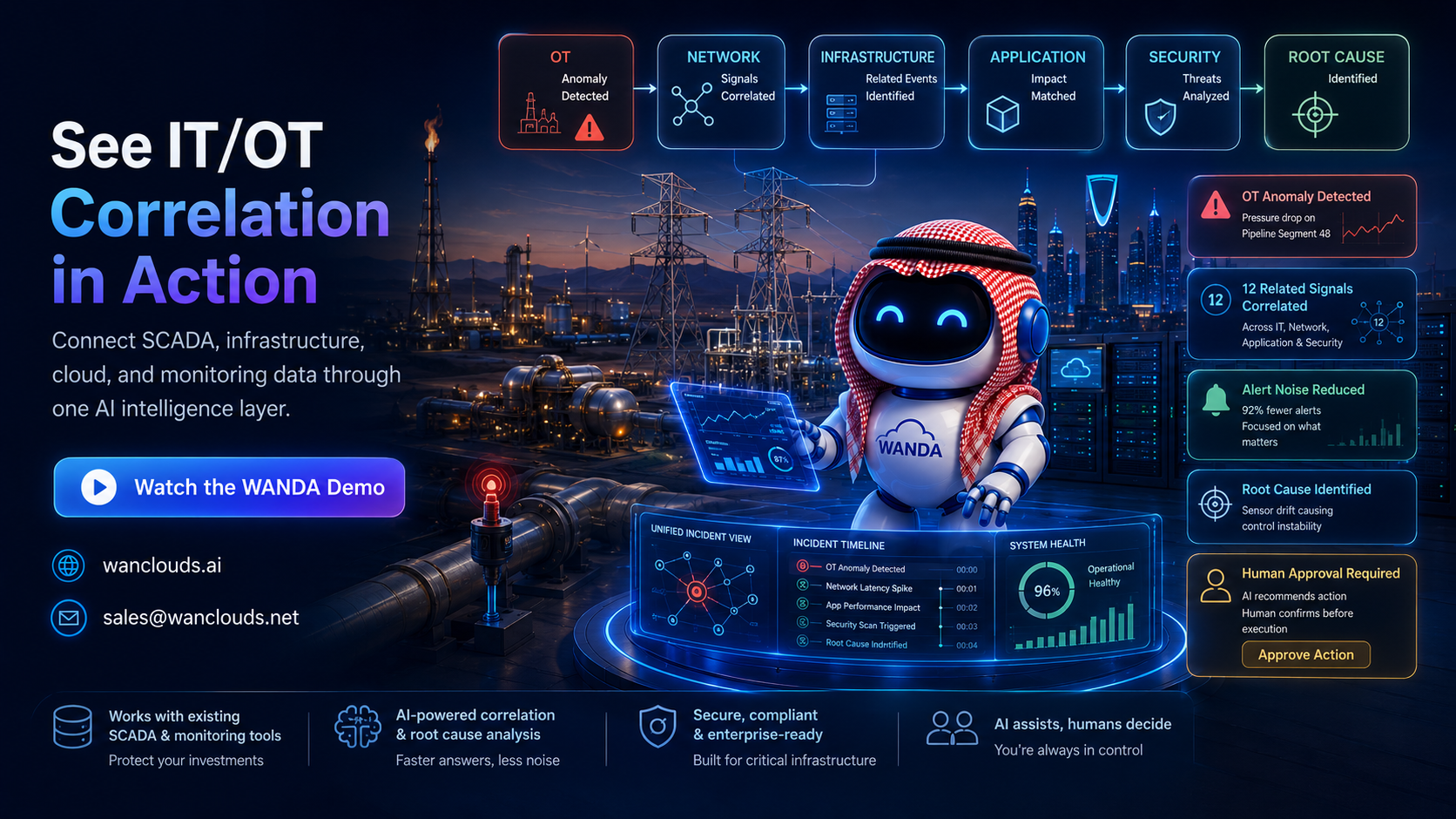
See IT/OT Correlation in Action
Distributed infrastructure, legacy SCADA, and modern IT systems rarely speak the same language until they're connected through one intelligence layer. Watch our demo to see WANDA correlate an incident across OT and IT environments in real time.
Want to see how this applies to your specific infrastructure? Request a personalized WANDA demo →