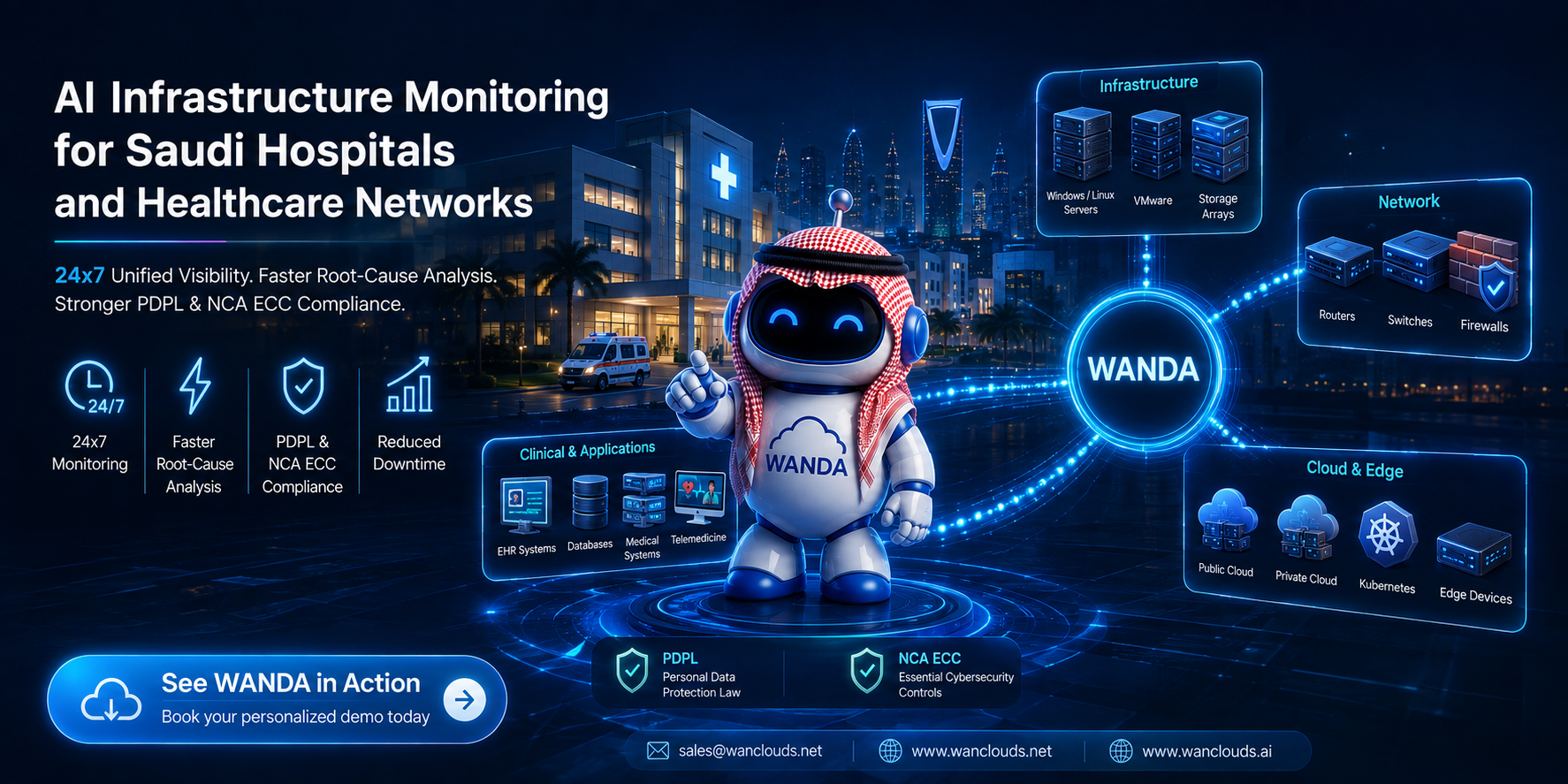
AI infrastructure monitoring gives Saudi hospitals and healthcare networks 24x7, cross-vendor visibility into the servers, networks, medical systems, and cloud platforms that clinical operations depend on, using natural-language queries instead of dashboards, with autonomous root-cause analysis that cuts incident resolution time by 70–80% and protects patient data in line with PDPL and MOH requirements.
Why Healthcare Infrastructure Monitoring Is Different in Saudi Arabia
Hospitals and healthcare networks in the Kingdom run some of the least forgiving IT environments in any industry. A short outage isn't just downtime; it can delay a diagnosis, disrupt a surgical schedule, or take an electronic health record system offline mid-shift. At the same time, Saudi healthcare organizations are operating under real pressure:
- Vision 2030's digital health push from Seha Virtual Hospital to nationwide EHR rollouts, is expanding the attack surface and the number of connected systems
- Personal Data Protection Law (PDPL) requirements around patient data residency and handling
- NCA Essential Cybersecurity Controls (ECC) and sector guidance from the Ministry of Health
- Legacy medical devices and systems that can't run traditional monitoring agents, sitting alongside modern cloud and telemedicine platforms
- 24x7 uptime expectations with lean IT and security teams who can't watch a dashboard around the clock
Most hospital IT teams are stitching together separate tools for servers, networking, security, and applications, and manually correlating alerts across all of them during an incident, at the exact moment speed matters most.
Key Takeaways
- Healthcare infrastructure incidents carry clinical risk, not just operational cost, MTTR reduction has a direct patient-safety dimension.
- Legacy monitoring tools generate alert floods; they don't tell you why a system degraded or what changed.
- Protecting patient data requires infrastructure-level visibility, not just application-layer security controls.
- AI-driven, agentless (where possible) monitoring lets hospitals cover modern cloud systems and legacy on-premise medical infrastructure with one unified layer.
What AI Infrastructure Monitoring Should Do for a Hospital Network
1. Correlate Across Infra, Application, Network, and Security, Automatically
When a hospital information system slows down, the root cause could be a database, a switch, a storage array, or a misconfigured firewall rule. Cross-layer correlation, infra → app → network → security. turns a multi-team war room into a direct answer: "What changed before performance degraded?"
2. Cut Through Alert Floods with Noise Reduction and De-Duplication
A single failing component can generate dozens of duplicate alerts across different monitoring tools. Noise reduction and automatic incident-context building mean on-call staff see one clear incident, not twenty fragmented tickets.
3. Monitor Legacy Medical Systems Without Requiring New Agents
Many clinical and hospital-network devices can't accept new monitoring agents, either for compatibility or regulatory reasons. Agentless monitoring (where possible) means legacy servers, networking gear, and medical infrastructure can be brought into a unified view without touching the device itself.
4. Protect Sensitive Patient Data at the Infrastructure Layer
Security posture assessment, drift detection, and compliance mapping against PDPL, NCA ECC, and international baselines like ISO 27001 and SOC 2 catch the configuration issues, exposed ports, and overly permissive access rules that put patient data at risk before they become a breach.
5. Support Telemedicine and Digital Health Platforms at Scale
As virtual care and remote monitoring platforms expand, so does the infrastructure footprint spanning on-premise data centers, edge devices, and public or private cloud. A unified monitoring layer needs to follow that footprint without adding a new dashboard for every new platform.
How Agentic AI Executes This in Practice
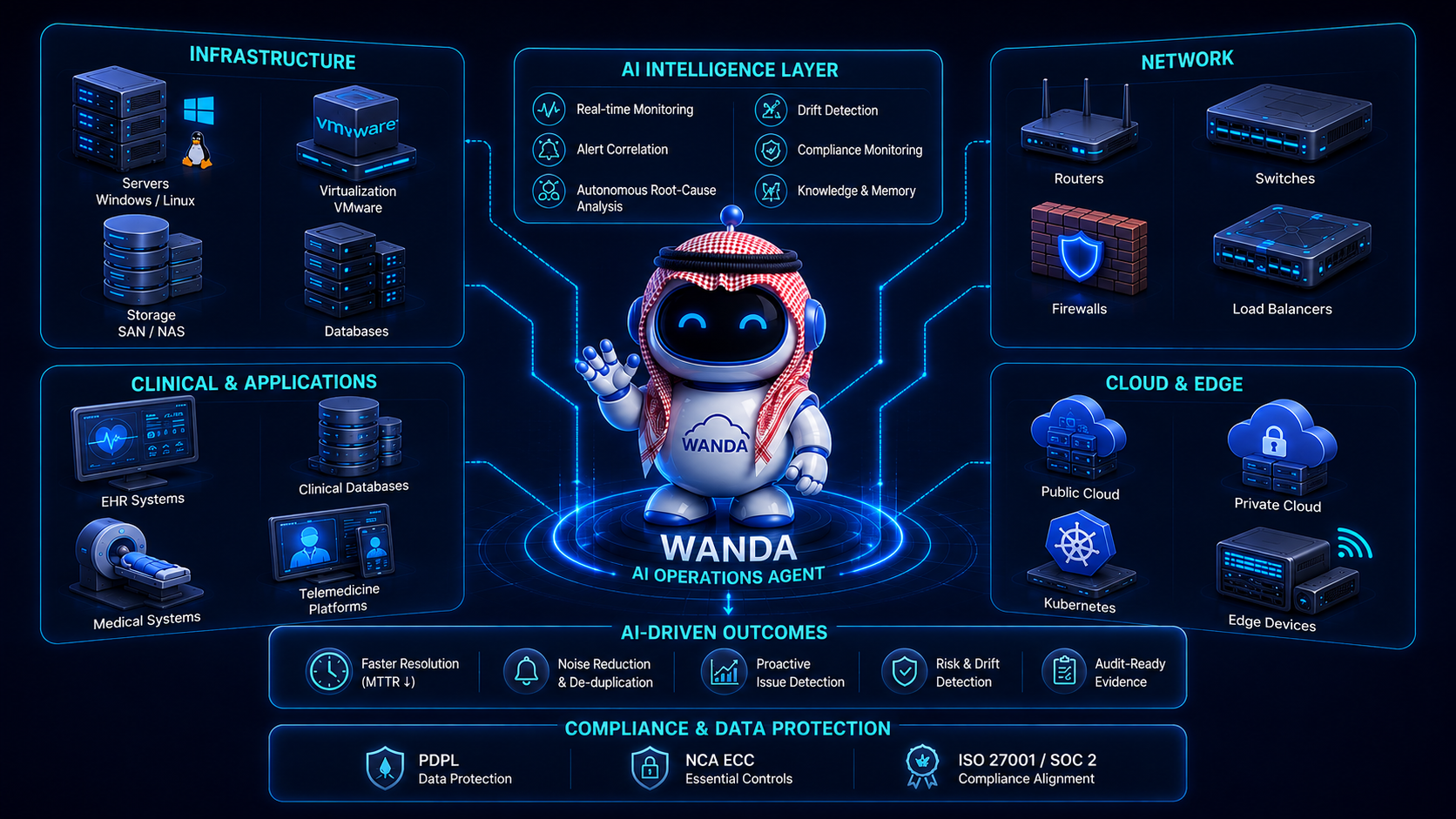
This is the exact problem Wanclouds AI (WANDA), an agentic AI platform for multi-vendor IT and cloud infrastructure, is built to solve, and it maps closely onto hospital environments:
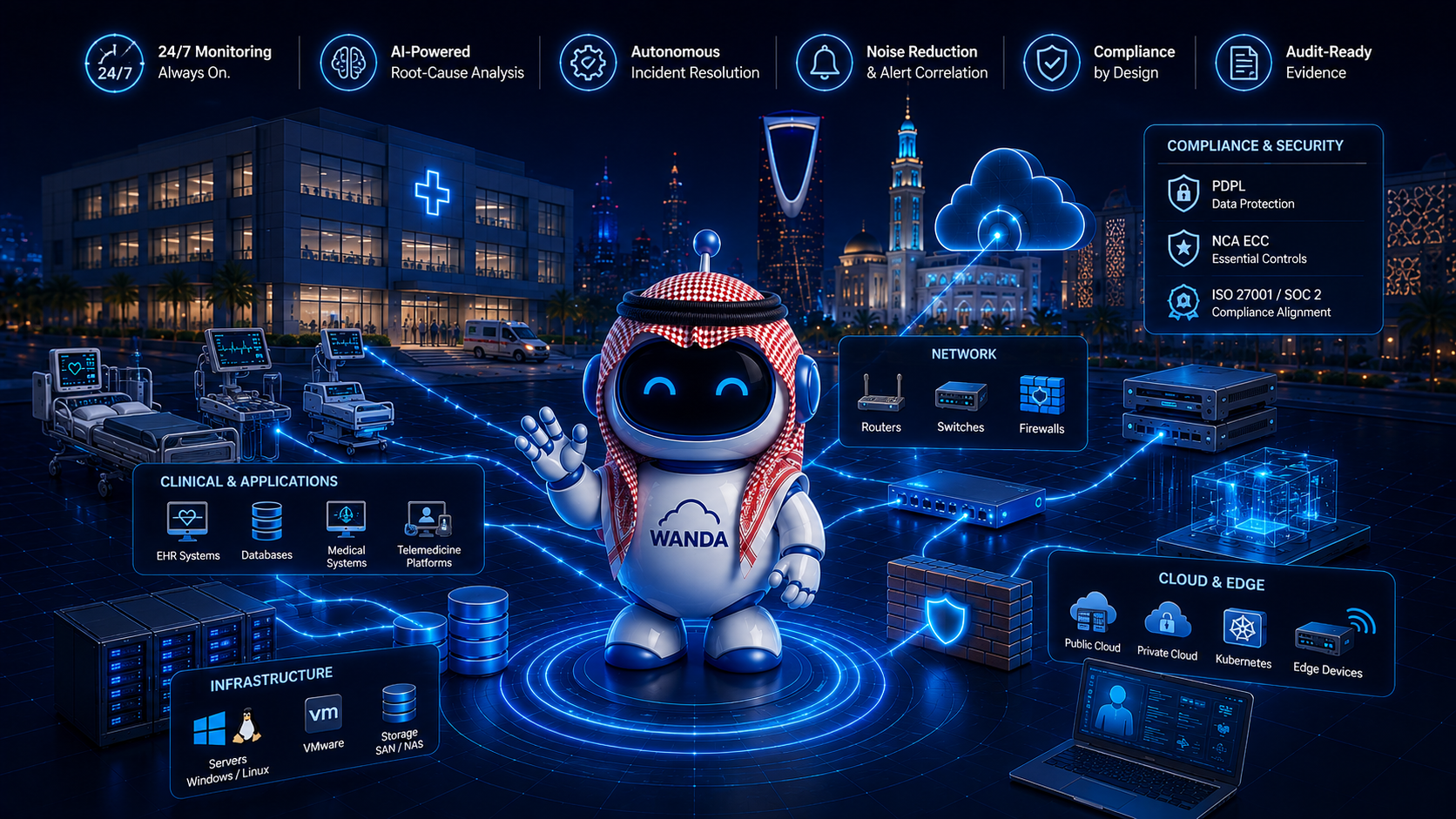
- 24x7 monitoring across on-premise datacenters, edge devices, and public/private cloud, covering servers (Windows, Linux), VMware, firewalls, routers, switches, and Kubernetes environments alongside databases and clinical workloads
- Autonomous root-cause analysis in seconds, replacing manual, multi-team triage during patient-care-impacting incidents
- No agents required (where possible), so legacy medical and hospital-network systems can be monitored without new software footprints on sensitive devices
- Compliance mapping to PDPL, NCA ECC, ISO 27001, SOC2, and other relevant frameworks, with drift detection and audit-ready evidence generation for patient-data protection requirements
- Natural-language interaction, asking "Give me an executive summary of the last 24 hours" or "Which systems violate security baselines?" instead of navigating multiple dashboards during an active incident
- Memory-driven operations, retaining knowledge of past incidents and known failure patterns so resolution gets faster over time, important in environments with high IT staff turnover
- Connections via MCP to existing monitoring, logging, and ITSM tools (Splunk, Prometheus, Zabbix, ServiceNow, and more), so hospitals don't need to rip out existing investments to gain unified visibility
The Industry Context: Why This Is Becoming Urgent
Healthcare IT spending is accelerating fast enough that infrastructure sprawl, not just budget, is becoming the primary operational risk. Gartner forecasts that global healthcare and life sciences IT spending will keep climbing toward $444.2 billion by 2029, driven largely by growth in software and managed services. For hospital networks, that growth typically means more connected systems, more vendors, and more surface area for an outage or misconfiguration to affect patient care, reinforcing why unified, AI-driven visibility is becoming less of a nice-to-have and more of an operational necessity. [Source: Gartner]
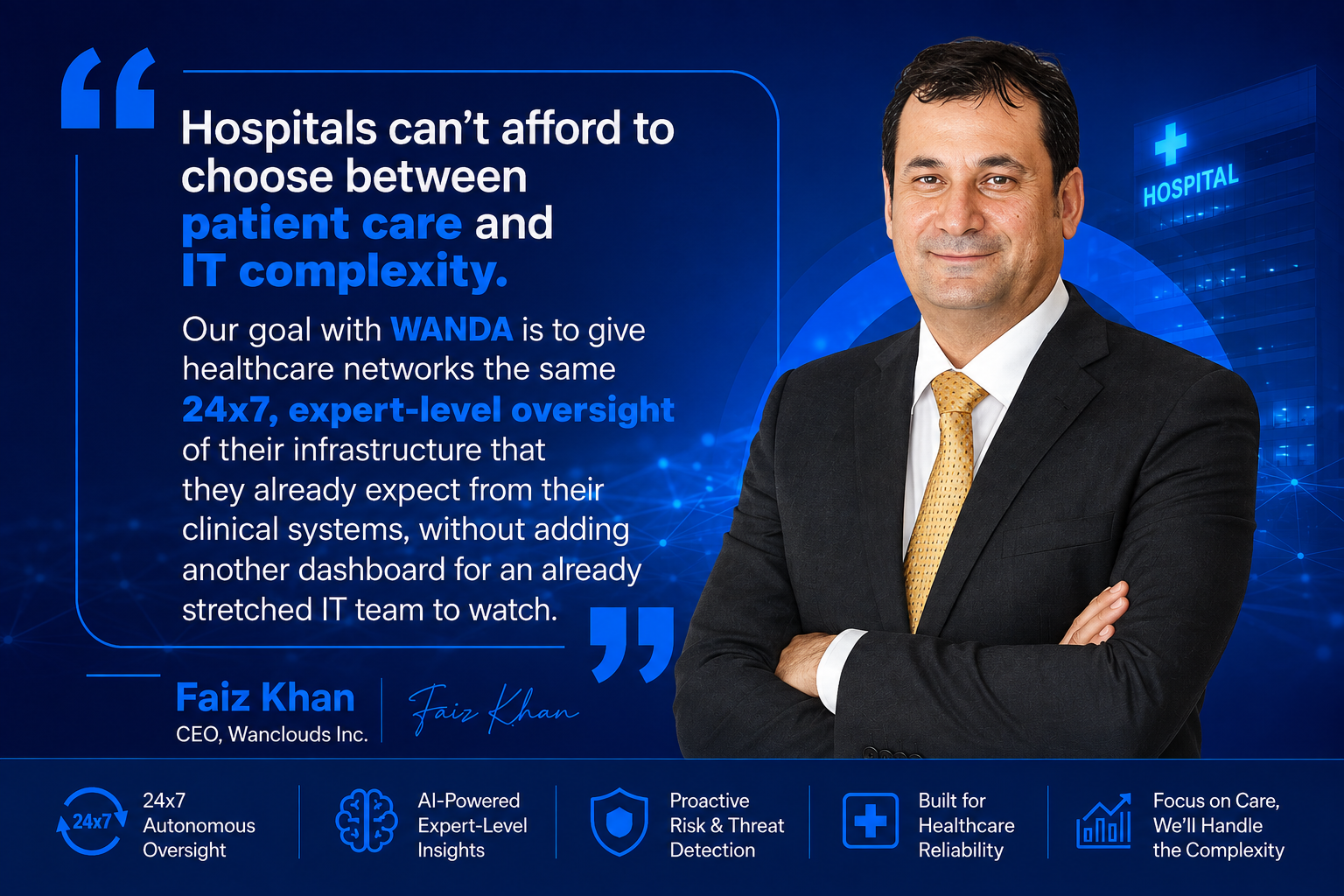
"Hospitals can't afford to choose between patient care and IT complexity. Our goal with WANDA is to give healthcare networks the same 24x7, expert-level oversight of their infrastructure that they already expect from their clinical systems, without adding another dashboard for an already stretched IT team to watch." — Faiz Khan, CEO, Wanclouds Inc.
The Impact: What Faster, Unified Monitoring Looks Like
Incident resolution time (MTTR): 70–80% reduction
Unplanned downtime: 60–70% reduction
Security incidents: 70% fewer
Compliance audit effort: Up to 90% reduction
Infrastructure cost optimization: 30–40%
Payback period: Approximately 3 months
For a hospital network, faster MTTR and fewer unplanned outages translate directly into fewer disruptions to clinical systems, not just a smaller IT bill.
Ready to Give Your Hospital Network 24x7, Unified Visibility?
Fragmented dashboards and manual triage cost precious minutes during exactly the incidents where minutes matter most in healthcare.
WANDA, Wanclouds AI, is built for exactly this. It connects to your existing servers, medical infrastructure, cloud accounts, and monitoring tools without requiring new agents in most cases, continuously correlates infra, application, network, and security signals, and generates audit-ready evidence for PDPL and NCA ECC as changes happen. Ask it a direct question like "what caused last night's outage?" or "which systems violate security baselines?" and get a straight answer with the evidence behind it, no dashboards or scripting required.
See how Wanclouds AI (WANDA) maps to your hospital or healthcare network's infrastructure. [email protected] | www.wanclouds.ai | www.wanclouds.net