
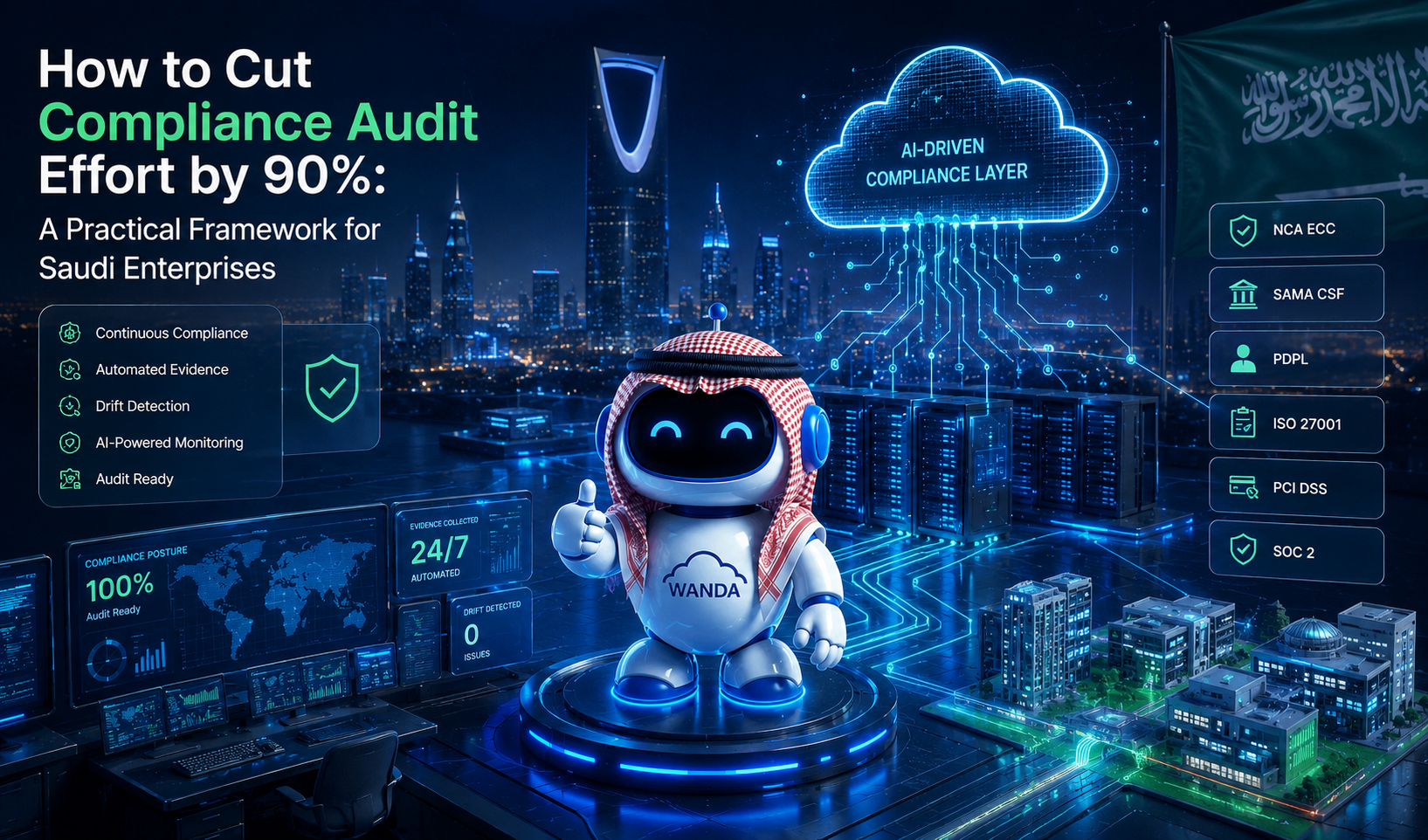
Saudi enterprises can cut compliance audit effort by up to 90% by replacing manual, point-in-time audit prep with continuous compliance monitoring, automated evidence collection, and AI-driven drift detection mapped directly to frameworks like NCA ECC, SAMA CSF, PDPL, ISO 27001, PCI DSS, and SOC 2. The shift is from "prepare for an audit" to "always be audit-ready."
Why Compliance Audits Consume So Much Time in Saudi Arabia
Organizations operating in the Kingdom face one of the densest regulatory stacks in the region. A typical enterprise, bank, hospital, telecom, or government entity must simultaneously satisfy:
- NCA Essential Cybersecurity Controls (ECC) and sector-specific NCA frameworks
- Digital Government Authority (DGA) compliance requirements for public-sector and citizen-facing systems
- SAMA Cybersecurity Framework for financial institutions
- Personal Data Protection Law (PDPL) for data handling and residency
- International baselines such as ISO 27001, PCI DSS, SOC 2, CIS, and NIST
Each framework has overlapping but not identical control requirements. Most teams still manage this with spreadsheets, screenshots, quarterly scripts, and tribal knowledge scattered across IT, security, and compliance staff. That's why audit prep routinely takes weeks of cross-team effort per cycle, and why audit effort, not just audit outcome, has become the real operational cost.
The core problem isn't a lack of controls. It's a lack of continuous, provable evidence that controls are working.
Key Takeaways
- Manual audit prep is a point-in-time exercise; regulators increasingly expect continuous assurance.
- The biggest time sink isn't fixing gaps; it's finding and documenting evidence across siloed tools.
- Mapping infrastructure state directly to control frameworks (rather than translating spreadsheets after the fact) is what actually compresses audit timelines.
- Organizations using continuous, AI-driven compliance monitoring report up to 90% reduction in audit effort and 70% fewer security incidents.
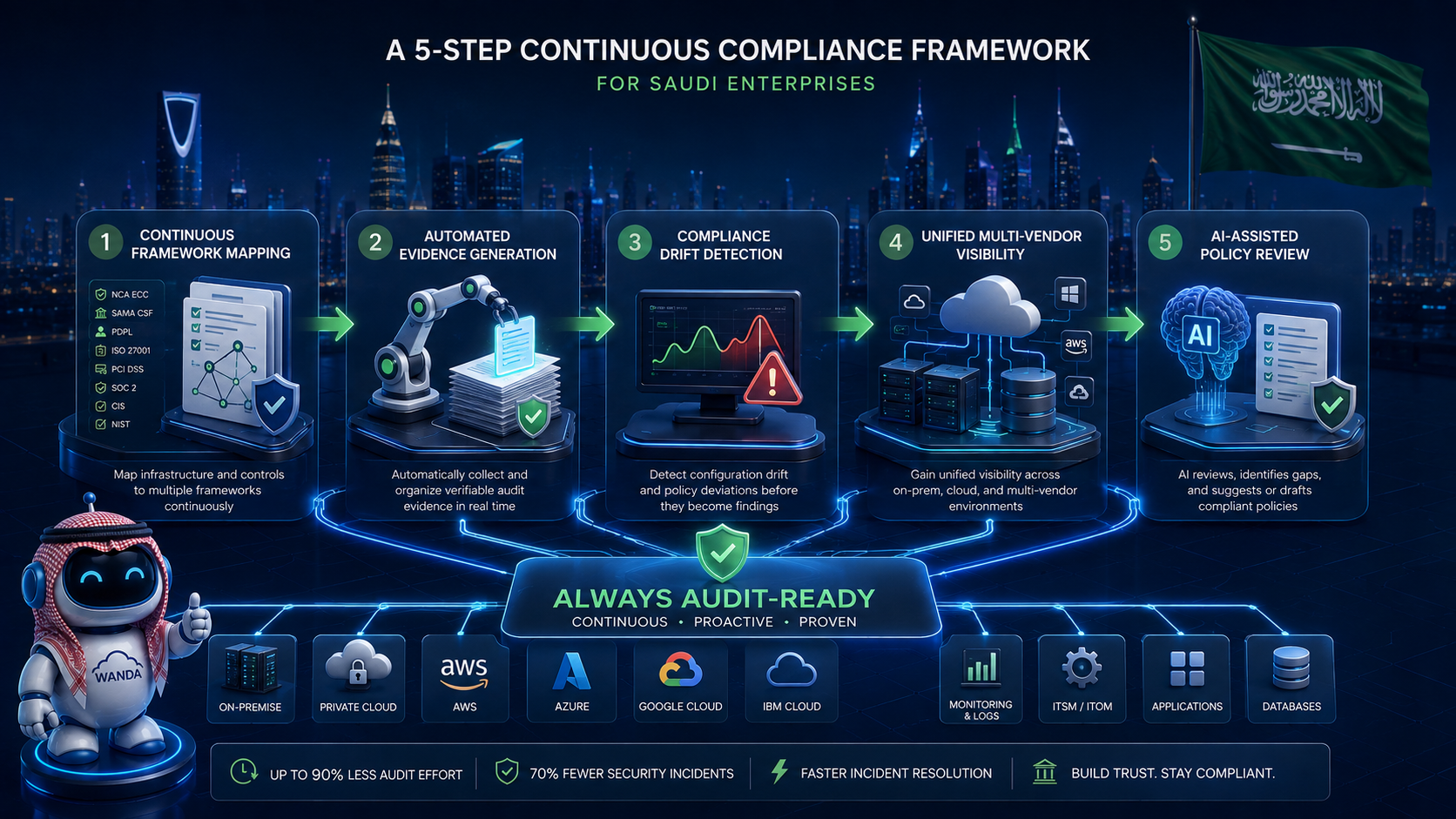
The 5-Step Framework to Cut Audit Effort by 90%
Step 1: Map Infrastructure to Frameworks Continuously, Not Quarterly
Instead of manually cross-referencing servers, firewalls, and cloud accounts against NCA ECC or ISO 27001 controls before an audit, map every asset to every relevant framework as configuration changes happen. This turns "what's our compliance posture?" into a question you can answer in seconds instead of days.
Step 2: Automate Evidence Generation
Auditors don't just want a "compliant" checkbox, they want proof: timestamps, configuration snapshots, change logs, access records. Manually assembling this evidence is the single largest source of audit labor. Automating evidence capture at the point of change (not reconstructed afterward) is what compounds into a 90% effort reduction.
Step 3: Detect Drift Before It Becomes a Finding
Most audit failures trace back to configuration drift, a firewall rule loosened for a project and never reverted, a patch that silently failed, a policy exception that outlived its justification. Continuous drift detection against your approved baseline catches these issues in near real time, well before an auditor does.
Step 4: Unify Visibility Across Multi-Vendor Environments
Saudi enterprises typically run a mix of on-premise datacenters, public cloud (AWS, Azure, GCP), and edge/OT systems, layered with different monitoring and logging tools (Splunk, Prometheus, Zabbix, ServiceNow). Every silo is a place evidence gets lost or duplicated. A unified layer that queries all of it, without requiring a dashboard for each vendor, removes the manual correlation work entirely.
Step 5: Use AI to Review and Draft Policy, Not Just Report Status
Beyond monitoring, gap analysis against a specific framework (e.g., "review our existing policies against HIPAA" or "identify gaps against NCA ECC") is traditionally a consultant-driven exercise. AI-assisted policy review can surface gaps and even draft updated policy language in a fraction of the time, keeping documentation, not just infrastructure, audit-ready.
How Agentic AI Executes This Framework in Practice
This is precisely where Wanclouds AI (WANDA), an agentic AI platform for multi-vendor IT and cloud infrastructure, is purpose-built to operate. Rather than adding another dashboard to an already-fragmented toolchain, WANDA acts as a conversational layer across your existing environment:
- Compliance mapping across CIS, NIST, ISO, PCI, SOC2, and Saudi-specific NCA ECC and DGA frameworks, kept current as infrastructure changes
- Drift detection against configuration baselines and approved values
- Audit-ready evidence generation, produced continuously rather than assembled under deadline pressure
- Security and risk assessments across vendors, without manual, tool-by-tool review
- Software inventory and end-of-life (EOL) risk tracking, a frequent and easily-missed audit finding
- Policy review and drafting, including gap analysis against a named framework and generation of new policy where none exists
- No dashboards, no scripting, teams ask questions directly, such as "Run a security assessment for PCI compliance" or "Review our existing policies and identify gaps against NCA ECC," and receive a direct answer with supporting evidence
Because WANDA connects to devices directly and to existing monitoring, logging, and ITSM tools via MCP integrations, with no agents required where possible, the audit-relevant data doesn't need to be centralized manually first. It's read where it already lives.
The Business Case: What "90% Less Audit Effort" Actually Looks Like
Organizations adopting continuous, AI-driven compliance monitoring, in place of manual, tool-siloed audit prep, typically see:
| Metric | Typical Improvement |
|---|---|
| Compliance audit effort | Up to 90% reduction |
| Incident resolution time (MTTR) | 70–80% reduction |
| Unplanned downtime | 60–70% reduction |
| Infrastructure cost | 30–40% optimization |
| Payback period | ~3 months |
The mechanism behind the 90% figure is straightforward: most audit effort isn't spent fixing non-compliance, it's spent finding and formatting proof of compliance across disconnected systems. Automating that evidence trail removes the majority of the manual labor without changing the underlying controls.
Ready to Reduce Your Audit Effort by 90%?
If your team is still assembling audit evidence manually across a dozen tools every quarter, the fastest path to change isn't a new dashboard; it's a continuous, AI-driven compliance layer that already speaks the language of NCA ECC, DGA, ISO, PCI, and SOC 2.
WANDA, Wanclouds' agentic AI, is built for exactly this. It connects to your existing servers, cloud accounts, firewalls, and monitoring tools without requiring new agents in most cases, continuously maps your environment against the frameworks that matter to you, and generates audit-ready evidence as changes happen rather than after the fact. Ask it a direct question like "review our policies against NCA ECC" or "run a PCI compliance assessment" and get a straight answer with the evidence behind it, no dashboards or scripting required.
See how Wanclouds AI (WANDA) maps to your specific compliance requirements. [email protected] | www.wanclouds.ai | www.wanclouds.net