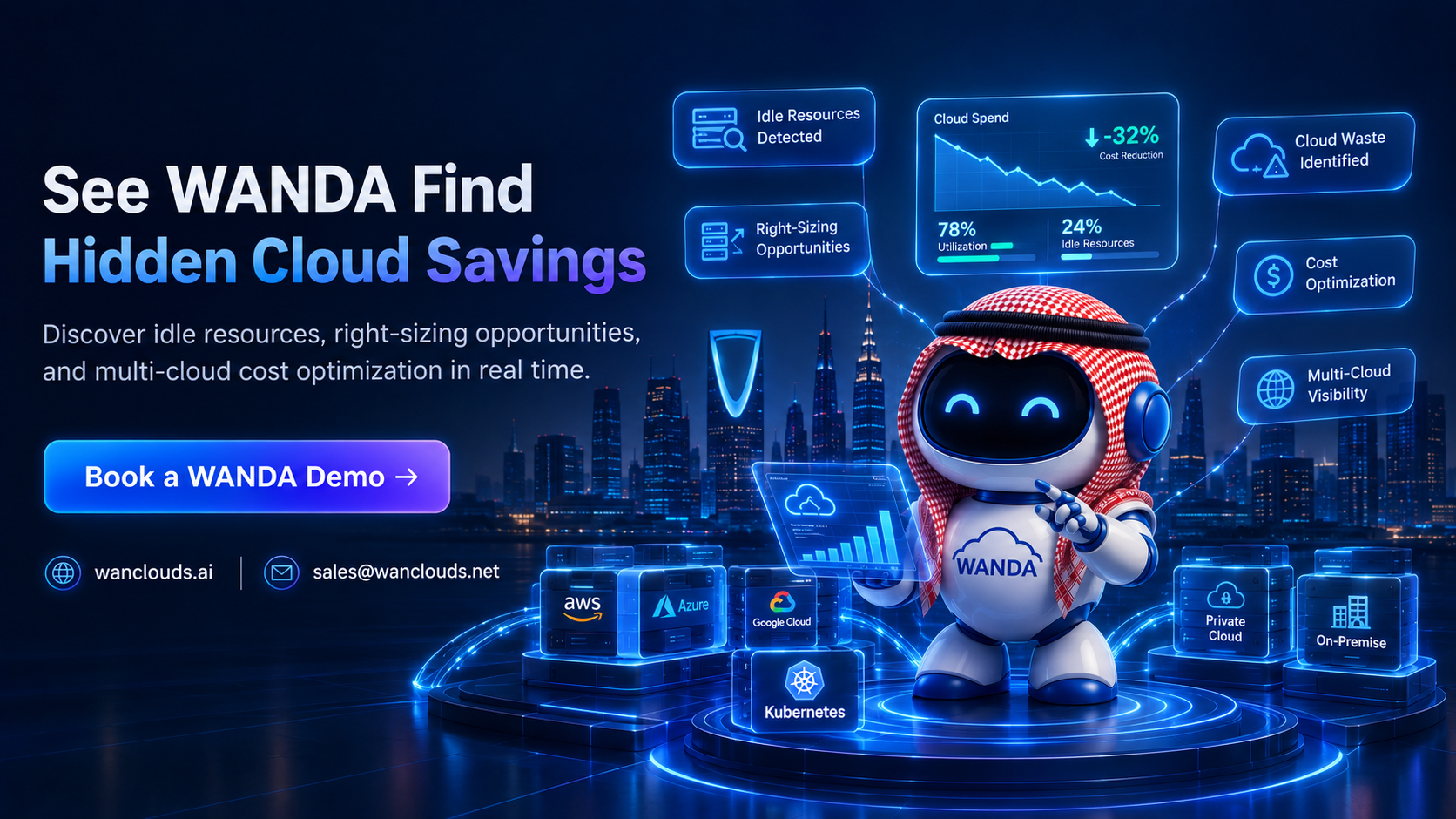

Cloud adoption in Saudi Arabia has accelerated fast, driven by Vision 2030 digital transformation mandates and a wave of enterprises moving workloads from on-premise data centers to public and hybrid cloud. But rapid adoption has brought a quieter, more expensive problem along with it: waste. Globally, cloud spend waste just hit a five-year high, and Saudi enterprises scaling multi-cloud environments are exposed to the same dynamics, often without the visibility to see where the money is actually going.
The Scale of the Problem
According to Flexera's 2026 State of the Cloud Report, based on a survey of more than 750 global cloud decision-makers, an estimated 29% of infrastructure-as-a-service and platform-as-a-service spend is now wasted, up from a low of 27% and breaking a steady decline that had been underway since 2022. The same report found that 72% of global companies exceeded their allocated cloud budgets in the past fiscal year, and separate industry analysis puts idle compute as the single largest waste category, with a significant share of cloud instances running at under 20% CPU utilization for weeks at a time, capacity that's fully billed and doing almost nothing.
For enterprises running multi-cloud environments specifically, the waste rate climbs even higher than single-provider deployments, since cost visibility fragments further as more providers, accounts, and billing models enter the picture.
Source: Flexera 2026 State of the Cloud Report
Why Saudi Enterprises Are Especially Exposed
Three factors compound this problem locally:
Rapid, mandate-driven migration. Many Saudi organizations are moving to the cloud on accelerated timelines tied to national digital transformation goals. Speed of migration often comes at the expense of governance; workloads get provisioned quickly, and rightsizing gets revisited later, if at all.
Hybrid and multi-cloud by necessity. Data residency and regulatory requirements mean many Saudi enterprises run hybrid environments, a mix of on-premise, private cloud, and public cloud (AWS, GCP, Azure, IBM Cloud). Each environment has its own cost model, its own dashboard, and its own blind spots.
Limited dedicated FinOps capacity. Cloud financial management is a specialized discipline, and mid-market and even large enterprises in the region often don't have a dedicated team solely to tracking utilization, negotiating commitments, and flagging waste in real time. That capability gap is exactly where cost leaks accumulate.
Where the Waste Actually Hides
Cloud waste rarely comes from one obvious source; it accumulates from several smaller, less visible ones:
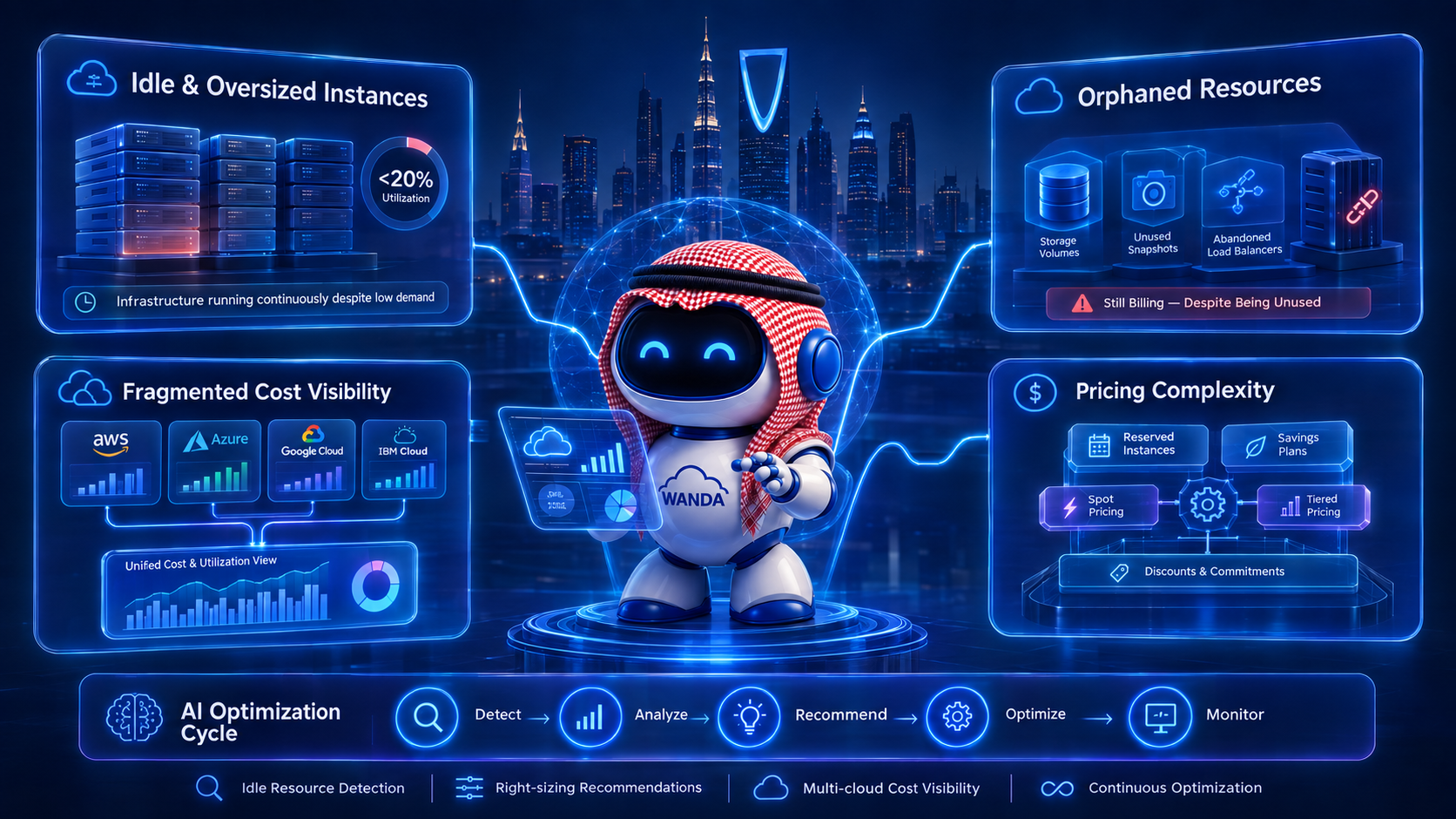
- Idle and oversized instances. Compute provisioned for peak load that keeps running at a fraction of that capacity long after the peak has passed.
- Orphaned resources. Unattached storage volumes, unused snapshots, and load balancers left behind after a project ends but never decommissioned.
- Lack of cost visibility. A majority of organizations cite unclear or fragmented cost visibility as a primary driver of cloud waste, not because the data doesn't exist, but because it's scattered across billing consoles that don't talk to each other.
- Complex, hard-to-model pricing. Reserved instances, savings plans, spot pricing, and tiered discounts create pricing complexity that many teams simply don't have the bandwidth to optimize manually.
How Agentic AI Closes the Gap
This is precisely the kind of cross-domain, high-volume optimization problem that's difficult to solve manually but well-suited to AI. Instead of a FinOps team manually auditing usage reports across accounts and providers, an agentic AI platform can be asked directly:
- "Which resources have been idle for the last 30 days?"
- "Where are we over-provisioned relative to actual utilization?"
- "What would right-sizing our database tier save this month?"
This works by combining continuous capacity and utilization insight with automated idle and waste detection, surfacing right-sizing suggestions as an ongoing process rather than a quarterly audit. Because the same platform also tracks infrastructure configurations and drift, cost optimization doesn't happen in isolation from operational stability; a resource doesn't get downsized in a way that risks performance because the system has full context on how that resource is actually being used.
Applied consistently, this kind of AI-driven optimization typically delivers 30–40% infrastructure cost optimization for organizations that adopt it, directly addressing the same waste categories driving up costs industry-wide.
What This Looks Like in Practice
Picture a Saudi enterprise running a hybrid environment: core systems on-premise, customer-facing applications on public cloud, and a growing set of container workloads on Kubernetes. Historically, understanding true cost efficiency means pulling reports from three separate billing consoles, reconciling them manually, and hoping nothing was missed.
With AI-driven optimization in place, the same environment surfaces a single, continuously updated view: which resources are idle, which are oversized relative to actual demand, and which configuration changes would reduce spend without risking performance, all cross-referenced against real utilization data, not guesswork. The FinOps function that used to require a dedicated team and a monthly reporting cycle becomes a standing capability instead of a project.
Getting Started: What to Look For
Saudi enterprises evaluating AI-driven cloud cost optimization should prioritize:
- Cross-cloud visibility: a platform that unifies cost and utilization data across on-premise, private cloud, and public cloud providers rather than optimizing one environment in isolation.
- Continuous, not periodic, monitoring: waste detection that runs constantly, since idle resources accumulate daily, not quarterly.
- Context-aware recommendations: right-sizing suggestions that account for actual performance and configuration data, not just raw utilization numbers.
- No vendor lock-in: integration with existing cloud APIs and infrastructure telemetry rather than requiring a rip-and-replace of current tooling.
The Bottom Line
Cloud waste isn't a one-time cleanup project; it's a continuous byproduct of scale, complexity, and limited visibility, and the data shows it's getting worse globally, not better. For Saudi enterprises balancing rapid cloud adoption with tightening budget scrutiny, AI-driven optimization offers a way to close that gap continuously, rather than rediscovering the same waste every audit cycle.
See Cloud Cost Optimization in Action
Idle resources and hidden waste are easy to describe and hard to spot manually. Watch our webinar demo to see WANDA identify real cost optimization opportunities across a live multi-cloud environment.
Want a cost optimization assessment scoped to your environment? Request a personalized WANDA demo →