
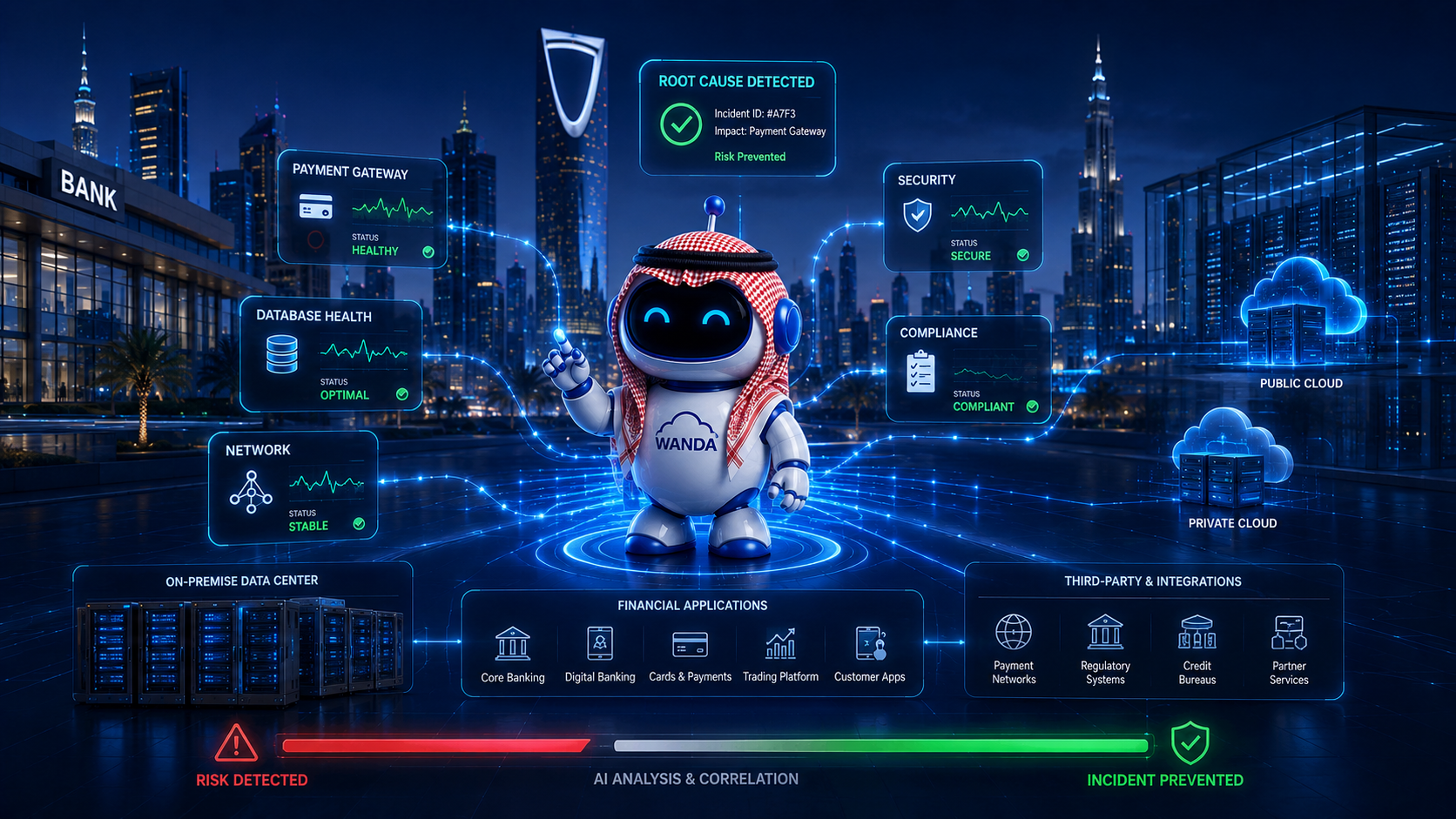
For Saudi financial institutions, downtime isn't just an inconvenience; it's one of the most expensive risks on the balance sheet. Every minute a core banking system, payment gateway, or trading platform is unavailable translates directly into lost transactions, regulatory exposure, and eroded customer trust. As KSA's financial sector accelerates its digital transformation under Vision 2030, the infrastructure supporting it has grown more complex, not less. That complexity is exactly where downtime hides.
Why Downtime Hits Financial Services Hardest
Financial services consistently ranks among the most expensive industries for unplanned downtime. Splunk's 2026 "Hidden Costs of Downtime" report, produced in partnership with Oxford Economics, found that financial services organizations face average annual downtime costs of $309 million, and that's part of a broader trend, since aggregate downtime costs across the Global 2000 have surged to $600 billion annually, a 50% increase in just two years. Per-incident, the picture is just as stark: the average cost of downtime across industries has reached $15,000 per minute, and a single outage now triggers an average 3.4% drop in stock price for public companies.
For Saudi banks, insurers, and fintechs, the stakes are compounded by regulatory frameworks like SAMA and NCA ECC, where an outage isn't only a financial event; it's a compliance event that requires documentation, root-cause evidence, and audit trails.
Source: Splunk & Oxford Economics — The Hidden Costs of Downtime 2026
The Hidden Driver of Downtime: Fragmented Infrastructure
Financial services environments are rarely built on a single, unified stack. A typical Saudi bank or fintech runs core banking systems, payment switches, fraud detection engines, customer-facing apps, and third-party integrations, often across a mix of on-premise data centers and cloud environments. Each layer has its own monitoring tool, its own dashboard, its own alerts.
When something breaks, the real cost isn't the outage itself; it's the time spent figuring out why it happened. Engineers manually cross-reference logs across systems that were never designed to talk to each other. That manual correlation step, repeated incident after incident, is where minutes turn into hours, and hours turn into regulatory findings.
How Agentic AI Closes the Gap
Agentic AI platforms solve this by sitting across the entire infrastructure stack, compute, network, security, databases, and cloud, and performing cross-layer correlation automatically. Instead of engineers manually piecing together what happened, a financial services IT team can ask direct questions:
- "What caused last night's outage of the payment gateway?"
- "Which systems currently violate our security baselines?"
- "Give me an executive summary of system health for the last 24 hours."
This shifts incident response from reactive investigation to autonomous root-cause analysis, with noise reduction and alert de-duplication filtering out irrelevant signals so teams focus only on what matters. The result is measurable: organizations deploying this kind of platform typically see 70–80% reductions in incident resolution time and 60–70% less unplanned downtime, numbers that compound significantly when applied to an industry where every minute has a dollar figure attached.
Compliance Without the Manual Burden
Downtime reduction and compliance aren't separate problems for financial services; they're the same problem viewed from two angles. Continuous compliance mapping to frameworks like PCI DSS, ISO, SOC2, and NCA ECC means security posture is assessed on an ongoing basis rather than scrambled together before an audit. Drift detection catches configuration changes before they become the root cause of the next incident, and audit-ready evidence generation removes the manual documentation burden that typically follows every outage. Organizations automating this process report up to 90% reduction in compliance audit effort—time that IT and risk teams can redirect toward prevention instead of paperwork.
What This Looks Like for a Saudi Financial Institution
Picture a mid-size Saudi bank running a mix of on-premise core banking infrastructure and cloud-based digital channels. A performance degradation on the mobile banking app historically means pulling logs from the app servers, the database team, the network team, and the security team separately, each investigating in isolation, unaware they're looking at symptoms of the same root cause.
With cross-domain correlation in place, that same incident surfaces as a single, plain-language answer within seconds: what changed, what broke, which systems were affected, and the likely fix, with a human still required to approve any corrective action. What used to take a war room of four teams and several hours now takes minutes, with a full audit trail intact for SAMA reporting.
A Word From Wanclouds Leadership
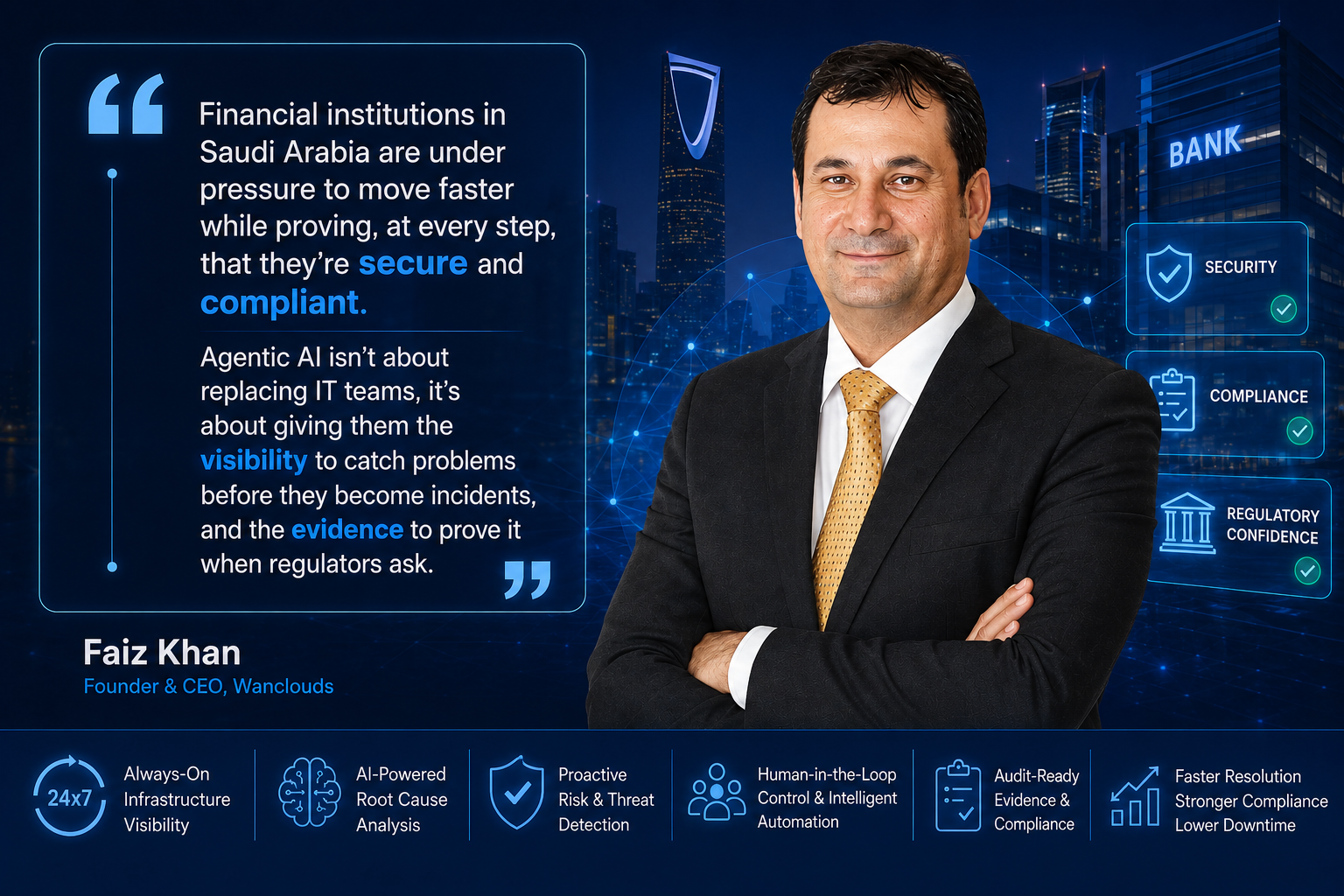
"Financial institutions in Saudi Arabia are under pressure to move faster while proving, at every step, that they're secure and compliant. Agentic AI isn't about replacing IT teams, it's about giving them the visibility to catch problems before they become incidents, and the evidence to prove it when regulators ask." — Faiz Khan, Founder & CEO, Wanclouds
Getting Started: What to Look For
Financial institutions evaluating agentic AI for infrastructure operations should prioritize:
- No agent sprawl: integration with existing monitoring, logging, and ITSM tools rather than replacing them.
- Human-in-the-loop controls: automated analysis, but explicit confirmation required for any state-changing action.
- Data residency guarantees: deployment options including private cloud, on-premise, or sovereign regulated cloud regions, with no data leaving the environment.
- Compliance-native design: built-in mapping to SAMA, NCA ECC, PCI, and ISO frameworks rather than compliance as an afterthought.
Final Words
In an industry where downtime is measured in millions of riyals per hour, the fastest path to resilience isn't more dashboards or more headcount; it's infrastructure that can explain itself. For Saudi financial institutions balancing rapid digital growth with regulatory scrutiny, agentic AI offers a way to reduce downtime and strengthen compliance at the same time, rather than trading one for the other.
See How Agentic AI Reduces Downtime
Numbers on a page are one thing. Watching AI trace a live incident across infrastructure in seconds is another. Watch WANDA in action on a real multi-vendor environment.
Want a walkthrough scoped to your institution's environment? Request a personalized WANDA demo →