
Modern DevOps practices have transformed how organizations build, deploy, monitor, secure, and manage applications. But there's an ironic problem: as DevOps environments mature, the number of tools teams rely on often grows with them.
A typical environment can include tools for source control, CI/CD, Kubernetes, cloud infrastructure, monitoring, logging, security, IT service management, configuration, and incident response. Each tool has a purpose. The problem starts when engineers have to move between several of them just to understand one issue.
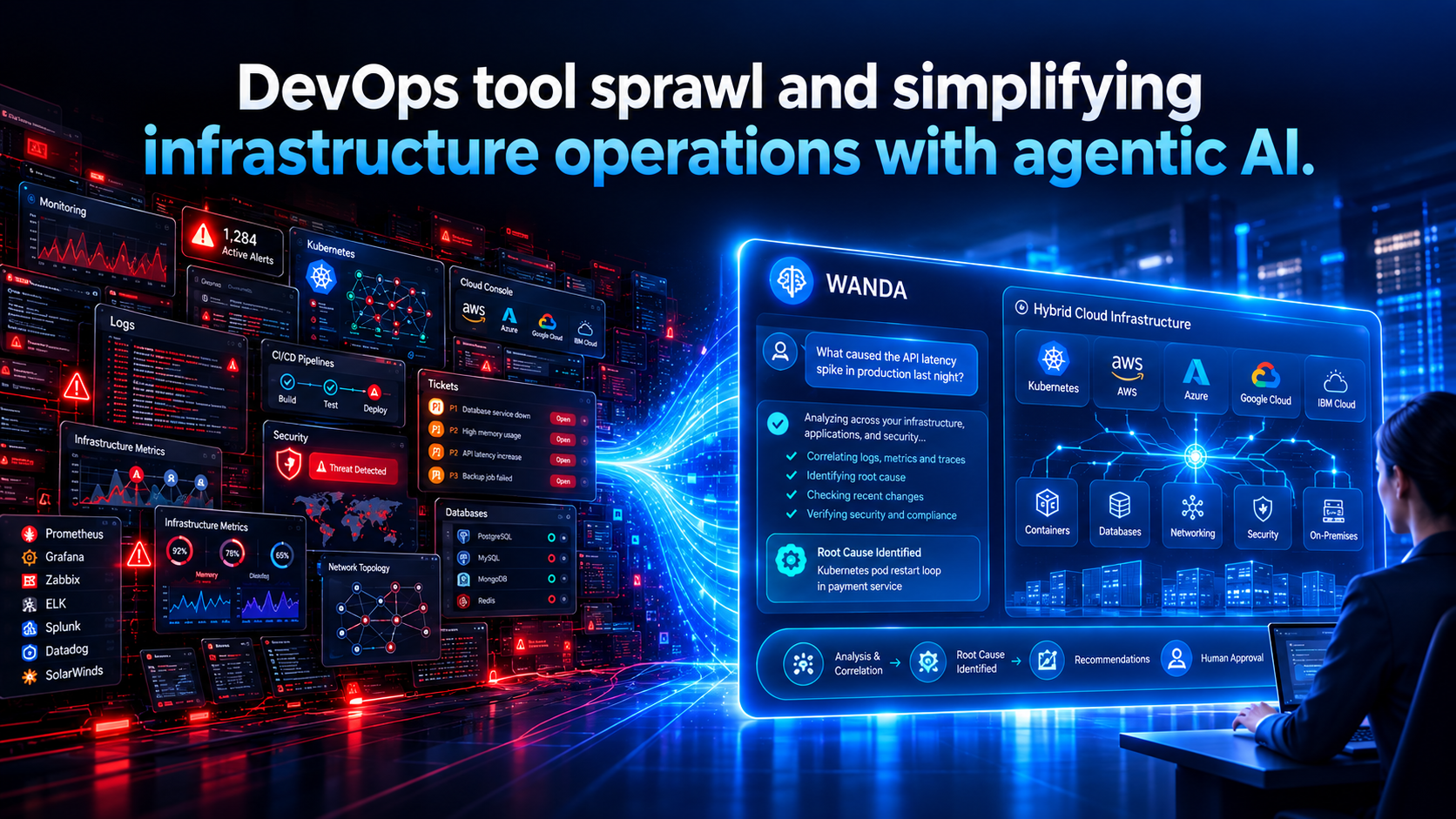
An application slows down. One dashboard shows increased latency. Another shows infrastructure metrics. Logs reveal errors. A cloud console shows a recent change. The network monitoring platform reports something else.
Now someone has to connect the dots.
This is DevOps tool sprawl.
The answer isn't necessarily to eliminate every tool. It's to make the tools teams already use easier to operate together.
That's where WANDA, Wanclouds' agentic AI platform, comes in. WANDA provides a conversational intelligence layer across cloud, infrastructure, monitoring, security, and operational systems, helping teams investigate issues, understand their environments, and take action without constantly jumping between dashboards.
What Is DevOps Tool Sprawl?
DevOps tool sprawl happens when organizations accumulate multiple tools across their development and IT operations workflows.
At first, this usually happens for good reasons. A team needs better monitoring, so it adopts a monitoring platform. It needs better logging, so it adds a logging solution. Kubernetes introduces new operational requirements. Multi-cloud introduces another layer of complexity. Security teams add their own platforms.
Before long, engineers aren't dealing with one operational environment. They're dealing with a collection of systems, each with its own interface, alerts, queries, workflows, and data.
The real problem isn't the number of tools.
It's the effort required to connect the information they provide.
When something goes wrong, engineers may need to check infrastructure, applications, networks, cloud resources, configurations, logs, and recent changes before they can identify the root cause.
The data exists. The challenge is bringing it together quickly.

Why Modern DevOps Practices Need So Many Tools
Infrastructure Is More Distributed
Modern applications rarely run on a single server. Organizations may have Kubernetes clusters, virtual machines, databases, APIs, firewalls, network devices, cloud resources, SaaS platforms, and on-premises infrastructure operating at the same time.
Each layer produces different operational signals. A database issue can look like an application problem. A network problem can look like a performance issue. A configuration change can trigger what initially appears to be an infrastructure failure.
That's why DevOps teams need visibility across multiple layers.
Specialized Tools Solve Specialized Problems
There's also nothing inherently wrong with specialized tools.
Monitoring platforms are good at monitoring. Logging platforms are good at searching logs. ITSM platforms are good at managing incidents. Cloud platforms are good at managing cloud resources.
The challenge begins when engineers become responsible for manually connecting all those systems during every investigation.
That's where tool sprawl becomes an operational burden.
Multi-Cloud Makes It Harder
Modern enterprises may operate across AWS, Azure, Google Cloud, IBM Cloud, VMware, Kubernetes, and on-premises environments. Each environment can have different services, configurations, dashboards, and operational procedures.
As infrastructure grows, the question changes from:
"Do we have enough visibility?"
to:
"How quickly can we make sense of all the visibility we already have?"
That's an important distinction.
The Hidden Cost of Too Many DevOps Tools
Tool sprawl doesn't always appear directly on a budget. Its cost often appears as lost engineering time.
Context Switching
Every tool requires engineers to learn a different interface, workflow, terminology, and way of finding information.
Jumping between dashboards may take only a few minutes during one incident. But across hundreds of incidents and daily operational tasks, those minutes add up.
More importantly, constant context switching makes complex investigations harder.
Alert Fatigue
Modern infrastructure can produce enormous amounts of telemetry. One underlying issue can trigger alerts across several monitoring systems.
Instead of one incident creating one investigation, engineers may receive dozens of alerts and then spend time figuring out which ones are actually related.
The result is more noise when teams need clarity.
Integration Overhead
Tools also need to communicate with each other. That means APIs, credentials, permissions, integrations, maintenance, and documentation.
Every additional integration creates another dependency that teams have to maintain.
Knowledge Gaps
Every new tool creates another learning requirement.
Engineers may need to understand Kubernetes, cloud networking, CI/CD, observability, security, ITSM, infrastructure automation, and more.
DevOps was meant to improve collaboration and automation. It shouldn't require every engineer to become an expert in every operational interface.
Why Adding Another Tool Isn't Always the Answer
When teams experience operational complexity, the obvious response is often to buy another tool. But sometimes the organization doesn't have a tool problem. It has a context problem. The monitoring already exists. The logs already exist.
The cloud platforms already exist. The security systems already exist. The ITSM platform already exists. What's missing is an intelligent way to bring the information together. This is where WANDA takes a different approach.
Rather than asking organizations to replace their existing technology stack, WANDA is designed to work across existing infrastructure and operational systems, including cloud platforms, Kubernetes, VMware, monitoring technologies, networking environments, and ITSM tools.
The goal isn't simply fewer tools.
It's less effort spent managing those tools.
7 Ways WANDA Simplifies DevOps Practices
1. Replace Dashboard Hunting With Natural-Language Questions
Traditional infrastructure operations often start with a dashboard. WANDA can start with a question.
An engineer can ask:
"What's wrong with this cluster?"
Or:
"What changed before application latency increased?"
Or:
"Which systems are currently affected?"
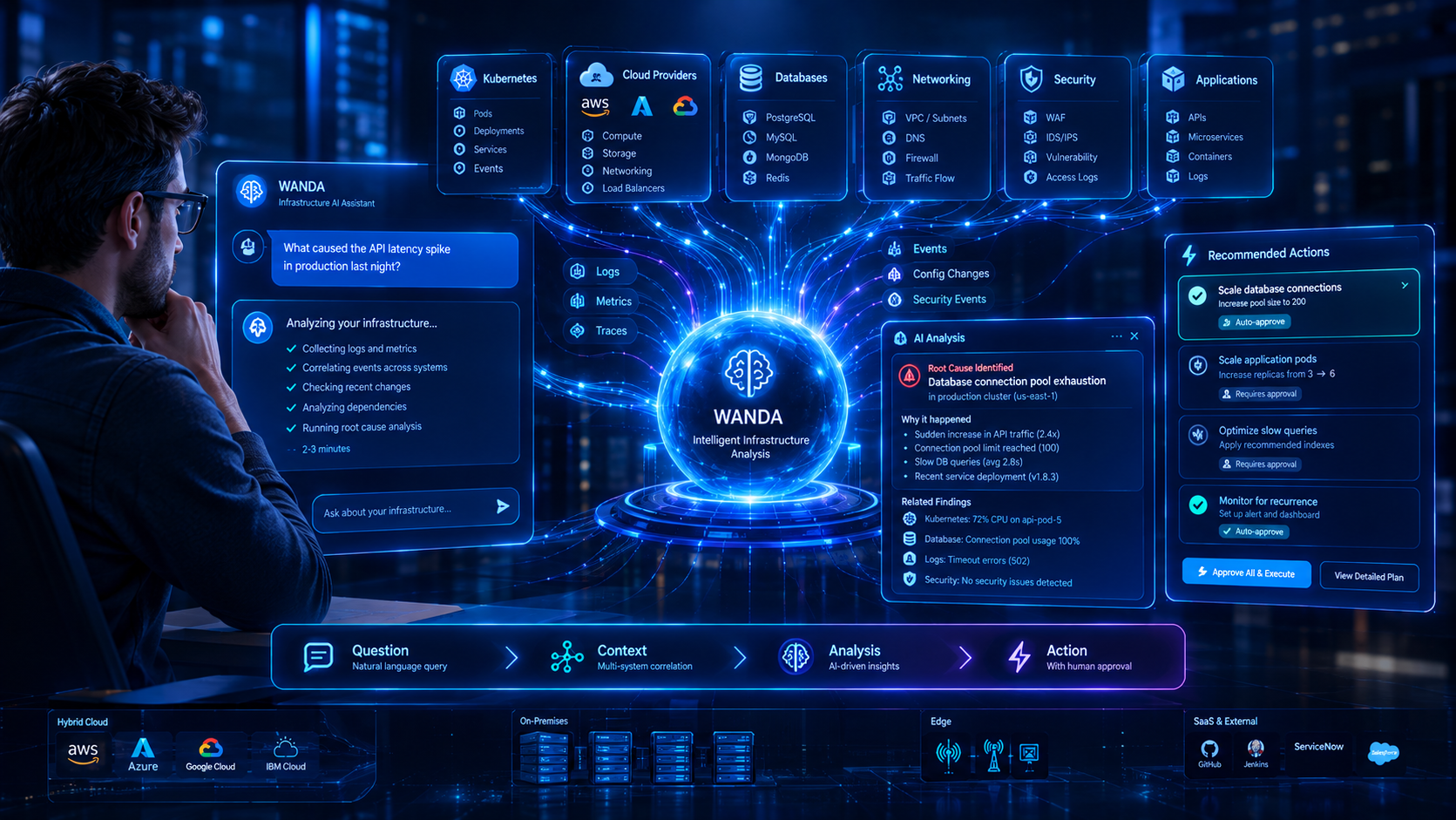
Instead of manually deciding which dashboard to open first, engineers can describe the problem in natural language and let WANDA investigate the relevant infrastructure context.
This creates a simpler operational experience:
Question → Context → Analysis → Action
The underlying tools don't disappear. They're simply easier to interact with.
2. Connect the Tools You Already Use
Replacing an organization's entire technology stack isn't practical for most enterprises. Teams have already invested in monitoring, logging, cloud platforms, Kubernetes, security systems, and ITSM tools.
WANDA is designed to work across these existing environments rather than requiring a complete rip-and-replace strategy. This makes it possible to introduce an intelligence layer without turning simplification into another large migration project.
3. Automate Root Cause Analysis
Root cause analysis is one of the most time-consuming parts of incident response. An engineer may need to compare infrastructure metrics, application logs, network events, security alerts, configuration changes, and deployment history.
The first symptom isn't always the actual cause.
WANDA's RCA capabilities are designed to correlate signals across infrastructure, application, network, and security layers and build incident context automatically.
Instead of starting with:
"Where should I look?"
Teams can start closer to:
"What happened and why?"
That can significantly shorten the path from detection to understanding.
4. Reduce Alert Noise
Not every alert represents a separate incident. A database problem could trigger application errors, service-health alerts, latency warnings, and user-facing availability notifications.
Without correlation, engineers may see several alerts. With context, those alerts may point to one underlying problem. WANDA is designed to correlate related signals and reduce duplicate alerts, helping teams move from simply managing alerts toward understanding incidents.
The objective isn't to hide alerts. It's to make them more meaningful.
5. Turn Infrastructure Data Into Conversations
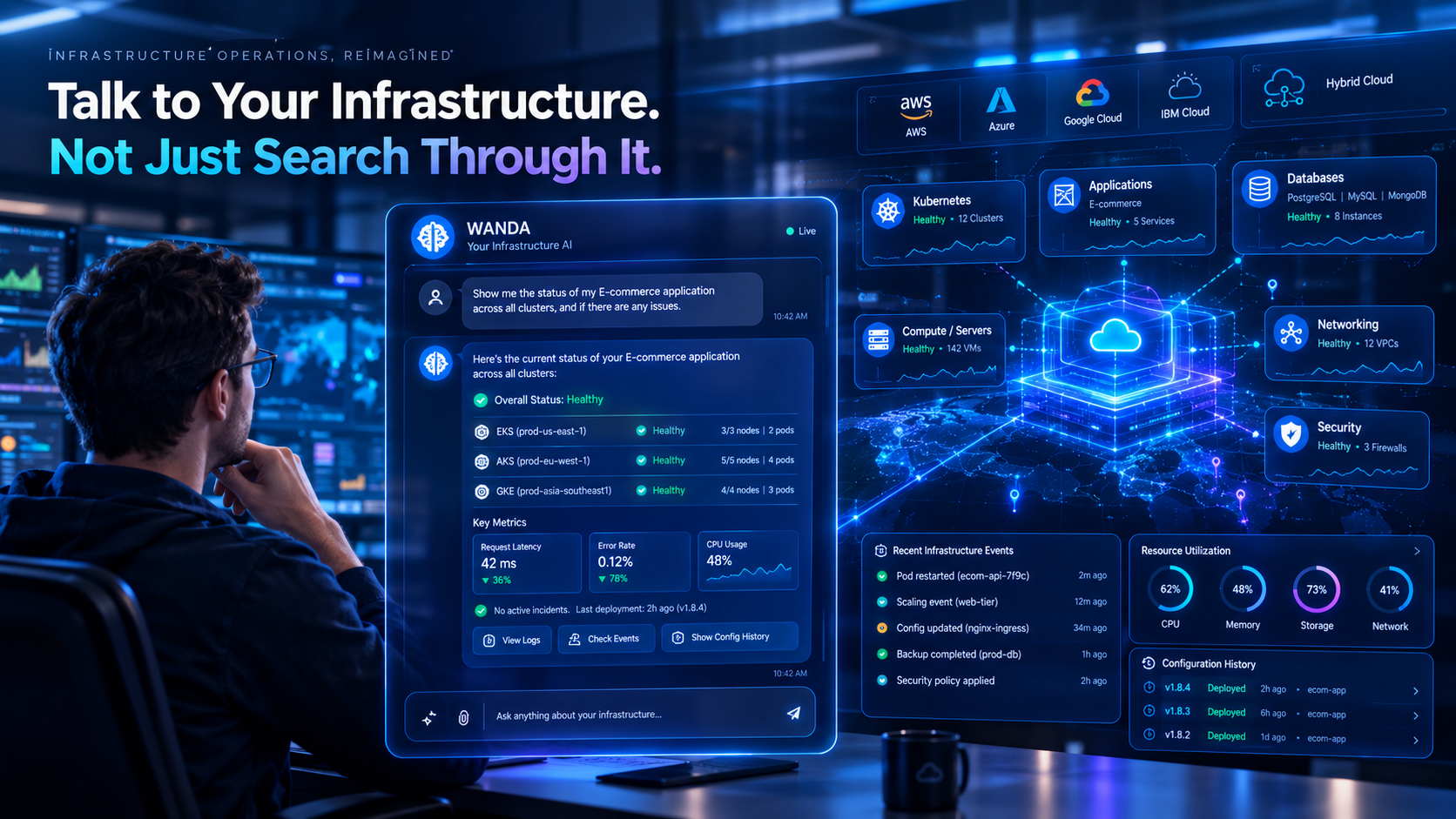
Traditional tools often require engineers to know exactly what to search for. Conversational infrastructure management changes that interaction.
Teams can ask questions such as:
- "What changed overnight?"
- "Why is this server using more CPU?"
- "Which systems are affected?"
- "Show me recent configuration changes."
- "Are there any security issues?"
- "Summarize today's critical incidents."
WANDA is designed around this conversational model, allowing teams to interact with infrastructure through natural language.
Technical expertise still matters. But engineers don't have to remember the exact location, query, or dashboard for every piece of information.
6. Detect Configuration Drift and Security Issues
Not every operational problem starts with an outage. Sometimes it starts with a configuration change. A firewall rule changes. A resource moves away from its intended configuration. A security policy is no longer being followed. An unauthorized change is made.
WANDA includes capabilities for detecting configuration drift, anomalies, unauthorized changes, and security posture issues. This helps teams move beyond reactive troubleshooting toward more proactive infrastructure management.
For organizations with compliance requirements, continuous monitoring can also reduce the manual effort involved in identifying and documenting infrastructure changes.
7. Automate Repetitive Operational Work
DevOps teams spend significant time on repetitive tasks:
- Checking system health
- Investigating alerts
- Reviewing configurations
- Collecting incident information
- Looking for anomalies
- Checking compliance
- Reviewing historical events
- Preparing operational reports
Agentic AI can help automate parts of these workflows.
WANDA is designed to monitor, investigate, analyze, and support operational actions across infrastructure.
Importantly, automation doesn't have to mean giving AI unrestricted control of production.
WANDA's approach includes human confirmation for state-changing operations, allowing teams to maintain oversight while reducing the manual work involved in investigation and response.
WANDA and the Future of DevOps
The next evolution of DevOps isn't necessarily about replacing every tool. It's about changing how engineers interact with the tools they already have.
Platform engineering is already moving toward abstraction, self-service, standardized workflows, and reducing cognitive load for developers and technical teams.
Agentic AI can extend that idea into infrastructure operations. Instead of expecting engineers to understand every underlying system, organizations can provide a more unified operational experience.
The infrastructure remains complex.
The interaction with it becomes simpler.
That's the real value of an intelligence layer like WANDA.
How to Reduce DevOps Tool Sprawl
Organizations don't have to start by removing tools. Start by understanding how they're being used. First, identify every tool involved in development, deployment, monitoring, security, infrastructure, and incident response.
Then look for overlapping capabilities and repetitive workflows.
Ask:
- Which tools generate similar alerts?
- Where are engineers switching between multiple systems?
- Which operational tasks are still manual?
- Where is information duplicated?
- Which incidents require the most cross-system investigation?
- Which workflows could be standardized or automated?
Once those gaps are clear, an intelligence layer can help connect the existing environment.
This is where WANDA can become part of the DevOps strategy. The objective isn't to make the technology stack smaller just for the sake of having fewer tools. It's to make the stack easier to operate, understand, and scale.
Conclusion: Simplify the Experience, Not Just the Tool Count
Modern DevOps practices have given organizations powerful ways to build and operate applications. But they have also created increasingly complex technology environments.
The answer isn't necessarily another dashboard. And it isn't always removing the tools teams already depend on. The bigger opportunity is to make those tools work together more intelligently.
WANDA brings agentic AI into that environment by helping teams connect operational information, investigate incidents, perform root cause analysis, detect drift, understand security issues, and interact with infrastructure through natural language.
Instead of asking engineers to spend their time finding the right dashboard, query, or alert, WANDA helps shift the experience toward:
Ask. Understand. Resolve.
That's how organizations can simplify DevOps without sacrificing the tools and capabilities they need.
Your infrastructure is complex. Managing it shouldn't have to be.